[In part three of this series, Citizen Matters spoke to urban hydrologists and researchers, Rashmi Kulranjan and Shashank Palur, about how Bengaluru can reduce dependence on external water sources, like Cauvery, and become water resilient.]
In this interview, the researchers say that the first step towards achieving the goal of resilience is to understand water usage by building a water balance for the city.
About the researchers
Rashmi and Shashank work at the Urban Water Programme at WELL Labs, where they study water flow patterns in urban water systems, especially lakes in Bengaluru. Rashmi is also a PhD scholar at the Ashoka Trust for Ecology and Environment (ATREE) where she studies Bengaluru’s cascading lake system and how current practices of individual lake management impact these systems as a whole.
Shashank’s previous work looked at how much of Bengaluru’s cascading lake system is still intact. Currently, both researchers focus on the city’s wastewater production and how it can be reused at WELL labs.
CM: What is an urban water balance?
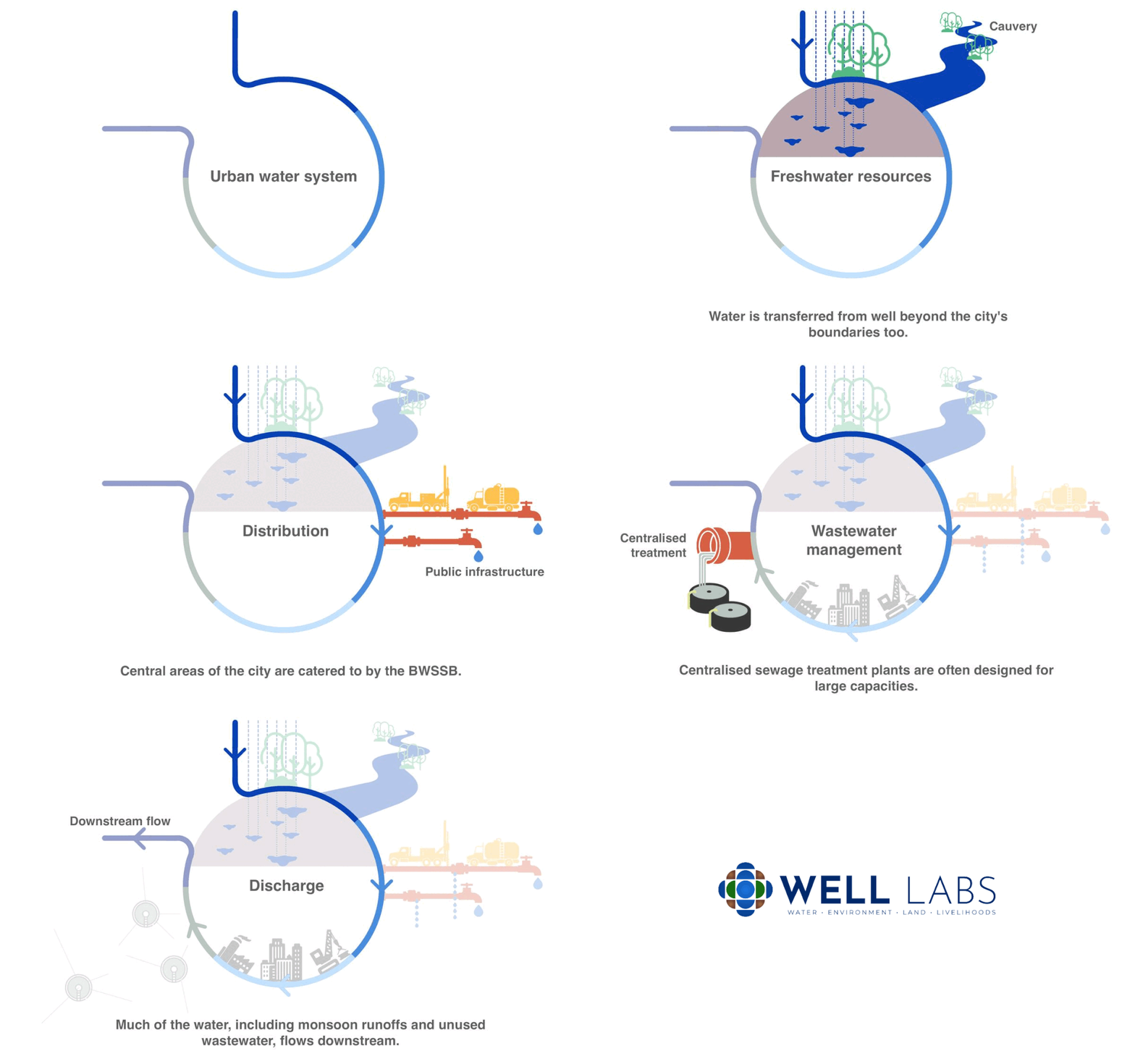
Rashmi: We were interested in looking at alternatives to fulfill Bengaluru’s water demand without increasing Cauvery water supply because that is not infinite. We started the exercise by trying to quantify how much water there is in the city. Where it is coming from and where it is being used.
There are five components to this: 1) Freshwater coming in 2) distribution within the city 3) different sectors that use the water – domestic, industrial and commercial 4) the resulting wastewater and 5) finally, the water leaving the city. This is the water balance for a city.
We started putting a number to each component of this water balance. This work is ongoing. The eventual goal is to quantify water use and estimate the cost of each component. This will help us understand what we need to make the city more water-reliant.
CM: How do you undertake a task like this, that too at the scale of the entire city?
Shashank: A bunch of studies have been done on water supply and demand, wastewater and population growth in Bengaluru. But most are restricted to 2015-2017.
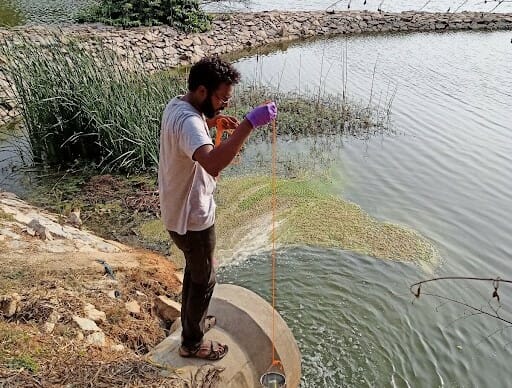
Japan India Cooperative Agency (JICA) had estimated the population growth and water demand for the city when they funded the Cauvery water project. That report was our baseline. But that data was restricted till 2017. So, we also turned to the economic census, BWSSB numbers, etc. We don’t have a population census since 2011, 12 years ago, but most estimates suggest the population is around 12.8 million. We used this as our population.
A Metro city requires around 50 litres of water per capita, per day [LPCD]. Tier 1 cities need 150 LPCD. So, we can adding up. The net water demand of 12.8 million people at 150 LPCD is much greater than the volume of Cauvery water supply. So, where is the rest of the water coming from? Clearly, people are supplementing with groundwater.
Read more: How open data, wastewater reuse and other measures can prevent flooding in Bengaluru
Rashmi: Most of these reports are old or each component of the water balance has been studied separately. What we are trying to do is to combine all of them and then see how it looks at the city level.
CM: What is the use of the water balance?
Shashank: It is supposed to be a decision-making tool. Knowing where there is potential to reuse water or offset something can help us reduce our burden on external sources. It is also a refresher on the current condition of our city. And it will also help us answer the question of whether Mekedatu or other such projects are needed. It is true that Bengaluru is the state’s financial capital and generates significant GDP, but does that mean we can take away resources from rural areas? A water balance can help us reduce that burden.
Rashmi: It is also a good way to monitor solutions. For example, people do use treated wastewater in the city, but how much is being used in the city right now and how much more is possible? There is a limit on the quantity of rainwater available to harvest and how much wastewater can be reused.
For example, BWSSB aims to harvest 50% of rainfall in Bengaluru, but the run-off in the city is only 44% of the total rainfall. They also claim that enough rainwater can be collected to use over three months. But most people don’t have adequate-sized tanks for this in their 30×40 site.
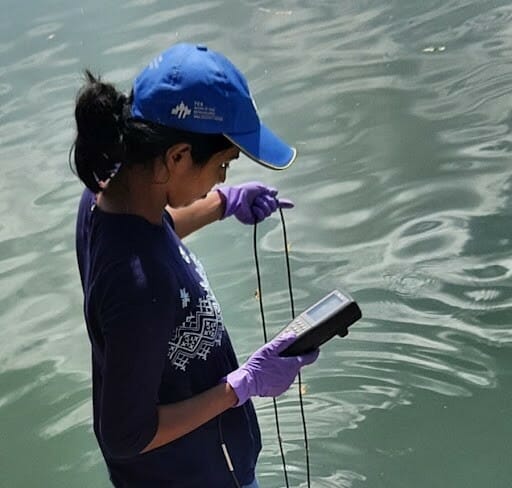
A water balance can help us identify what is feasible. And we can make informed decisions while implementing solutions.
Shashank: We are also developing a template for all cities to follow, so they can develop their own water balance and update it every year. This is also mandatory under the Central Government’s AMRUT scheme to avail assistance for water projects.
***
Note: Well Labs will release the Urban Water Balance report for Bengaluru today.
It appears most of the recent researchers have not looked into the detailed study carried out since past 12 – 13 years by Subhash Chandra and Hegde(2011,2012, 2014,2015 etc.)and the papers published there on in the national reputed journals like Current Science, Jour. Geo. Soc. Ind. Etc., also where further We have clearly brought out even in our book ” Bengaluru Water Resource Management : Challenges and Remedies (2015)” all the critical issues as to how surface run -off is getting wasted, lake waters are polluted,how the treatment of urban sewage of about 1200 mld ( then estimated ) upto tertiary level and making it potable and considered for water supply , how preventing leakage of Cauvery water etc., can all
cumulatively serve nearly 14 million people of Bengaluru without any water diversion schemes like of Yettinahole and even with no dependence on groundwater that has hit the rock bottom in most part of the city. Unfortunately earlier works get masked and that now becomes fresh proposal.