As dusk descends over Thozhuvur village, 41 km from Chennai, S Kasinathan, rests on a small chair in his thatched roof house. He coughs incessantly and curses his fate for being a burial ground worker. The 42-year-old man from this village in Thiruvallur district has just cremated a body and has had to inhale the smoke for hours.
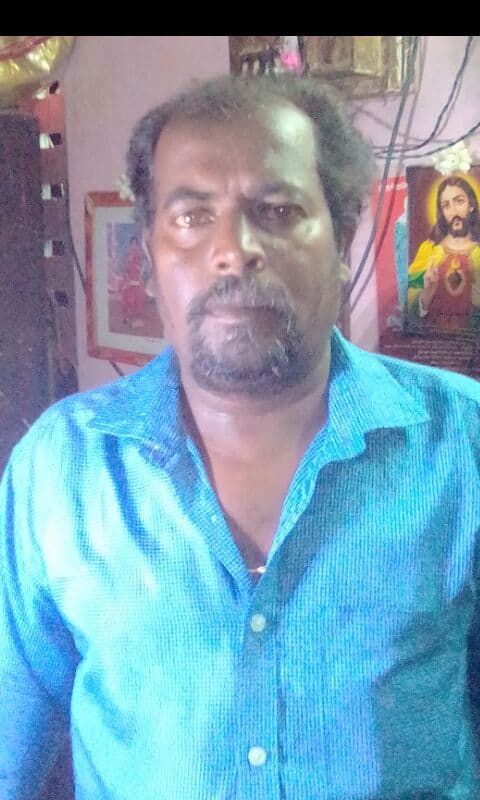
S Kasinathan, a Vettiyan
Kasinathan laughs sarcastically when asked why he was not wearing his safety gear. “I do not even get a monthly salary here, despite working as a ‘vettiyan’ (one who cremates and bury the dead) for over 15 years now. Asking for a mask is something that I can never dream of,” he snorts.
The life of a vettiyan is unusual and complicated. Death brings them money and joy, but the burial grounds maintained by the civic bodies are not generous enough to pay them regular monthly salaries. So, the money paid by relatives of the deceased is their only income.
“I get around Rs 2,500 to 3000 for cremating a body. I have to share it with the other workers who help in fetching the wood and other rituals,” Kasinathan adds.
Caste discrimination
Money is not their only woe however. The workers are often subject to caste discrimination and ignominy, only because of their occupation.
Kasinathan is no different. A ninth standard drop-out, he was forced to take up this profession by the village panchayat authorities after his father passed away. “I was working as a driver before that. It is an unsaid rule that those belonging to the Adi Dravidar community must take up the work. I am a third generation vettiyan,” said Kasinathan.
Located a small distance off the Thozhuvur village, the burial ground has separate space for the upper and lower caste people. Social bias has not left the dead alone either, as the space for the upper caste people is equipped with Erimedai (shelter like structures) but is absent for the lower caste people, also often referred to as ‘colony people’ in a rural set up.
“Once they learn who we are, people don’t even give us a glass of water. Caste discrimination is a constant reality in our lives,” said Kasinathan, in a low tone.
Certain things are common among all these workers, most of whom belong to the Scheduled Castes: the absence of proper education, the complete lack of upward mobility in their jobs and medical problems.
Abitha Raj, a life skills trainer, who did in-depth research on the occupational mobility of burial ground workers as part of her research project for the Masters in Social Work from Madras Christian College, was shocked at the prevailing caste discrimination among the community.
“Burial ground workers are still struggling to create a proper identity for themselves and often, in most of the cases, are stigmatized due to their caste which is associated with their occupation. It is an outright violation of human rights. It is distressing to know that the caste in which we are born decides the occupation we are supposed to pursue and restricts avenues for us to grow in.”
Are things different in the city?
Sadly, no.
Chennai’s dead are cremated either in crematoriums, which are equipped with cremulators, or in the burial grounds, where open burning is the norm. While the Chennai Corporation pays monthly salaries to those working in the former, burial grounds have a largely unorganised set up. Workers in burial grounds, however, have a much more difficult job, carrying out their duties in hazardous conditions.
There are 38 such burial grounds maintained by the Chennai Corporation in the city, each presumably serviced by one or two Vettiyans. It is difficult to put a number on this community, as they are not on the payrolls of the Corporation.
26-year-old C Balamurugan, who has been working at the Babu Nagar burial ground in Pattabiram (Avadi Municipality), for the past seven years says, “There have been many instances when people have advised me to quit and take up a better job. For me, this job is sacred, though they (the municipality) don’t pay me every month.”
Balamurugan is not willing to switch professions, even though the work has given him a chronic cough. A majority of the workers, in fact, struggle with complicated health issues including eye irritation, asthma and abdominal problems.
While he replaced his father at work after his demise, he doesn’t wish his children to follow suit. “It is very difficult to lead a decent livelihood, as we don’t get monthly salaries. The corporation officials have said that they will give us a monthly pay, after converting it to a crematorium,” he says hopefully.
The uncertainty has worsened the plight of workers, especially as many burial grounds, despite being renovated and turned into crematoriums (including the one at Babu Nagar), are waiting to be inaugurated.
The scene is similar across the 38 burial grounds in Chennai, and the salaries of the Vettiyans don’t cross Rs 6000 a month, as confirmed by a source from the Otteri Corporation burial ground.
Throwing light on the planned functioning of the burial grounds, a senior corporation official said, “Many of these currently do not have an organised structure. The proposal is to convert them to crematoriums, to end open burning. We shall then hand them over to the private organisations for maintenance. The Vettiyans would be taken in as permanent employees or as contractors. In any case, monthly salary is ensured.”
Similar scenes in private burial grounds
Unfortunately, standards of burial grounds maintained by the religious institutions are no better. Though the workers here are given a monthly pay, a reality check confirmed that the vettiyans are largely underpaid.
A worker, who has been working at the St Thomas Garrison Church Cemetery for the past 18 years says, “I get a monthly pay of Rs 6000. Though it is insufficient to feed my family, I am happy about the work.” A worker from the burial ground maintained by the Jama Masjid in Ekkaduthangal also appears to be comfortable with his job, although he earns a meagre amount less than Rs 8000 a month.
Workers from the burial grounds maintained by these religious institutions however say that they are not discriminated against on the basis of their profession or caste, and that is probably one way in which they are better off than their counterparts in civic burial grounds in the city and beyond.
Good article.. Video stories would be an add on…