Bengaluru has been ranked the least liveable city, among Delhi, Mumbai, Chennai, and Ahmedabad, in the 2022 Global Liveability Index by the Economist Intelligence Unit (EIU). While the parameters of such surveys are contested, living conditions in Bengaluru slums certainly comes close to such characterisation.
For example, the high price of liquified petroleum gas (LPG), a key household need, provided by Indian oil companies, has impacted people living in slums.
The reality on the ground
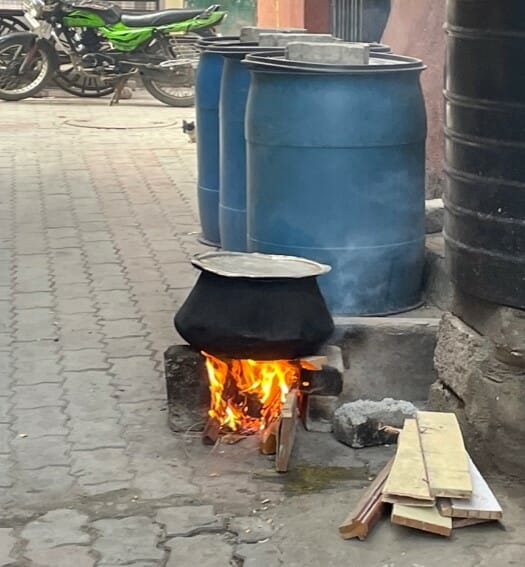
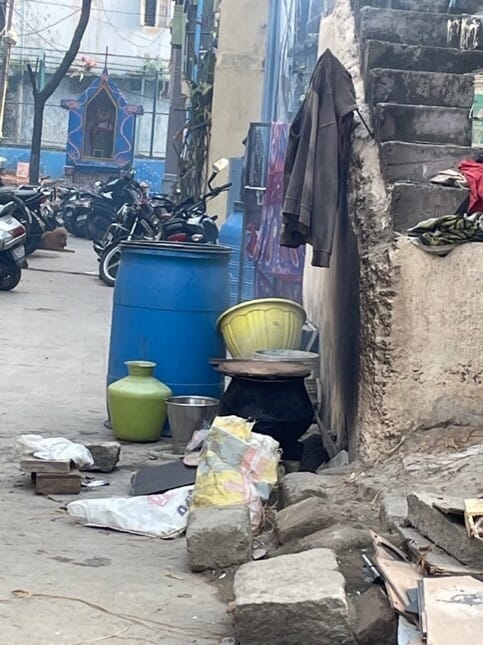
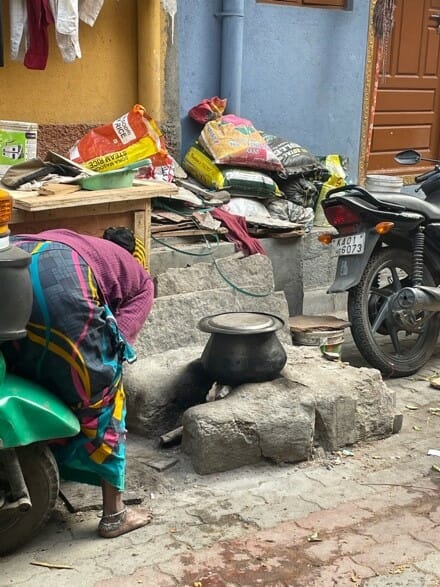
As one moves through the neighbourhood of Rajendra Nagar slum, large vessels are seen outside people’s houses. On asking the residents of the purpose of these vessels, it is clear that they are used to heat water. Due to the high price of gas cylinders, most slum residents prefer alternatives, especially when it comes to boiling/heating water, a necessity during winter months.
For a neighbourhood that suffers from water scarcity and intermittent water delivery at irregular hours through the week, getting warm water is far from a possibility. As a result, several families use vessels to boil water and choose not to use gas for this, lest they run out of fuel soon.
Read more: Costly and scarce: Water access a daily struggle for Bengaluru slum dwellers
The issue of household air pollution
With low average household income, aggravated financial constraints due to the after effects of COVID-19 lockdown, the slum is deeply affected. Prince, a resident of the slum, states that his home also uses the bigger vessel with firewood to boil water. On probing, he admits that sometimes people use garbage items, like discarded plastic pieces as raw material to start a fire for cooking. This has led to increased levels of toxic fumes within these neighbourhoods. Small clouds of black smoke are visible from most of the streets throughout the day. This comes with severe consequences.
Declining health conditions are a major concern in a settlement that already suffers from a deficit of primary healthcare infrastructure. The entire neighbourhoods of Rajendra Nagar and LR Nagar, comprising more than 12,000 families, are dependent on one Primary Health Centre in LR Nagar, along with a few local clinics. As per the Global Burden of Disease Study 2019, nearly 600,000 deaths in India in 2019 can be attributed to indoor air pollution.
In addition to this, it also has significant climate related consequences. Household air pollution contributes to 30% to 50% of the ambient air quality in India, according to CEEW’s State of Clean Cooking Energy Access in India (2021). This disproportionality affects women and children. Where the former are usually at the helm of cooking while the latter spends most of their daytime in these narrow lanes, where these vessels are kept.
Read more: Editorial: Can’t afford cooking oil, gas or vegetables? Eat less, or eat cake
Pradhan Mantri Ujjwala Yojana (PMUY)
LPG connections are considered an essential welfare service and is the locus for sustainable household cooking.
Pradhan Mantri Ujjwala Yojana (PMUY) aims to address this by providing LPG connections among more than 80 million households, particularly people living below the poverty line (BPL). PMUY has certainly emerged as a flagship scheme, which intends to reach every household through gas connections.
Several estimates report more than 90% households have LPG connections. Karnataka itself boasts more than 32 lakh connections. However, it is difficult to ascertain how regularly these have been made available.
Affordability of refills
Not everyone is affected equally by rising LPG prices. Some families with high purchasing capacity are able to afford a new cylinder every month, which costs about Rs 1,100 in Bengaluru. A food shop owner, on the condition of anonymity, shares that he gets an extra cylinder in the black market at a higher price because of the large scale of cooking in their shop. The question remains, how can LPG be made not only accessible but also usable for families that already have a connection? This has to do with affordability of refills, which must be accounted for if the government wants to ensure that PMUY remains a credible intervention.
Further, there is a grave need to see climate-change related issues in slums as a consequence of deep infrastructural inequalities that force residents to make unsustainable choices. It is clear that the urban poor are at the forefront of climate change exigencies. If capacity building is seen as a way to make communities make better choices, then such unsustainable choices must be read as a consequence of lack of capacity. Policy makers and authorities must realise that at the core of unsustainable practices is the issue of prices and affordability. Without such supply-side changes, all rhetoric about ‘Sustainable Cities’ will be baseless, leading to further marginalisation of the urban poor from the newly emerging sustainability discourse.