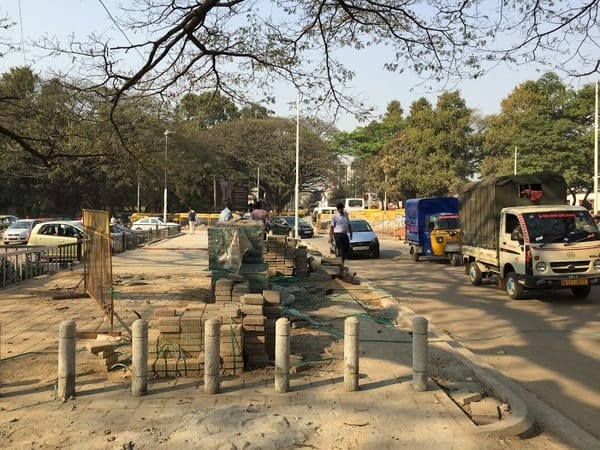
TenderSURE work in progress on St Marks Road. Pic: Josephine Joseph
The criticism against Tendersure projects is misplaced. All these days we were shouting from house top that we should have wide, safe and seamless footpaths and when it is provided the same groups are crying hoarse that the width of roads have shrunk. Obviously it will shrink. It is common sense when you are not or cannot widen the roads. It is not about the design which does seem to be faulty considering what happened on St Mark’s Road after the recent deluge. There are other far more serious issues involved in the whole process.
Firstly, the choice of the agency and the shroud of secrecy around the entire process of selection. They have chosen a group which can, at the most charitable level, be termed as a group of lobbyists.
Secondly, the tendering process was carried out in the most unscientific way leading to a situation where hardly a few contractors have quoted (have been allowed to quote) and it is alleged that each one is awarded at least one work. Shades of cartelisation?
Thirdly, who has standardised the specifications and on what grounds was this agency selected? What are their qualifications? These are the questions which do not elicit any response from the authorities.
Fourthly, the whole irony of the situation is that with one of the strongest votaries of citizen participation being a part of this group, there is absolutely no attempt at public hearings and consultations in the entire process. We start wondering at the metamorphosis and the reasons behind that.
Fifth issue is the cost of constructing these Roads. It is alleged that the cost is around Rs 8 crores per km. Yesterday I was walking along St Marks Road when it was drizzling after the deluge and I and my wife had to wade through a pool of water. Was it because there was no space in the drain underneath to carry all this water because the money had already gone down the drain and literally there was no space for water there?
Finally, the way BBMP has been ordered to keep off the process of the entire tendering process and the direct intervention by the State government through the Urban Development Department raises a lot of questions about the commitment of the State government to the strengthening of the urban local bodies.
These are in my opinion some of the more serious issues that the civil society organisations should take up with the State government, rather than taking up the self-contradictory stand on the width of footpath.
Related Articles
NBF asks BBMP to desilt drains, repair footpaths and expedite TenderSURE
What’s this Tender SURE all about?
India is a democracy but a chaotic one. TenderSURE is a pilot project and as such there will be some deviations from the norm and lessons to be learnt. However, I strongly feel a whitepaper on the above questions would be a welcome move from the authorities concerned.
Good points, Mr. Mukunda.
As a cyclist and user of public transport, I should be very happy with this project that gives more road space to pedestrians and cyclists.
On the contrary, I am scared of the precedent that this project has set, of ‘no questions asked’ projects For big business, By big business, with citizens’ money.
It is not clear what they have done in terms of quality of roads in this TenderSure method. I would have expected the roads to be concertized at the least. While wider footpaths are welcome, hope they don’t become mini markets with pedestrians squeezed in the middle.