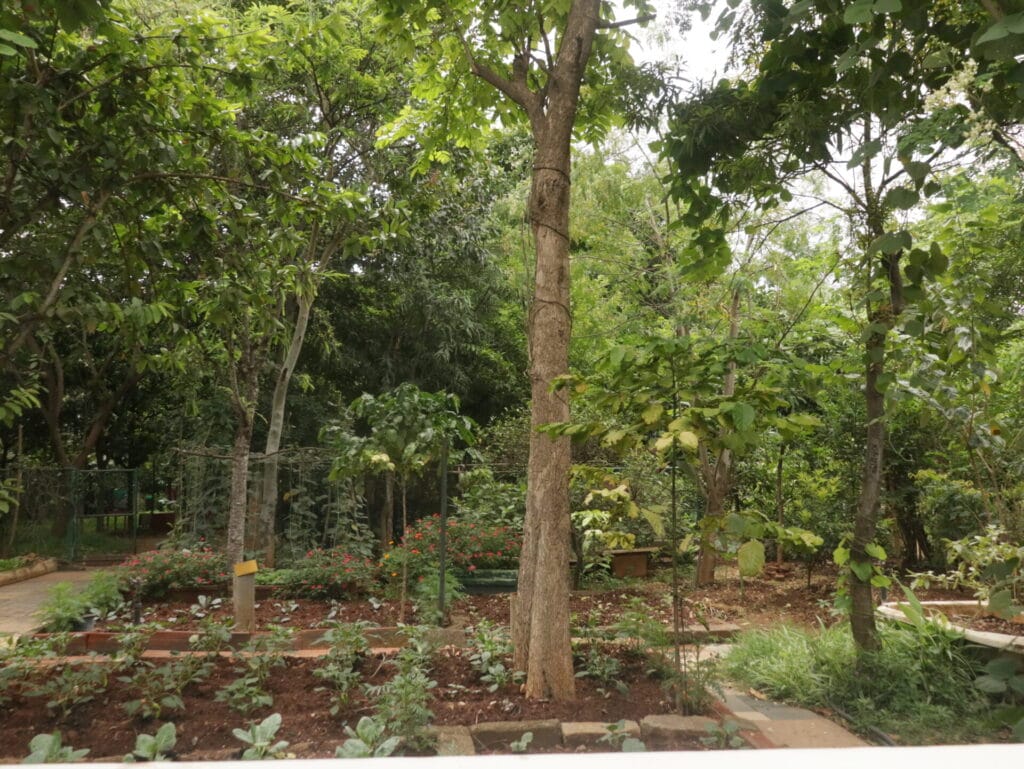
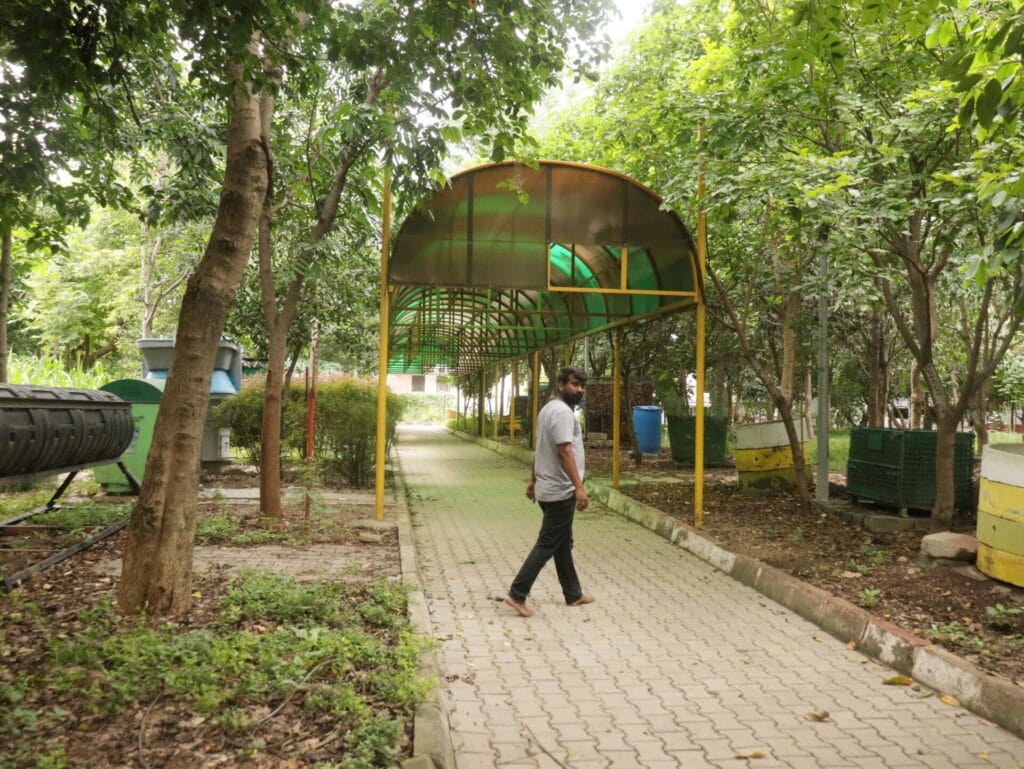
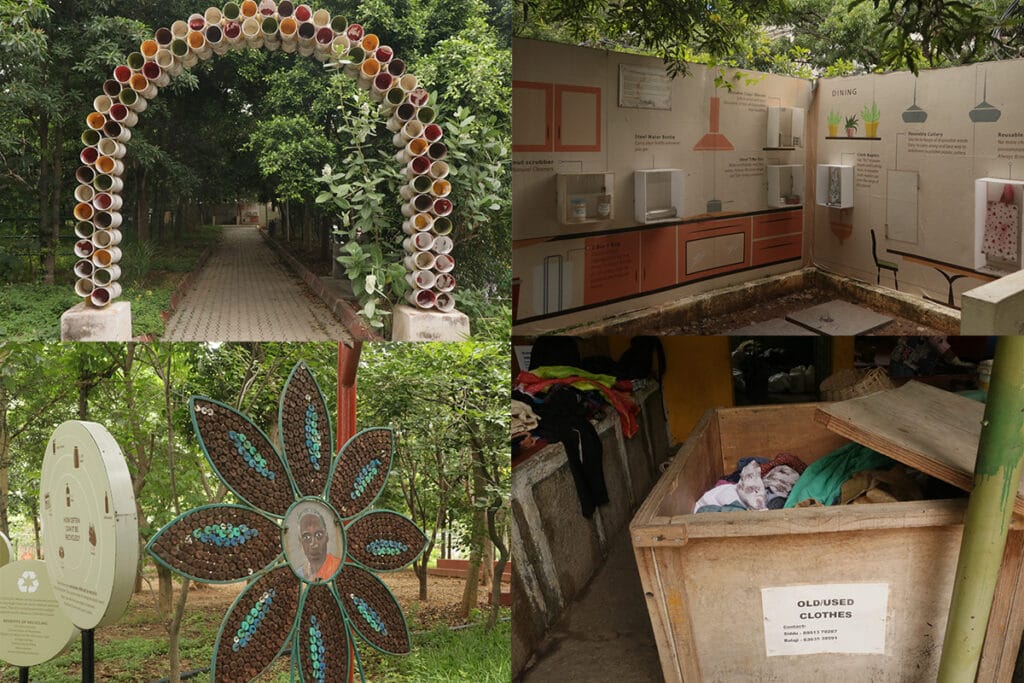
Amidst the urban sprawl of HSR Layout, Swachagraha Kalika Kendra (SGKK) stands out, looking nothing like a traditional park. At the entrance, a striking archway made of old plastic bottles and scrap materials makes a statement on creative reuse. Stepping further in, visitors to the park are greeted by a thriving community garden, where vegetables are grown organically.
SGKK is not just a park; it is a place for learning and community action, and inspires people in the locality to adopt sustainable waste management practices. The park stands as a microcosm of what the city could become—greener, more conscious, and community-driven.
The process of composting
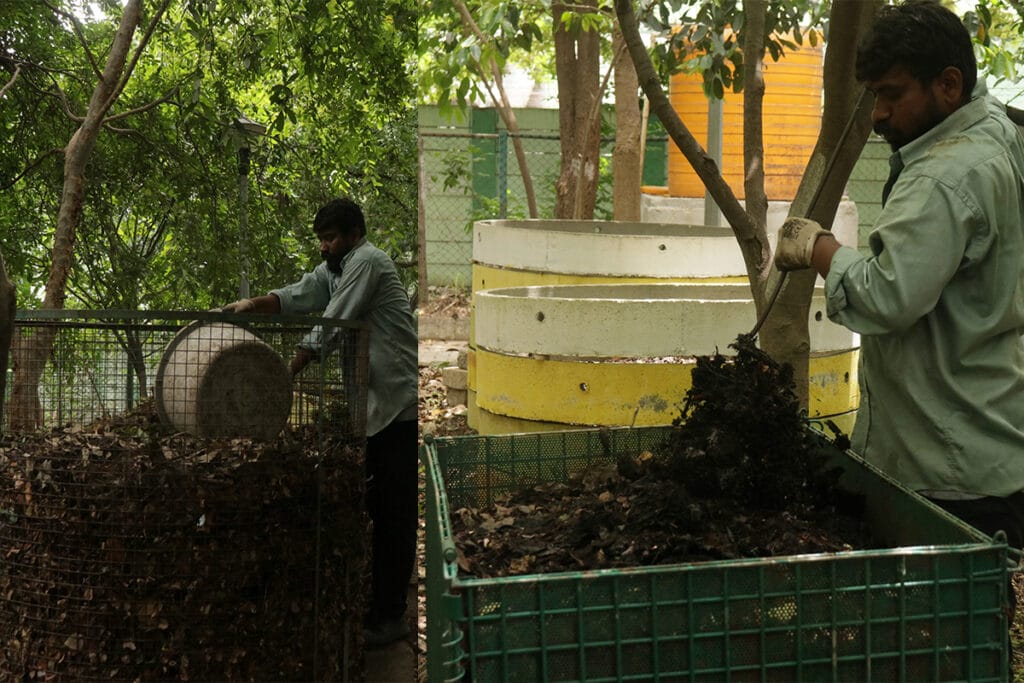
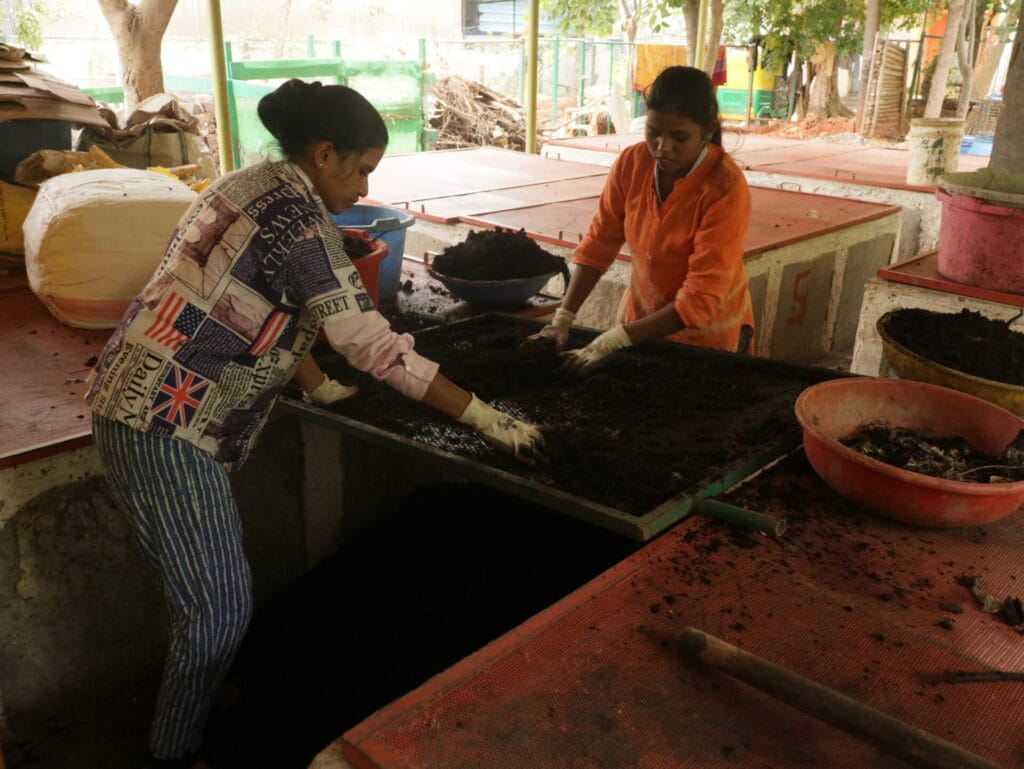
Here is how the composting happens. Every day, BBMP’s sanitation workers collect around 600 kg of wet waste from the neighbourhood and bring it to the centre at around 11 am for processing. This waste is then mixed with dry leaves from the park and 18 other BBMP parks nearby, and readied for composting.
“Overloading a composter is one of the biggest reasons composting fails. You need the right ratio of greens and browns,” says Vasuki, a waste management expert and a key member of SGKK.
Equal parts of wet waste and dry leaves are added to composting units and regularly aerated. Over 45 days, the waste breaks down naturally. It’s then cured further for 2–3 weeks to improve quality, with or without earthworms. Optional additives such as cow dung or cocopeat can enhance the process.
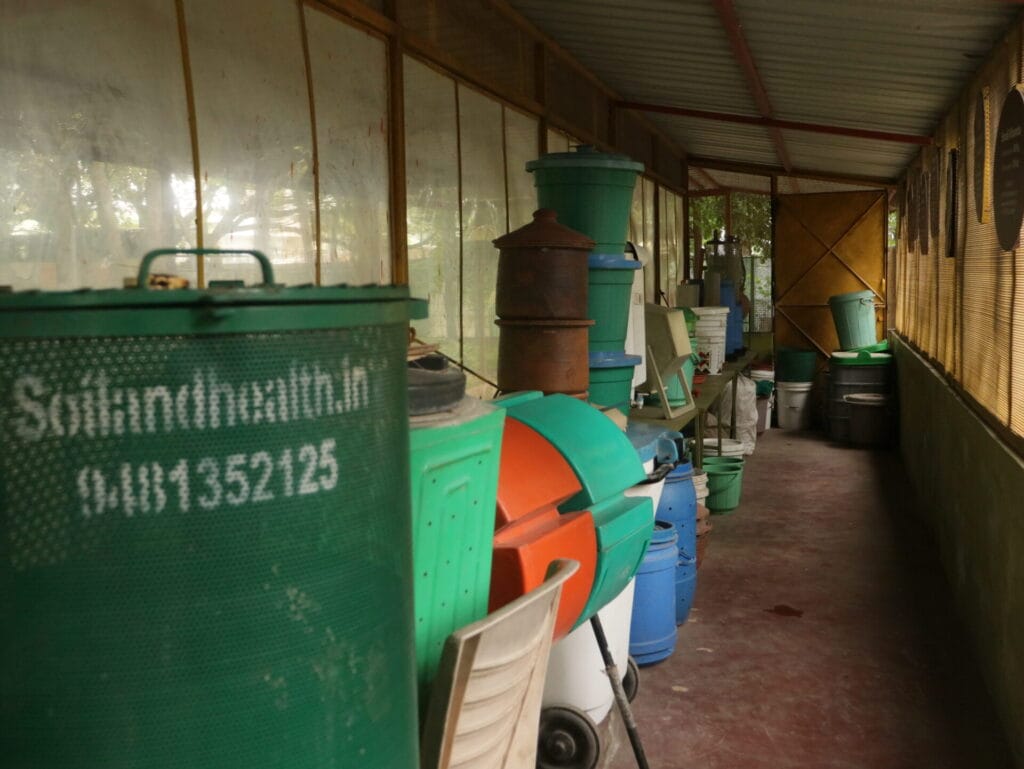
The centre has 20 different composters, categorised into two types: home composting models, which include simple DIY setups, and community composting models offered by vendors to manage waste on a larger scale in apartment complexes, educational institutions, and other facilities.
How it all began
In 2012, HSR Citizen Forum started awareness campaigns for waste segregation at the source. “After the SWM rules were strictly implemented from 2016, we slowly achieved more than 90% segregation at source,” says Shanthi Tummala, founding member of HSR Citizen Forum.
She adds that the growing need to process waste effectively required more effort and it necessitated the setting up of a training centre for waste management. This led to the founding of the Kendra in 2018. With some modification and setting up of composting models and exhibits of sustainable home models, the BBMP park turned into a school for composting.
Read more: How the people of Kannamangala are setting an example in sustainable waste management
Breaking composting myths
Schools, colleges and RWAs visit the centre to learn more about composting. “People come here with one idea—for example, how to compost in their college. But we teach them much more than that; how to make their campus sustainable, how to spread awareness, etc.,” says Shanthi.
“People also worry that the composters will stink, or there will be flies or mosquitoes,” she adds. “As the composting equipment is a working model, people can stand next to it and see for themselves. There’s no stench, as the composting methods are scientific and the composters are well-maintained. That gives visitors confidence.”
The models here are energy-efficient, made of different materials such as metal mesh and cement rings, among others.
Another concern of some community members is that during monsoons, rainwater mixed with the waste will produce leachate. “Rainwater is not the villain,” Vasuki explains. “If it’s seeping into the soil and not getting blocked, there’s no problem. Also, atmospheric nitrogen in rainwater helps composting,” says Vasuki.
A successful model
He attributes the success of SGKK to its multiple stakeholders — HSR Citizen Forum, Solid Waste Management Round Table, BBMP, local MLA Satish Reddy, and the local garbage contractor. “It’s not just a citizen initiative, but a collaborative one. And that’s why it works,” he says.
SGKK sells the composted manure to urban farmers in the city. The centre also buys compost from the apartments, where it helped set up composters, so residents can earn from the waste. One such community that has benefited from this initiative is the Temple Bells apartment.
In 2023, Temple Bells apartment, with the help of SGKK, adopted wet waste processing within its premises. A sprawling 900-flat apartment complex in Bengaluru’s Rajarajeshwari Nagar, it earlier had 600 kg of wet waste piling up with no sustainable solution.
“Vasuki and his team guided us end-to-end, from set-up to staff training, and continued to support us long after installation,” says Achal Venkatesh, a resident of the apartment. The community started with 45 mesh composters — one for each day’s waste. So while one composter gets filled, one would be ready to be filled. Over time, they also set up cement tanks and green bins with air blowers, where further composting happens. “It took 6–7 months to fine-tune the process. We now compost 100% of our wet waste in-house, roughly 18 tonnes a month,” Achal adds.
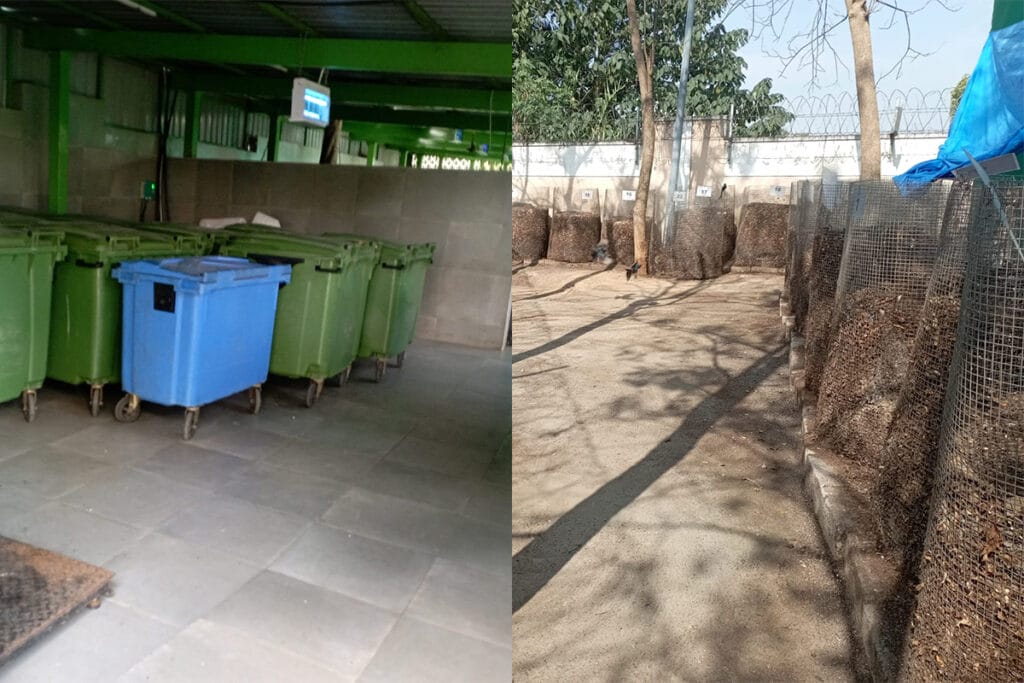
Rainy seasons initially posed challenges, but simple solutions like tarpaulin sheets helped manage excess moisture. They now produce 4–5 tonnes of compost monthly, which is sold to SGKK and nurseries.
Read more: Mestri Palya’s journey to successful waste management
Financial benefits
Beyond the environmental benefits, the community also sees clear financial gains. “Earlier, BBMP charged us ₹1.2 lakh a month to lift waste. With in-house composting, costs are down to ₹80,000, including staff and cocopeat, plus we earn from compost sales. If we send waste out now, the new SWM fee would raise costs to ₹2.2 lakh,” Achal notes.
Moreover, Achal emphasises that success hinged on resident support and a committed team. “Even the best system won’t work if people don’t segregate at home. We had to build that culture first.”
A few challenges
Mosquitoes breeding in a stormwater drain next to the park led locals to complain about the centre, and that it was stinking. “However, we managed to convince people about the importance of the centre and now it is a pride to the nation,” says Shanthi.
According to a few media reports, the centre also faced backlash from some locals, who wanted it to be shifted to another location. However, a plea against the relocation gained momentum with community support, and the centre stayed. A manager of the centre says, “The centre is unchanged and remains open to the public, with our work making it greener.”
Kamesh Rastogi, an HSR Layout resident, believes the centre is beneficial in many ways. “Training people to set up composting, promoting waste segregation at source, conducting workshops for several sustainable practices and promoting other recycling activities are very appreciable.”
Other sustainable activities
The centre also collects dry waste including textile waste, e-waste, books, toys and chappal and shoes, which are sent to professional waste management centres, including Saahas Zero Waste and Hasiru Dala Innovations.
People lack awareness and intent, which need to be built. “If people visit the dry waste collection centres and landfills and witness the amount of waste piled up, they will understand the need for waste segregation within their houses,” Shanthi said. “Since decentralised waste management is good for the city, every house should have a composter,” reiterates Vasuki.