An initiative aimed at redesigning 75 junctions in Bengaluru

BBMP’s junction improvement initiative "Suraksha 75" is being done in association with Bengaluru traffic Police, WRI India and BIGRS.

The Karnataka and Bruhat Bengaluru Mahanagara Palike (BBMP) Budgets, 2023-24, recently announced that 75 junctions of Bengaluru would be improved, at a cost of Rs 150 crore. In keeping with this vision, the BBMP and Bengaluru Traffic Police, in collaboration with World Resources Institute India (WRI India), under the Bloomberg Philanthropies Initiative for Global Road Safety (BIGRS), launched the Suraksha 75 Mission 2023 initiative on March 25th.

The Suraksha 75 Mission aims to create people-centric and holistic intersection designs to make them safe, efficient, inclusive, and universally accessible.

This initiative aims to make Bengaluru’s busy intersections safer for pedestrians, along with improved traffic movement and more robust enforcement. Suraksha 75 will be managed under Bengaluru’s Road Safety Cell under the BBMP TEC (Traffic Engineering Cell) with WRI India as a knowledge partner.
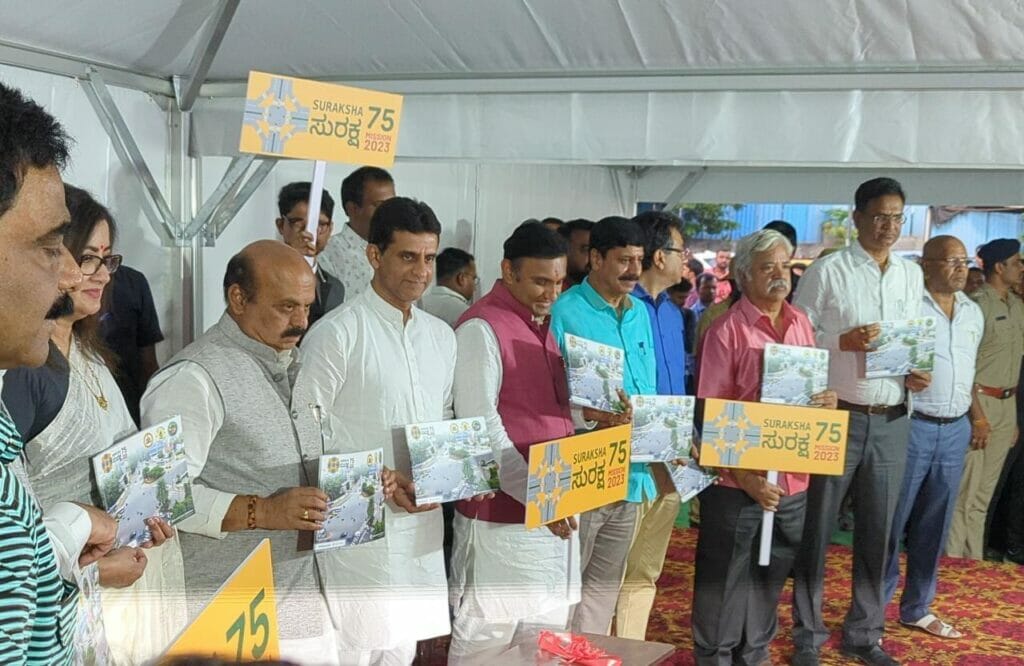
People holding placards and books
Inauguration of the Suraksha75 program. Pic courtesy: BBMP

Read more:  Living with the metro construction: Safety, pollution and accessibility concerns


75 junctions to be redesigned

Intersections are complex spaces in any road network. It’s a space where the occurrence of conflicts between various modes of transportation is quite common. Taking cognisance of this issue, BBMP has made several junctions – Town Hall junction, Maurya junction, and Balekundri circle – safer by design over the past few years.
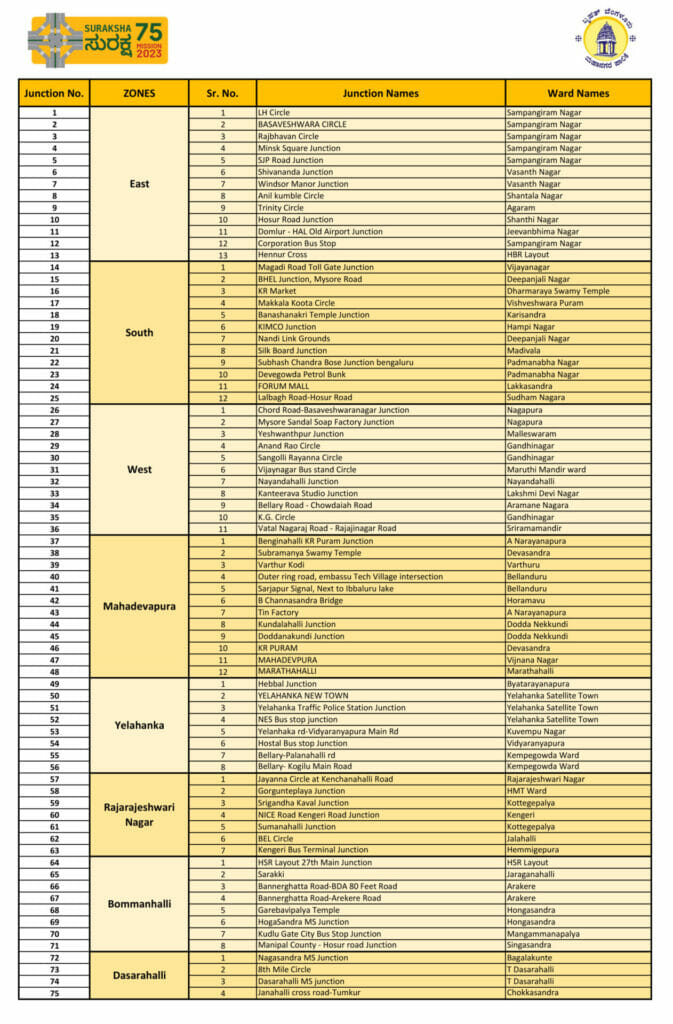
List of 75 junctions under 8 zones of Bengaluru
75 Junctions to be redesigned under the Suraksha75 program. Pic courtesy: BBMP

Read more: Road safety: Audit reveals BBMP roads most hazardous, with 19-20 hazards per km


Safer streets and more efficient junctions can only be created when civil engineering, traffic engineering, and urban design are integrated. The 75 junctions, chosen under the Suraksha75 program, will be improved by tapping into all three expertise and will follow global principles of road safety with the inclusion of critical elements such as pedestrian refuge areas, speed calming measures, safe demarcated crossings and more.

More information on this project is now available on the BBMP website: https://suraksha75.bbmpgov.in/

(The content is a BBMP press release with minimal edits)

Also read:

Leave a Reply

Your email address will not be published. Required fields are marked *

Similar Story

A four-hour commute: The daily transport struggles of women from Chennai’s resettlement areas

Watch this video to understand how absence of last-mile connectivity and unreliable public transport in Chennai is failing those who need it the most.

Chennai has long had a tradition of public transport usage, with commuters having the choice of the suburban railway network, Metropolitan Transport Corporation (MTC) buses operating in the city and the Metro Rail for their daily transit. Despite the government introducing new services recently, especially electric buses, private vehicles numbers have soared and bus ridership has gone down considerably. Last mile connectivity issues, poor coverage in certain areas and the inability of the government to encourage residents to use public transport are major impediments. In fact, private vehicles make up 65 per cent of all motorised transport in the Chennai…

Similar Story

The infrastructure of waiting: How Bengaluru’s gridlock steals our right to time

Bengaluru needs accessible infrastructure that makes life easier for everyone, not tunnels and corridors built for a privileged few.

Selomi's text arrived at 7 am. "Let's leave by 8.30. The traffic will be brutal otherwise." We both live about 10 kilometres from the government office we had been going to every day for the last two weeks. The nearest metro station is four kilometres from our homes, which means forty minutes to reach it, twenty on the metro, and twenty-five on foot from Vidhana Soudha to the office. An hour and twenty minutes each way, assuming nothing goes wrong. In Bengaluru, something always does. By the end of the second week, we had the routine down. Coffee in a…