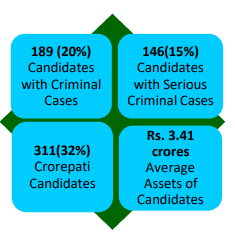
ADR has analysed the self-sworn affidavits of 967 out of 979 candidates, who are contesting in the sixth phase of the ongoing general elections, scheduled for May 12th. Topping the list of crorepatis is Jyotiraditya M. Scindia fighting from Guna constituency of Madhya Pradesh with a Congress ticket. He possesses assets worth Rs 374 crore.
Second on the list is Gautam Gambhir with assets over Rs 147 crore. The former national-level cricketer also has the highest liabilities (among Phase 6 candidates) of over Rs 34 crore and highest annual income of over Rs 12 crore for financial year 2017-18 as declared in the Income Tax Returns.
Rangalal Kumar of SUCI party contesting from Purulia, West Bengal happens to have lowest declared assets worth Rs 500 only. He is closely followed by Sukchand Soren of CPI(ML) Red Star, contesting from Bankura, West Bengal with declared assets of Rs 800.

Out of 967 candidates analysed by ADR , 189 candidates (20%) have declared criminal cases against themselves. Around 146 (15%) out of 967 candidates have declared serious criminal cases against themselves. There are about 21 candidates who have committed crimes against women, including assault, molestation and rape. Among these 21 candidates, 2 have declared cases related to rape.
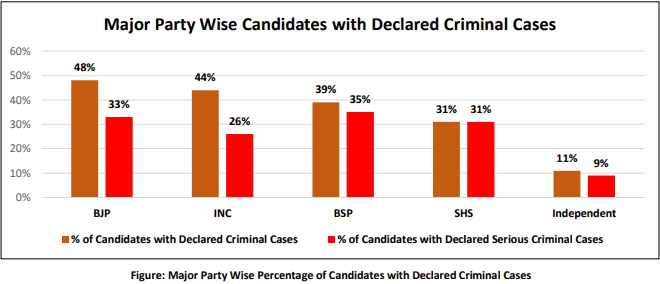
Among the major parties, 26 (48%) out of 54 candidates from BJP, 20 (44%) out of 46 candidates from INC, 19 (39%) out of 49 candidates from BSP, 5 (31%) out of 16 candidates analysed from SHS, and 34 (11%) out of 307 independent candidates have declared criminal cases against themselves.
The constituencies where 3 or more contesting candidates have declared criminal cases against themselves are regarded as Red Alert Constituencies. Out of 59 constituencies voting in Phase 6, 34 have been declared as Red Alert Constituencies.
With regard to educational qualification 304 (41%) candidates have declared their educational qualification to be between 5th and 12th standard, while 509 (53%) candidates have declared to have completed graduation or above. The number of barely literate candidates stands at 35 while there are 10 illiterate candidates.
The number of women candidates contesting the sixth phase has dipped in comparison to the fifth phase. Only 9% of the total candidates are women. The total number of women candidates contesting the sixth phase stands at 83.
Read the full ADR report here.