“Many years ago, I bought all of my computer parts from Ritchie street. It was my first ever PC. The market still fills me with nostalgia,” says Gokoulane Ravi, a resident of Tambaram.
Ritchie street area has been the go-to market for electronics for people not just in Chennai, but in other areas in Tamil Nadu and Andhra Pradesh. For decades the shopkeepers have kept up with changes in technology and sourced the most in-demand goods. But competition with e-commerce websites and crackdowns from authorities is a looming threat to the business.
History of Ritchie street
“My father used to call Ritchie street the Radio Market,” says Gokoulane.
“It was the place for radios, transistors, resistors, capacitors, etc. Back then, most of these goods were smuggled. So, you got them at Burma Bazaar and then Ritchie street,” notes Sudha Umashanker, a history aficionado.
Ravi, Gokoulane’s father, used to go to work near Ritchie street since the 80s. “The market also bloomed around the 70s and 80s. There used to be a few shops selling vinyl records of movies then,” Ravi recollects.
Then, at the end of the 80s and 90s, the electronics market expanded its area spatially and technologically. Cassettes, tape recorders and computer systems became available.
Read more: Way behind in conserving heritage, what will Chennai showcase to the future?
Present state of the electronics market
“There are around 2000 registered shops in the street and a sizable number of unregistered shops,” says Ramesh. He owns a registered mobile shop owner there for around 15 years. Ramesh is a member of the Chennai Electronics and Infotech Traders Association in Ritchie Street.
Colloquially, the name ‘Ritchie street’ applies to other lanes apart from Ritchie street itself and includes Wallers road, Narasingapuram street, Meeran Sahib street and other smaller lanes nearby.
From vinyl records to integrated chips, Ritchie street has kept on updating its goods with the pace of technological advancement. In the 2000s, came the mobile phones. Today, we see mostly mobile shops which sell smartphones and accessories for phones. However, there are other electronics shops selling kitchen appliances, laptops, cameras and watches. Some shops are wholesale and also offer repair services.
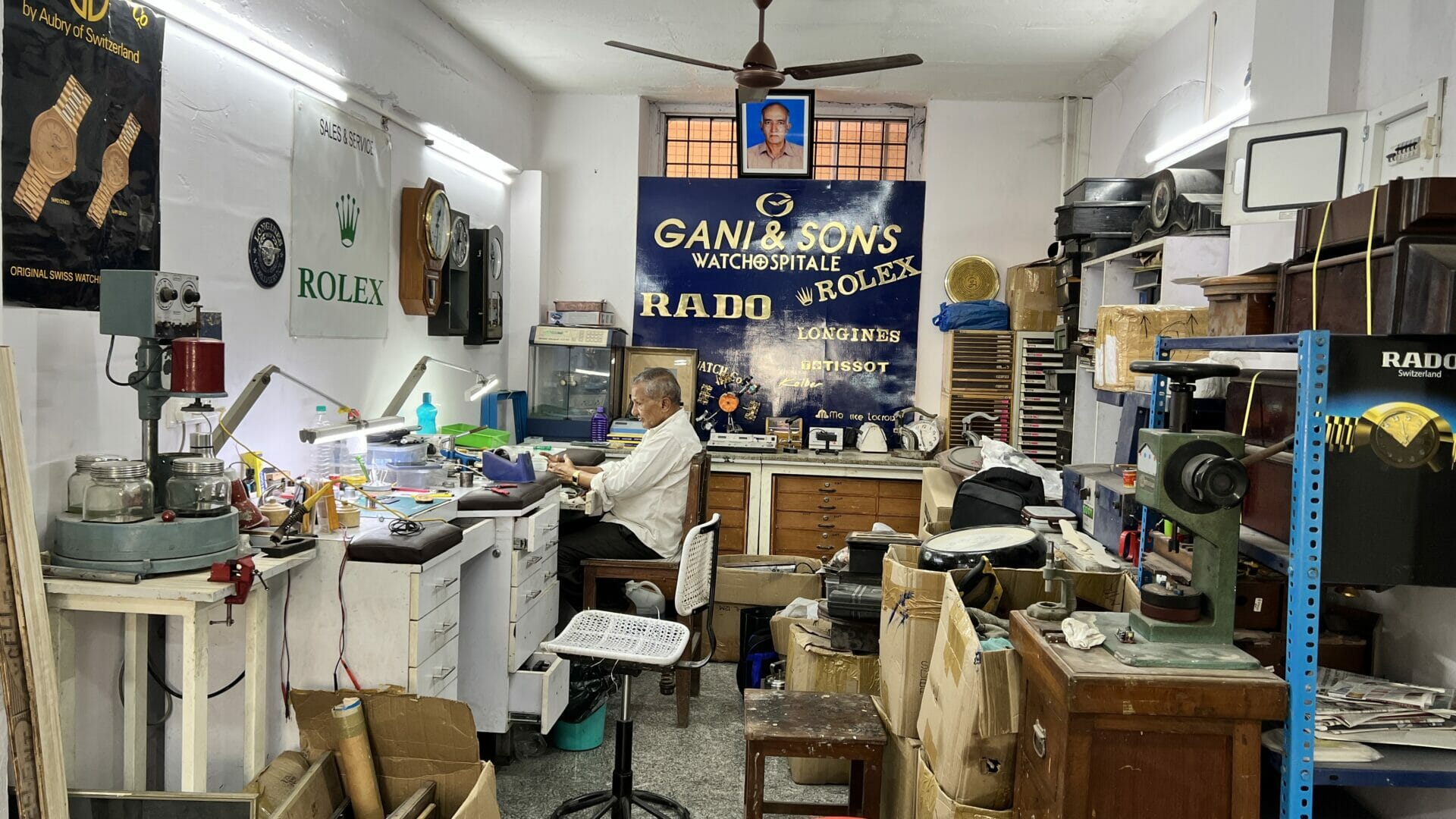
Ramesh and Bharath get their electronic items from Mumbai, Delhi and Punjab.
“Today bargaining happens using technology. Customers show us the prices of electronic items on e-commerce platforms and ask us to lower our prices. Sometimes it will stretch us too thin,” notes Bharath*, a shopkeeper selling remotes and wires on Wallers Road. His remotes are priced from Rs. 50.
Some shop owners like Ramesh have embraced e-commerce to sell their products. “Now, our customers are well-educated and aware. E-commerce is a better place to position my goods to access people outside Tamil Nadu easily,” says Ramesh.
“But we do not have a lot of choices on e-commerce websites. I like to feel the product before buying,” says Aruna, an electrical engineer.
Aruna and Gokoulane say that Ritchie street has the parts needed for engineering projects that may not be available elsewhere, even on e-commerce platforms. “Sometimes, the shopkeepers make some projects and keep them ready. Students buy the completed projects with record material here,” adds Gokoulane.
“I came here for repairing my laptop. I will get it back in another 1.5 hours. They do good service if we go to the correct shop and avoid shops that do not offer repair services,” says another customer who was waiting in Meeran Sahib street.
Most of the customers we spoke to, told us that they came to specific shops in Ritchie street via referrals. Aruna was introduced to some shops by her college friends. Gokoulane’s father has taken him to certain electronic shops since Gokoulane was a child. Ramesh also said that his regular customers brought other people to his shop through word-of-mouth.
Read more: Sellers and residents voice their concerns around street vending in Chennai
Navigating the grey market of Ritchie street
Although Ramesh does not sell fake goods, there are many shops that provide fake items at a lower cost. Some shops give options to customers- whether they want original or copy. The former is costlier than the copy usually. Some shopkeepers give one-year warranties even for copies.
“It depends on the customers’ needs and how much they can afford. Students who may not be earning will prefer to buy copies which might not be very shoddy,” says Aruna.
“Copies are made to look very similar to the original. For instance, copy laptops would be made in bulk. Then they stick the logos of different brands,” says Nithyanand, a mobile shop owner from Ashok Nagar. He visits Ritchie street every other day for seven years. “I make sure I sell only originals to my customers.”
Another shopkeeper dealing with printers says that people associated with electronic brands come on raids to catch hold of shops that sell copies. Two months back, a similar raid happened.
“To make sure you are buying a legally obtained, original item, you need to ensure that you are given a printed bill with the shop name and registration number,” says Ramesh.
Some people also sell their original electronic goods which are unused, says Bharath. The GST bill, warranty and other papers are kept intact and sold along with the original item to the customer.
Another function of Ritchie street is that some original electronic items are used as collateral by customers for securing short-term loans, similar to a pawn shop, says another shopkeeper from the electronic market.
Can we tap into the market to manage e-waste?
While Ritchie street fulfils many needs, there is also untapped potential.
With around 15,000 shops dealing with electronic goods, would it be possible to streamline Chennai’s e-waste management using Ritchie street?
“First, we need to find out how much of e-waste the city generates. Then, we should arrive at the frequency of collection. Also, we need to consider if shops have space for storage or not. Another aspect is arranging transport from the marketplace to the recycling plants,” says Darwin Annadurai, founder and managing trustee of Eco Society India, a registered non-profit-environmental-citizen-group.
“If I am going to buy a new phone, an easy way for me to get rid of the old phone is to give it to the person who sells it to me,” says Aruna. “It is a good idea to explore e-waste management in the street, but working out the logistics is important, and incentive mechanisms must be in place for every stakeholder.”
With not many e-waste handlers in Chennai, and the quantity generated in the city burgeoning day by day, the civic body could explore if the collection of e-waste is possible in the market.
Bustling with people and brimming with possibilities, Ritchie street has grown and changed over the decades to keep up with the times and needs of Chennaiites.
*name changed on request