This article is part of our special series on Delhi Elections 2020 |
Elections to Delhi’s legislative assembly are just around the corner with voting scheduled to take place on February 8th. Results will be announced on February 11th. The highly charged elections are a three-way contest between the incumbent Aam Aadmi Party (AAP), the Bharatiya Janata Party (BJP) and the Indian National Congress (INC). The assembly has 70 seats in total.
If you are preparing to case your vote this Saturday, the 8th, here is a quick guide for you that will answer most of the questions that you may be bothering you at this juncture.
How do I know if I can cast my vote?
You can only cast your vote if your name is present in the electoral rolls. To check this, visit the website of the election commission. Using the Elector’s Photo Identity Card (EPIC) number on your voter ID card, you can search for your name on the rolls.
If you do not possess a Voter ID card, you can search by name. Once you locate your name on the rolls, ensure that you note down the booth address, part number and serial number.
Which is my Assembly Constituency?
To find your assembly constituency, visit this page on the website of the Delhi Election Commission and enter details about your area mentioned in the voter rolls to identify your constituency.
Where is my polling booth?
There are 13750 dedicated polling booths that have been set up for the Delhi assembly elections. To locate your polling booth, voters may use the services of the Voter Helpline App developed by the Election Commission for this purpose.
The voter helpline number 1950 will also help voters locate polling booth. You can call this number after adding the STD code (011 in this case) or get the details by sending an SMS to 1950 with <ECIP011> space <YourEPICNo>
Alternatively, visit the National Voters’ Services Portal at nvsp.in; Choose the ‘Search in Electoral Roll‘ option and fill in the details asked for. Once you have entered the details and clicked Search, the electoral roll will appear together with the mention of your polling booth.
Can I vote if I do not have a Voter ID card?
If your name is absent from the rolls, you will not be able to cast your vote. If your name is present on the electoral rolls (see the first question), you are eligible to vote even if you do not possess a physical voter ID card. Voters without a voter ID card may carry any one of the below mentioned documents or ID to the polling booth to vote:
- Passport
- Driving License
- Service Identity Cards with photograph issued to employees by Central/State Govt PSUs/Public Limited Companies
- Passbooks with photograph issued by Bank/Post Office
- PAN Card
- Smart Card issued by RGI under NPR
- MNREGA Job Card
- Health Insurance Smart Card issued under the scheme of Ministry of Labour
- Pension document with photograph
- Authenticated Photo Voter Slip issued by the election machinery
- Official identity cards issued to MPs/MLAs/MLCs
- Aadhaar Card
How do I know who’s contesting from my constituency?
It is important to be informed and aware about the various contestants in your constituency and their promises and policies proposed. The list of candidates contesting can be found on the website of the election commission.
Websites such as MyNeta also provide consolidated information on the candidates along with details such as criminal cases, assets, electoral history of various candidates.
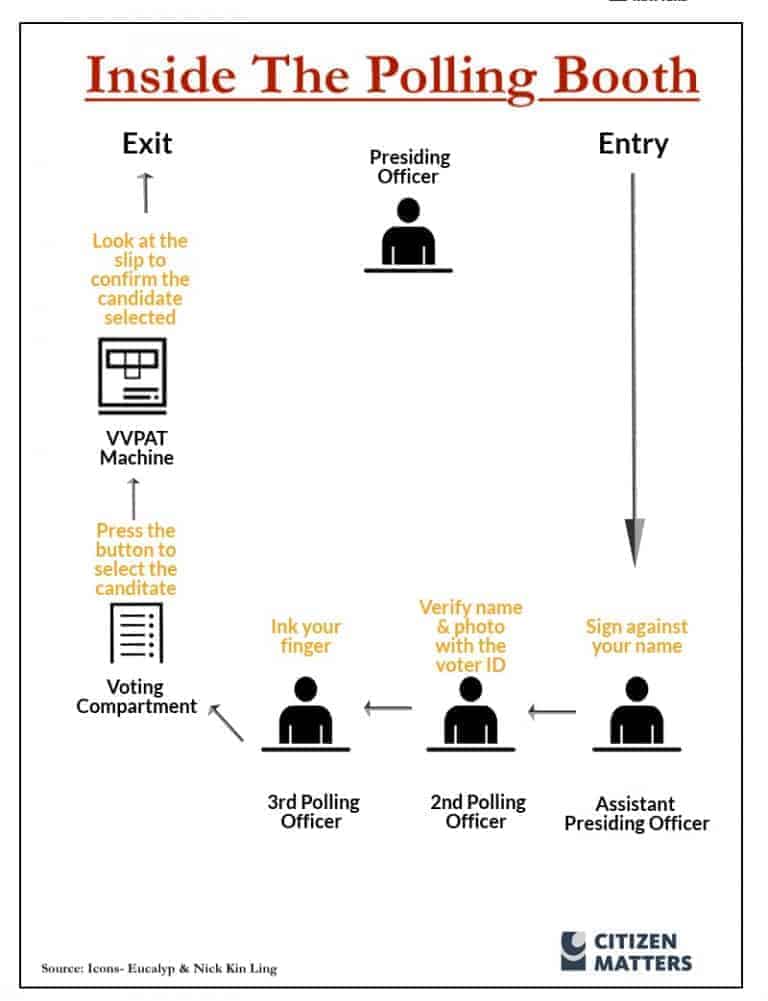
What is the process inside the polling station?
The Delhi Assembly elections will see the use of Voter Verifiable Paper Audit Trail (VVPAT) machines. Voters can verify if their vote has been recorded accurately as they will be able to see the name of the candidate for whom they have cast their vote on the VVPAT machine. The screen of the VVPAT machine will show the vote cast for seven seconds before a slip is printed and dropped into the VVPAT’s collection box.
What is the Model Code of Conduct that all candidates should follow?
The Model Code of Conduct (MCC) is a set of instructions announced by the Election Commission of India pertaining to general conduct, campaigning, holding meetings and processions etc. The MCC is to be followed by both political parties and candidates contesting elections.
You can find more details on the model code of conduct in force here, on the website of the Delhi election commission.
Where can I report if I observe any violation of the above code of conduct or any other offence?
Citizens can report violations of the Model Code of Conduct by using an exclusive app launched by the Election Commission of India, cVigil. More details on the app can be found here
Violations can also be emailed to complaints@eci.gov.in. Voters can also use the voter helpline 1950 to complain.
Are there facilities for the elderly and persons with disability in voting booths?
Voters with disabilities can vote in a regular booth. Facilities that include signage, help desk, polling booths on the ground floor, ramp, braille ballot guide and braille EVMs, accessible restrooms and drinking water facilities are being put in place by the election commission. There will also be sign language interpreters at polling booths.