On January 18th, the Brihanmumbai Municipal Corporation (BMC) invited people to send in their suggestions for the annual municipal budget on Twitter. This is a step towards making the country’s richest municipal corporation’s budget more democratic. But with such an open question, and the fact that not many people are not even familiar with the structure and form of the budget, where do you start?
In a previous explainer, we covered the basics of the BMC’s budget. We touched on how to read through the budget estimates as and when the BMC releases it, as it is a complicated bunch of documents that divides its accounts into different fund codes: general, health, improvement schemes, slum clearance, education, water supply and sewerage, tree authority as well as sections on income and operational expenses.
We also considered its criticisms, of which the lack of citizen involvement was glaring. In that sense, the current call is definitely a step forward.
“We definitely need a participatory budget in some form, where the corporation asks people for their views,” says Milind Mhaske, founder and director of the urban governance NGO Praja Foundation. “This is a beginning.”
Read more: Here’s where your money goes. An explainer on BMC’s budget
Behind the BMC budget
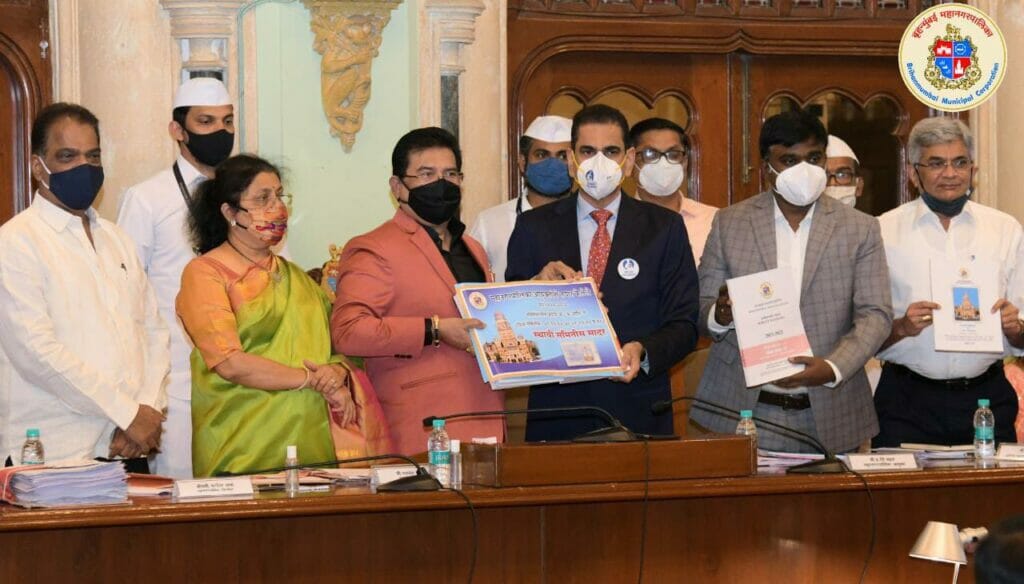
Mumbai’s budget-making process is pretty undemocratic. “It is driven more largely by the municipal commissioner, not the elected councillors,” says Milind. The councillors submit their requests for their ward, in a highly researched manner along with budget estimates and other supporting factors, to the municipal commissioner way back in October. He might consult certain departments in November and December. As it nears preparation, the standing committee, consisting of elected representatives, then discusses and debates the budget.
“The councillors don’t have sufficient power to make substantial changes to the budget. But they highlight points that they think will be largely disadvantageous,” says Milind. This time, as the BMC elections have been delayed since last March and the wards have been without any elected representatives or standing committees, it is unlikely these processes have happened at all. The municipal commissioner and acting administrator, Iqbal S Chahal, will prepare, approve and present the budget to himself for the second time in history.
Citizens are not included throughout the process, although they always have the option to approach their councillor.
Will citizen inputs make a difference?
With only a week between the deadline for suggestions and the presentation of the BMC budget, latest on February 5th, it is doubtful that the exercise will actually take the suggestions received into account. “The budget is probably already prepared by now. When are they going to compile the suggestions, deliberate and debate upon them, and incorporate them?” asks Milind.
This likelihood has been acknowledged on Twitter, even as demands for pothole-free roads, hawker-free footpaths, etc have rolled in.
“The exercise is purely optical,” says Milind, who nonetheless welcomes it. “It’s a beginning.”
However, he has reservations about the open-ended manner in which suggestions have been asked for. “If you want to engage citizens, you need to give them a structured format; a drop-down list from which they can choose a footpath, road, garden, hospital, etc, in their area. This way citizens can be specific and demand improvements on a micro-scale which is doable.”
One example of a way to do this systematically can be taken from Pune, which invites citizens to fill out suggestion forms in advance in October. A nominal portion of the budget is reserved for the selected suggestions.
Our call to you
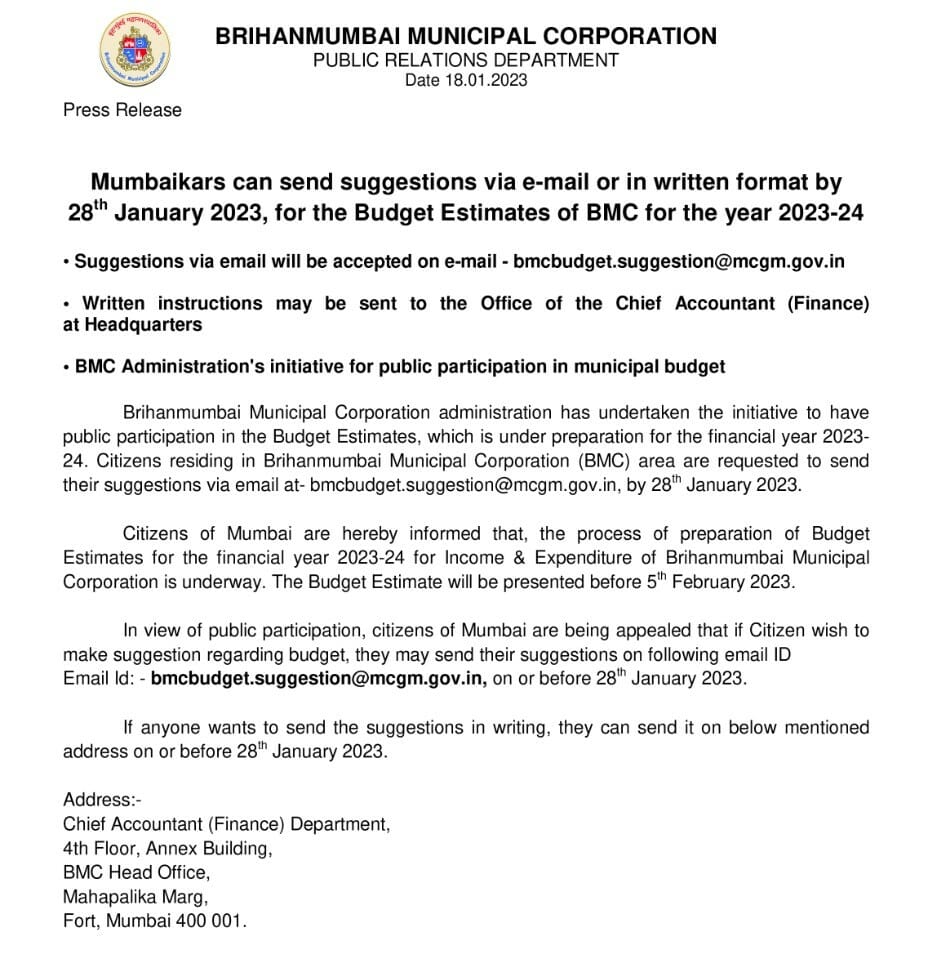
To send your suggestions for the budget to the BMC, you can either send an email to bmcbudget.suggestion@mcgm.gov.in or send a letter to the Chief Accountant (Finance) Department, 4th floor, Annex building, BMC head office, Mahapalika Marg, Fort, Mumbai 400 001.
As an exercise in public accountability, we would also like to publish your suggestions for the budget on Citizen Matters, irrespective of your response to the BMC.
Email us at mumbai@citizenmatters.in or message us on any of our social media accounts, and we will amplify your suggestions.
During monsoon most of the rain water which doesn’t fall in the catchment areas goes waste. We can follow Tamilnadu system of storing rain water in our Housing societies, bunglows etc ,thus solving water shortage problem. Those societies, houses store rain water should be some Rebate in water bill charged by BMC.
2) Dry and wet waste segregation by housing societies should be made compulsory and collection vans should have separate compartments for taking away separately, thus saving BMC the manpower. Hsg societies should be given suitable rebate in property tax, to encourage segregation of waste.