Maximum City, Glamour City, City of Dreams, City of Struggles — Mumbai wears many names and identities. One of the world’s most populous cities, it houses a staggering 2.17 crore people in just 603 square kilometres. Its carrying capacity in terms of accommodating a workforce was exceeded a decade ago, yet the daily inflow continues. Sky-high, artificially inflated real estate prices have pushed many to the distant suburbs, making the daily commute for work or study an arduous struggle. And yet the mobility solutions that the city administration and other powers that be come up with are not only inadequate, but also misplaced in many cases.
What Mumbai really needs
Close to 11 lakh people travel to Mumbai for work or to study, between Thane and Karjat alone. On average, close to 200 people die each year on this stretch, falling off overpacked trains. Stretches between Thane and extended regions like Karjat on the central line, and between Andheri and Virar on the western line, see the worst of overcrowding. These two lines reported over 50,000 deaths from 2005 to 2024 — 22,481 on the Western Railway (WR) and 29,321 on the Central Railway (CR). Kalyan, Thane, Vasai and Borivali are the four stations with the maximum incidence of fatalities.
This underlines a crying need for better transport from the outskirts of the Mumbai Metropolitan Region, such as Karjat, Virar, etc, into Mumbai. Common sense and logic dictate that the authorities must prioritise improving the frequency and number of trains on these routes. Compared to the metro, the cost would be minimal.
If not trains…
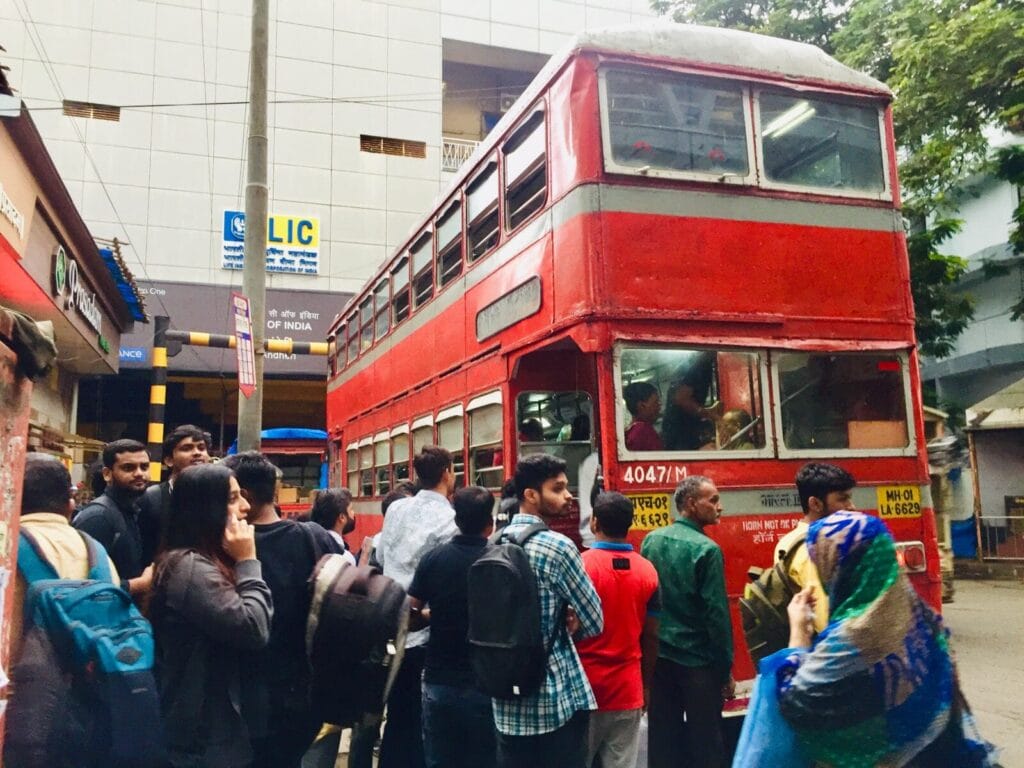
What would be the alternative mode of public transport that could best serve the demands of the huge number of commuters? BEST buses. Yet, nearly two-thirds of the fleet has been depleted over the past decade. To deflect public outrage, wet-lease buses were introduced, but the average wait time is around 20 minutes on most routes. Today, like the suburban railway, BEST seems to be testing Darwin’s theory—only the fit can squeeze into or hang out of dangerously overcrowded buses.
The lack of dedicated lanes, insufficient air-conditioned buses, and an overall shortage have made commuting a daily ordeal, with women facing harassment in packed conditions. It is apparent that bus travel has been deliberately degraded to justify declaring BEST a loss-making entity, paving the way for depot lands to be handed over to real estate interests. Even Metro 3’s app excludes integration with BEST while aligning smoothly with private operators, laying bare the real agenda.
Doesn’t this insensitivity and harassment of its citizens matter to the powers that rule us? How does the government plan to cope with the backlash from daily commuters who continuously suffer?
Well, the grand lollipop (read, pacifier) is ready. Soon, the Mumbai Metro network will be complete. Roads will see less traffic, and deaths from train falls will stop.
Mumbai Metro: Unclear rationale
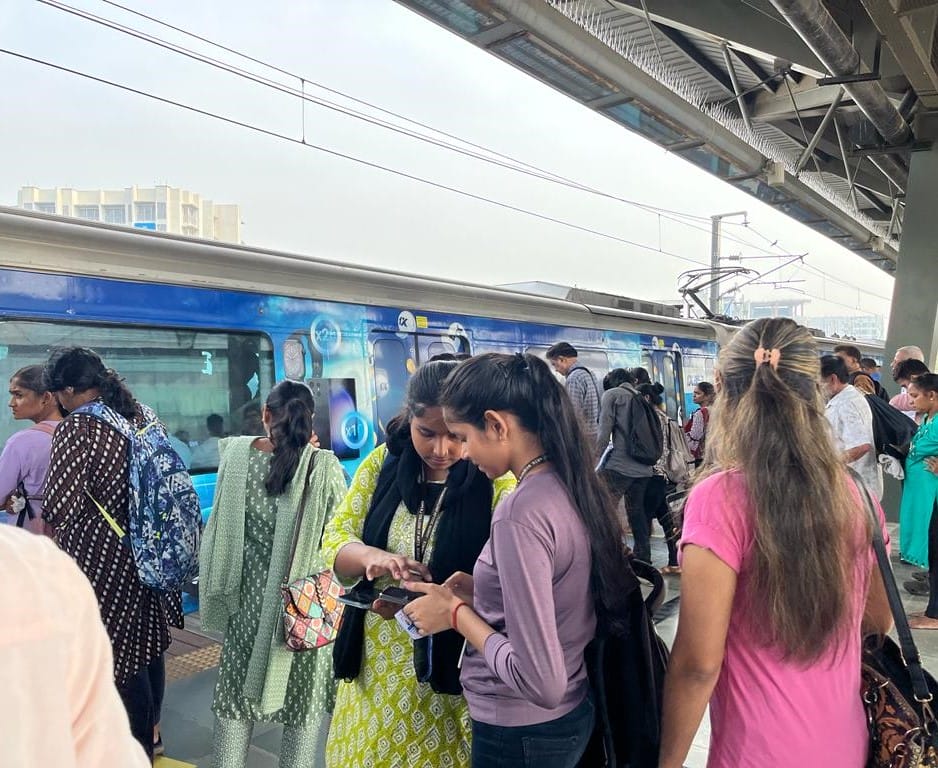
Mumbai is currently linked by a metro network that is envisioned to connect all parts of the city. Sounds great on paper. The city needs a facelift, and this will place it on par with other global cities, which have metros. Three metro lines are already operational: Metro 1, Metro 4 and Metro 3. While empty roads and less crowded trains on all three routes remain a pipe dream, let us accept, for the sake of brevity, that it is good for the city.
Read more: BEST fare increase: A necessary step to revive Mumbai’s lifeline
Metro 6, meant to link Jogeshwari to Vikhroli, seems to be taking longer than Shahjahan took to build the Taj Mahal. As the wait for it seems to be getting longer, comes the latest entrant. Another metro line project! This one is christened the Metro 11, the Wadala-Gateway line. The Mumbai Metro Rail Corporation Limited (MMRCL) held a public hearing on August 25th, inviting citizens to voice their objections and suggestions regarding the project — perhaps a lesson from the Aarey metro car shed controversy, where MMRCL claimed there were no objections during a 2012 public hearing.
I attended the Metro 11 hearing, expecting at least a few hundred attendees in a city of over two crore people. To my shock, only eight people had registered at the desk, and just 12 attended the final hearing. Clearly, Mumbai has better things to do than scrutinise a ₹23,000 crore public project, one that will likely cross well over ₹40,000 crore.
Who will benefit from Metro 11?
Metro 11 mirrors the Metro 3 model in that it is completely underground. When one studies the route as presented on the occasion, a question comes to mind immediately: for whom is this Metro being made? All along, the proposed route from Wadala-Anik to the Gateway of India in Colaba, the route passes below dense clusters of slums and empty spaces. The petroleum storage on one side and the Mazgaon Docks on the other make it practically impossible to generate a significant base of consumers who will use this line.
The project proponent used a Google Earth satellite image to explain the route. Most of them were near the slum clusters, and the presenter repeated that these areas at all these locations “will be developed later on.” This raises a basic question: when there are areas that are crying out for connectivity and being ignored, how does this project help them and others who really need it badly?
This becomes just another venture that authorities with a track record of incomplete projects and unfulfilled conditions have started anew. The harbour line railway network is well-served and has withstood the test of time, and the trains on the route from Wadala to CST are never crowded. In such a scenario, why is this project being brought in?
It would be interesting to explore and understand who the stakeholders are in these slum-saturated land parcels. Which big players are entering the eastern waterfront? There is definitely more to this than meets the eye.
Environmental impact
When questioned about the number of trees that will be slaughtered for the project, the number was an astonishing 2,300 trees. All this for an underground metro! The promise of planting new trees at or near the same locations rings hollow, especially as Metro 3 has still not kept its word on replacing the trees that were destroyed for the project.
One also has to question where they will plant new trees. It is officially accepted that there is no space to plant trees in Mumbai, as most open spaces have been taken over by construction. They could perhaps plant them at Aarey, or Sanjay Gandhi National Park or any remote place, but would that really help the microclimate of the harbour line area? Is it that easy for a resident of Anik, Sewri, to just walk 15–20 km away across to Aarey and relax in the cool shade?
At the consultation, MMRCL sheepishly issued pleas to people to find space to replace or plant trees destroyed by the project, since they have been caught trying to escape accountability.
Read more: Saving Aarey: An environmentalist’s learnings from a Mumbai movement
Not just trees
But trees aren’t the only issue here. An estimated two lakh tonnes or more of mud will be excavated. In the case of the Metro 3 line, the same project proponents had announced in the DPR that they would transport the excavated mud by sea route to far-off locations where reclamation was needed. This apparently was being done to avoid pollution from the movement of dumpers carrying mud inside the city.
In reality, we saw nothing of that. All the excavated mud was disposed of at multiple locations, and at times in brazen violation of the law, on lands that forbade reclamation. As this concern was raised at the Metro 11 consultation, the Environment Director reassured citizens that only areas which were not ecologically sensitive would be used for dumping the mud. That is, areas falling in the Coastal Regulation Zone (CRZ), wetlands, forests, etc, would be excluded. Experience makes it difficult for us to trust that, but let us take that in good faith for now.
Now comes the interesting part, the super important Metro Depot.
A disaster in the making?
The Metro 11 depot is planned at the existing BEST depot. Is this yet another move to take over BEST land? Has BEST agreed? MMRCL officials claim the existing depot won’t be touched and there’s no plan to evict BEST. This means either the Metro car shed will be elevated, or the BEST depot will.
Metro authorities have said that an area of 16 ha would be sufficient for the depot. Considering that the same company had usurped 67 ha of land inside Aarey forests and maintained that it was the bare minimum needed, the present claim needs to be taken with a mountain of salt. Soon, a Metro Bhavan, a command centre, and commercial office buildings, all of which are much needed for the Metro operations, will be planned. And then, the real target could be the vast expanses of mangrove lands next to the proposed depot site.
These low-lying marshes and salt lands have kept the western side of Wadala free from flooding so far. Once these areas are built over, the lost flood holding areas in the east will soon cause floods and misery. So, this is a disaster that will unfold in the future.
Points of contention
The fact that BEST is being gradually throttled to death, its lands taken over, and commuters made to wait endlessly to board overcrowded buses, is not even getting any attention. Even a measly ₹1,000 crore investment from Asia’s richest corporation can provide immediate relief to the suffering masses. Instead, over ₹150,000 crores are being pumped into what is supposed to be a game-changer for Mumbai, though it remains unclear how.
The mono rail misadventure is something that cannot be pushed under the carpet. It was supposed to decongest roads and provide speedy transport on a route that went from nowhere to nowhere, incurring an annual loss of ₹500 crores in the process. Metro 11 seems to be headed in the same direction.
To justify an ill-conceived transportation project, big real estate players will be needed to develop the barren, low-lying areas of Wadala, Anik, Sewri, etc. In that sense, it’s a game-changer for real estate sharks—without this line, investors would have little incentive to fund projects in the area.
The promise of improved public transport serves as a convenient ruse to deflect scrutiny over colossal spending. Yet, how are authorities getting away with branding land development schemes as transportation infrastructure projects? Judging by the poor turnout at the public consultation, one can only, sadly, thank Mumbai’s “Chalta hai, Kya kar sakte hai” attitude for that.
Just pathetic, there is no bounds to how low the governance in this city can sink. No empathy for live, no dignity for citizens.