“Voice of Freedom.” That is how Kajal Singh describes her relationship with graffiti art. The 24-year-old from Delhi who goes by the name Dizy is currently in Berlin and has built for herself an international reputation as a woman graffiti artist. She was first introduced to the art through the Hip-hop culture which embodies graffiti as one of its elements. “Being a shy person, graffiti became my voice of expression,” said Dizy. “It also allowed me to go beyond the stereotypes set for women in society”.
With its origins in the early 1960s in Philadelphia, graffiti art began when writers Cornbread and Cool Earl started writing their names on public walls to communicate and gain attention. It soon moved to New York and by the late 1960s with subway, trains, toilets and other public areas being coloured in different forms and designs using spray paints. In the 1980s, it finally gained recognition as an artform and entered the art galleries of New York.
In India, the art form is still evolving. Though it’s not new to our culture, modern graffiti art came to prominence after the famous Artist Daku ‘F***’ spray painted nine buildings overnight in Mumbai in 2001 to protest against ACP Vasant Dhoble cracking down on bars and pubs across Mumbai. Since then, there has been no stopping the movement.
But for women artists, graffiti is altogether a different ball game. Unlike the safety of studios, graffiti involves scaling tall buildings and working secretly at night with the risk of getting caught by the cops. Nevertheless, using graffiti as a tool of protest, female graffiti artists in India are breaking stereotypes. Artists like Jas Charanjiva, Kajal Singh, Jheel Goradia and Avantika Mathur have painted many of Mumbai’s walls, leaving their mark in what was a boy’s club.
Kajal Singh, who likes to be known as India’s first female graffiti artist, retraces her journey where she had to face gender bias. “I got introduced to hip-hop culture in Class 9 and decided to take it up seriously,” recalled Kajal. “Hip-hop culture also includes graffiti writing. I was smitten and excited and decided to become a Graffiti artist. I hadn’t seen a girl doing graffiti in India, so it was a challenge. There is always someone who goes against the norms. There were always prejudices. Being a girl always meant feeling the pressure of doing well all the time and proving why I was better than the boys.”
Other female artists like Jas Charanjiva, co-founder of KultureShop, do not hold back what’s on their mind. After the Nirbhaya incident, Jas painted a graffiti of Indian women in pink with BOOM written on the knuckles. Pictures of the graffiti went viral. “It’s because women could relate to it,” said Jas. “It’s important to me that my art always relays a message. It’s like holding up a mirror to society — I paint about issues that I am passionate about. You’ll notice that most of my art has something to do with women’s’ empowerment, equality or even just being kind and considerate to people.”
First female only festival
To nurture and encourage women artists, in March 2019, Mumbai had its first female-only street art festival “Ladies First”. The week-long festival, organised by Graffiti agency Wicked Broz in collaboration with Military Road Residents Welfare Association (MRRWA), included many female artists who had painted buildings and walls covering a 1,000 sq feet area. The idea behind the festival was to make the art scene more inclusive by increasing female participation and enabling them to express any idea through their art.
“If people see more women painting on the street and their artworks, more female artists and illustrators who are out there will get the confidence and desire to come out on the street,” said Zain, co-founder of Wicked Broz. “Art is still a male-dominated sector and organising an all-women art festival empowers women in a nice way,” said Avantika Mathur, a 30-year-old graffiti artist from Navi Mumbai. “I believe every woman empowers every other woman. So at the festival, we all come together, talked about something for the society and I think this is a really good initiative for artists, who are from all over the country.” The festival is planned around International Women’s Day this year too.
Surprisingly, unlike in other countries, India has been welcoming to this emerging art form. In many cities, it is illegal to spray paint on walls. But, in India, artists can get permission from building owners who are happy to have their walls and neighbourhood beautified. “People like to have beautiful coloured walls and they allow us to do it,” said Jas. “At times, they have volunteered to help me. Once I was painting at night with my girls in Hyderabad. The police came by and instead of snapping at us, they asked us to be safe and paint at a more prominent place.”
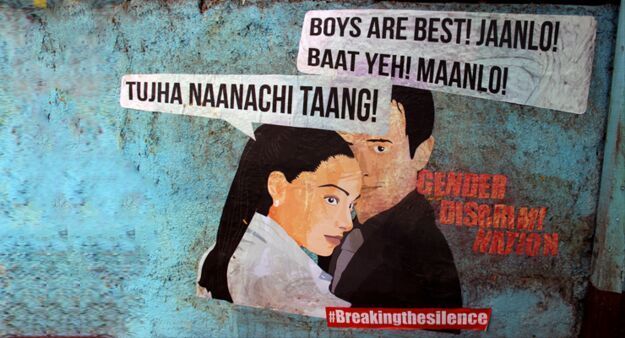
Graffiti by Jheel Goradia in Mumbai (IMG SOURCE:Dextra)
However, graffiti isn’t easy. Scaling buildings, working long nights, financial insecurity and above all safety remains a big concern for female artists. “If I am working at night, I always have someone with me and keep Pepper spray handy with me,” added Jas. “I don’t feel safe working alone at nights and I only go to the neighbourhood I know. But males have no such issues”.
Despite these hurdles, the future seems promising for women graffiti artists. As Neha Singh, a research scholar from Aligarh Muslim University wrote in her paper ‘Graffiti: A new emerging art form on Indian streets’,
“Graffiti is becoming a profession, more and more young artists are learning this art form and decorating the walls of their city. People are also encouraging them by hiring these artists for their home and business establishments. The walls of India could perhaps soon become a reflection of our time. There is an unleashing of creative art and thought, and it is also becoming trendy. It still needs a lot of encouragement, appreciation and respect as an art form. But there is growing passion, talent, and space, all the elements for a bright future for this art form in India.”