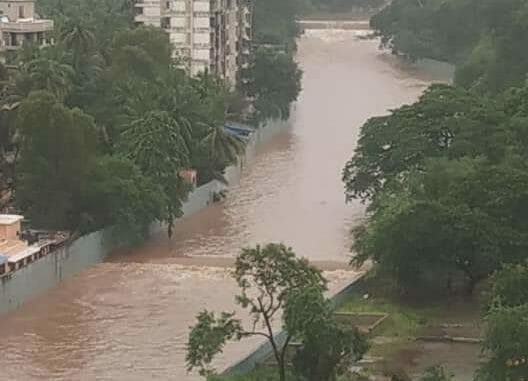
On 18 July, Renita D’Souza and her family woke up with neck deep water in their house at Hanuman Nagar slum along the storm water drains. They found themselves surrounded by houses laced with dirt. “Our house was full of muck and we had to wade through a foot-deep grime throughout the day and there was no water to either drink or clean up,” she said.
The electricity supply to their house was disconnected as a precautionary measure. The entire neighbourhood could not light gas stoves. “We had to ask our children to buy vada pav because we couldn’t even start the gas or make tea at home,” she said.
Living beside a naala means fear of flooding every monsoon. Though the height of the wall along the naala was increased recently, it failed to reduce flooding in her house.
Heavy flooding has now created new problems for the city in unfamiliar ways. Suddenly, many parts of Mumbai found their water supply disrupted. Earlier this week, while Mumbaikars were wading through flooded roads, they were struggling to receive drinking water in their homes.
The 18 July flooding disrupted water supply in almost 65% of the city due to flooding within the Bhandup Water Purification Complex, the largest water treatment plant in Asia with a cumulative water filtration capacity of 2810 million litres per day.
The ingress of water into the Bhandup complex forced the Brihanmumbai Municipal Corporation (BMC) to shut down operations in its water filtration plants and forced it to clean up on a war footing.
The BMC now plans to erect a flood prevention wall around the Bhandup complex to prevent ingress of water from the adjoining Sanjay Gandhi National Park (SGNP) and to strengthen its drainage capacity. It is also planning to ask the SGNP to develop a naala to divert the water flowing towards Bhandup complex into the Tulsi Lake instead.
In the early hours on 18 July, citizens residing at the Hanuman Nagar slums at Kandivli (E) lining the Poisar river channel could not sleep throughout the night due to sudden heavy showers.
Read more: A leak here, a leak there. No way to quantify water wastage in Mumbai
Climate change
Climate Change leading to heavier rainfalls is a huge part of the problem. The BMC recorded over 200 mm of rainfall due to five hours of uninterrupted heavy downpour between 11 pm to 4 am on July 17-18.
Families like D’Souza’s increasingly find themselves at the receiving end of climate change brought about by increasing urbanisation, lack of critical hydrological planning in the city and failure to implement the recommendations of the 2014 Chitale Committee report.
The report had recommended restoration and rejuvenation of the urban ecosystems like creeks, ponds, rivers, lakes and coastal zones to prevent flooding.
The D’Souzas lost a good portion of their ration stocks in the rains and Renita worried about stocking up again due to an Orange alert in the city for three days from July 19-22.
Reasons for flooding
Environmentalists accused flawed hydrological policies as responsible for the flooding.
Amrita Bhatacharjee of the Aarey Conservation Group said concretisation of floodplains and catchment areas along with building of the walls lining rivers like Mithi, Poisar and Oshiwara that originates from the Aarey forest, are responsible for the recent excessive floodings witnessed in the city. “When catchment areas are concretised, rain water does not get absorbed by the land and hence a larger volume of water enters the rivers causing floods,” she said.
Apart from concretisation of rivers and their tributaries, Gopal Jhaveri of River March, said BMC’s inability to implement available technological solutions, ignoring orders of the National Green Tribunal (NGT) and recommendations of the Chitale Committee Report is leading to “myopic contractor-driven big-ticket policies”.
He blames the flooding in and around the Sanjay Gandhi National Park to the concretisation of the floodplains around the Dahisar river.
The large-scale reclamation on the Arabian Sea to build the Coastal Road is also said to be a cause for heavy flooding in the Southern part of the city that had largely been quite insular from floodings earlier.