Is Metro realignment the only alternative?

Even as the Metro Phase-II is hitting the headlines for the realignment issue raised by the Jayadeva Hospital, citizens have started questioning the process. Here’s Citizen Action Forum’s N Mukunda’s take on this.

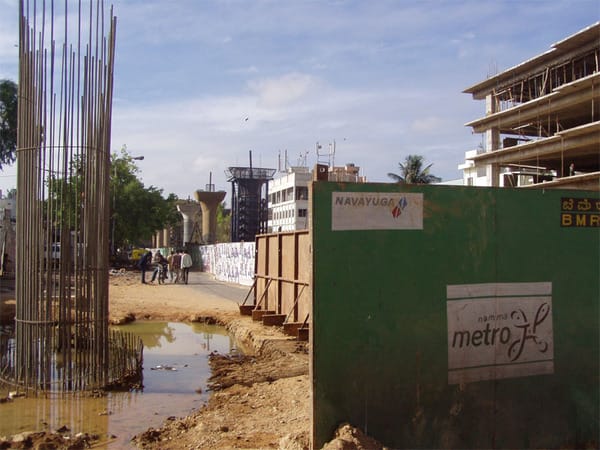
Metro Phase-I has not completed, but the plans for Phase-II have already begun. File Pic.

The new alignment near Jayadeva Hospital has caused panic among residents that many residential properties and commercial buildings on Bannerghatta Road would be demolished.

Here are some thoughts on this.

  1. Why public consultation with residents, experts,users ,metro officials and elected representatives is not being held on pros and cons, alternative routes etc, like the public consultation held by Additional Chief Secretary regarding Signal-free corridor of Koramangala? The project was scrapped unanimously by all stakeholders on direction of the High Court, based on the PIL filed by Citizen Action Forum and other Resident’s Welfare Associations.
  2. While the Metro is passing via Vani Vilas hospital and Bangalore Hospital, R V Road where similar surgeries are conducted, how the vibration will affect the patients in only Jayadeva?
  3. Instead of demolishing many other buildings by realigning the path, why Jayadeva can’t be shifted to Jayanagar General Hospital premises by constructing additional floors or build it on Jayanagar 4th T block bus depot?
  4. Alternatively multilocational Jayadeva Hospitals can be constructed across Bangalore.
  5. It is more easy to demolish a residential or private building rather than a government-owned building
  6. When Phase-I Metro is not completed in R V Road, why should the government think of Phase-II?
  7. Why underground metro or monorail or running of more BMTC buses cannot be considered instead of demolishing properties?
  8. A committee of residents, Metro, Jayadeva, elected representatives and experts should be constituted to look for practical alternative.

Comments:

  1. Vasanth Ramu says:

    Dedicated Bus Lanes and Commuter Rail is an alternative to Metro, whereas people are not ready for the Dedicated Bus Lanes to sacrifice a lane, nor want to travel in unattractive IR trains.

    People do not support once such idea is proposed rather only when their properties are going away alternative ideas come to their mind.

Leave a Reply

Your email address will not be published. Required fields are marked *

Similar Story

Civil society groups push for cleaner, safer and accessible transport in TN cities

The Tamil Nadu Urban Mobility Charter 2031 urges more buses, EV adoption, and safer streets to make cities equitable and people-first.

A collective of active citizens, non-governmental organisations, sustainable transport experts, and other stakeholders has called for strengthening the public transport network in Tamil Nadu's cities, making it accessible to all and creating low-emission zones across urban centres. The Sustainable Mobility Network (SMN), a coalition of over 30 civil society organisations across India, has released the 'Tamil Nadu Urban Mobility Charter 2031', a comprehensive roadmap urging political parties and governments to put sustainable mobility at the heart of the state’s development agenda. The Charter was shaped through a multi-stakeholder roundtable convened by ITDP India, Citizen consumer and civic Action Group (CAG),…

Similar Story

Freebies or freedom? What bus subsidies do for Indian women

Free bus travel for women in Indian cities cuts transport costs by 50 per cent and boosts jobs. Watch this interview to know more.

Across Indian cities, women depend heavily on buses to get to work, school, healthcare, and to manage everyday caregiving. In recent years, several states have introduced women-specific bus fare subsidy schemes. Delhi, Karnataka and Tamil Nadu offer completely free rides for women in state-run buses, while Maharashtra offers 50% subsidy. Read more: Who benefits from the free bus for women scheme? These schemes have been both vilified as 'freebies' or touted as transformative solutions for women’s mobility. But do these schemes actually work? In 2025, the Sustainable Mobility Network commissioned a study to answer this very question. Beyond Free Rides…