43-year-old Saridha from Hongasandra works as housekeeping staff at an apartment complex in HSR Layout, an affluent area in southern Bengaluru. There was a time when her work commute meant a one-hour, 3-km walk from her house to the apartment. And then the same way back after a tiring day’s work. Till she came to know of the HSR Feeder bus.
Now, she can take a BMTC bus from her place to Bommanahalli. It’s a short 400 metres from there to the Mangammanpalya stop, where she takes the feeder bus, which drops her off right next to where she works. Saridha still spends the same one hour in commute, but it is a much more comfortable and smooth journey.
“It used to be so tiring to walk after the entire day of work at the apartment,” she says, “the walking distance has reduced significantly, which is such a great relief.” The wait time is not more than 15 minutes either. “I use the Namma BMTC app to track the bus and the commute is now seamless,” she adds.
Arunakshi, a 24-year-old working professional used to spend ₹100 every day on auto, traveling approximately 2.5 km from Mangammanpalya to Parangipalya for work. Now she travels for free in the feeder bus. Saridha and Arunakshi are only two among 6000 odd passengers for whom the HSR Feeder bus has transformed daily travel.
Third time lucky
HSR Layout is a well-planned BDA layout, developed in the 1980s with a structured grid of roads and designated residential and commercial zones. However, last-mile connectivity was always a gap and in 2015, the Bengaluru Metro Transport Corporation sought to fix this by introducing a feeder bus service. Instead of long, city-wide travel, a feeder service connects neighbourhoods like HSR to major transit corridors and hubs. This makes public transport easier to access for daily commuters.
However when introduced in 2015, the routes did not connect all major points and publicity was poor. Despite initial optimism, the service failed to generate anticipated revenue and ridership. The service was abandoned as BMTC found it unfeasible.
Again, the service was restarted with expanded routes in 2020. However it was discontinued again, due to financial sustainability issues.
“Earlier buses were very infrequent. People had to wait for more than an hour sometimes. Eventually those services stopped, so residents completely lost faith in them,” says Jayanthi Srikanth, a resident and member of the volunteer group, HSR Citizen Forum.
But all that is a story of the past now, thanks to citizen participation. Their involvement has not only brought back the service to HSR Layout, but has turned it into a success story worth emulating.
Read more: How OMR residents strive for better last-mile connectivity and improved public transport
From scratch again
The public transport challenge for residents of HSR Layout was very similar to what is seen in many Bengaluru neighbourhoods, where accessing major transit points connecting them to other parts of the city is difficult without private vehicles. Here, for example, areas on the periphery like Hosapalya or Somasundarpalya lack public transport connections. To take buses to other parts of the city, or the airport bus, one has to travel a minimum distance of around 2 km to the HSR-KEB junction.
The feeder bus has now fixed this gap. It allows residents to access public transport easily, reducing the use of private vehicles. Not just that, as Lalithamba B V, a resident and member of the volunteer group Citizen Task Force says, “The area has a lot of start-ups, schools and other commercial hubs. Many students and office-goers are now using the feeder bus service to move around within the Layout, reducing private vehicle usage in the area.” But how did it all come about?
In October 2020, the Directorate of Urban Land Transport (DULT) invited communities and NGOs to participate in a programme called the Sustainable Mobility Accords (SUMA). The idea was simple: local communities understand their neighbourhood mobility needs better than anyone else. If citizens proposed workable ideas, the government would help pilot them.
The HSR Citizen Forum, along with the HSR Cyclists Group, applied to the programme. “The idea was to pilot a last-mile connectivity solution within our neighbourhood first, treat it as a prototype, study how it works on the ground, and then scale it up if it proves effective,” Jayanthi says.
Their application was not simple. It required detailed documentation of their past work and testimonials from more than 100 residents about the group’s contributions to the community. After multiple rounds of screening and interviews, the HSR group was selected along with seven other communities across Bengaluru.
HSR Citizen Forum and HSR Cyclists group mobilised citizens through RWA discussions and an already existing strong WhatsApp group network and started brainstorming on the solution they could take to DULT.
Data is key
Initially, the citizens did not focus only on buses. They proposed several ideas to improve mobility. But before finalising anything, they needed data.
Volunteers from the citizen forum conducted a detailed household mobility survey. It covered 323 households and 1028 individuals. Each participant shared information about their daily travel, where they went, when they travelled, how long it took, how much they spent, and the modes of transport they used.
“Without data, you cannot just say a bus service will work. We wanted to know how people actually travel in the layout, when they leave home, where they go, how much they spend and what challenges they face,” says Jayanthi.
The survey also asked residents about their priorities for improving mobility in HSR Layout. The results were clear. Nearly 96% of respondents wanted better public transport.
To complement the survey, the group conducted focus group discussions with different communities including women, students, senior citizens, low-income workers, people with disabilities, and people who commute to HSR for work. These discussions highlighted several issues.
The data confirmed what many residents already felt: HSR Layout lacked reliable public transport within the neighbourhood.
Prioritising the most wanted service
Based on the findings, the forum shortlisted five mobility proposals. These included safer intersections, traffic calming measures, a pedestrian-friendly street, a disability-friendly road near Samarthanam, and a bus service within the layout. The proposals were displayed in a public consultation exhibition over two weekends, in a park in HSR Layout. Residents visited the venue and voted for their priority projects.
“HSR already has a very active network of WhatsApp groups, street-wise and sector-wise, which helped us spread the word quickly,” Jayanthi says. What stood out was the level of trust residents placed in the forum. “People took it seriously because of the work we had done earlier. They showed up, engaged, and voted for their top priorities — and once again, public transport clearly emerged as the winner.”
After this, DULT began working with the Bangalore Metropolitan Transport Corporation (BMTC) to test the idea.
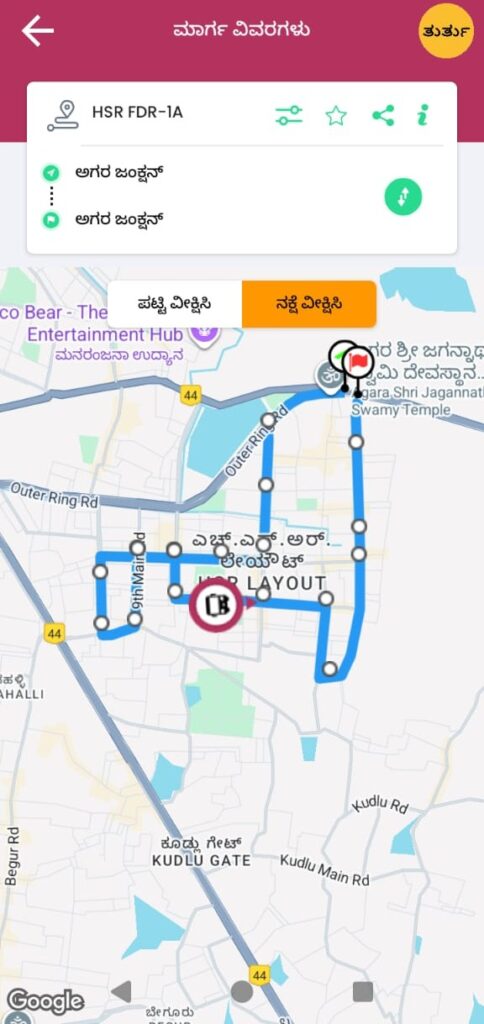
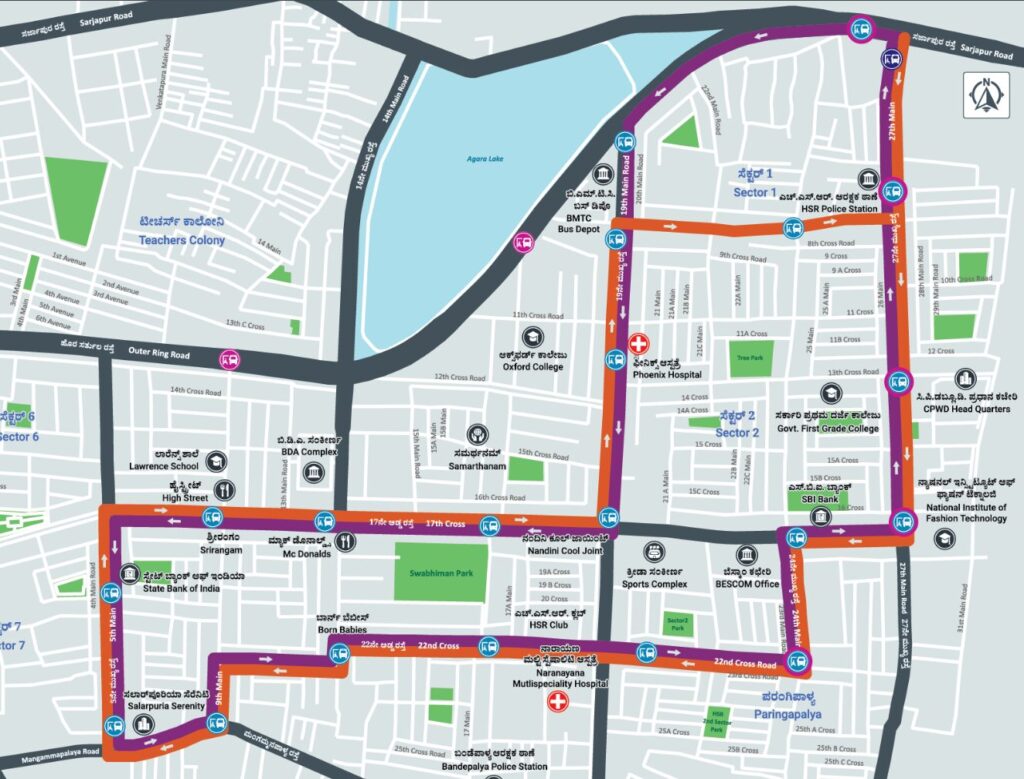
The route planning process involved several constraints. Roads had to be wide enough for buses; stops needed to be accessible within walking distance. Eventually, planners identified an eight-kilometre loop inside HSR Layout.
The proposal recommended 10 mini buses, five running clockwise and five anticlockwise, with a 10-minute frequency during peak hours. However, BMTC approved 8 buses.
The service was launched on August 1, 2023.
Ensuring better usage
Resuming the bus service was only half the work. The bigger challenge was making sure people used them. “A bus service cannot succeed only because you have the buses running. The community has to actively promote it, use it and help people understand why they should use it,” Jayanthi points out.
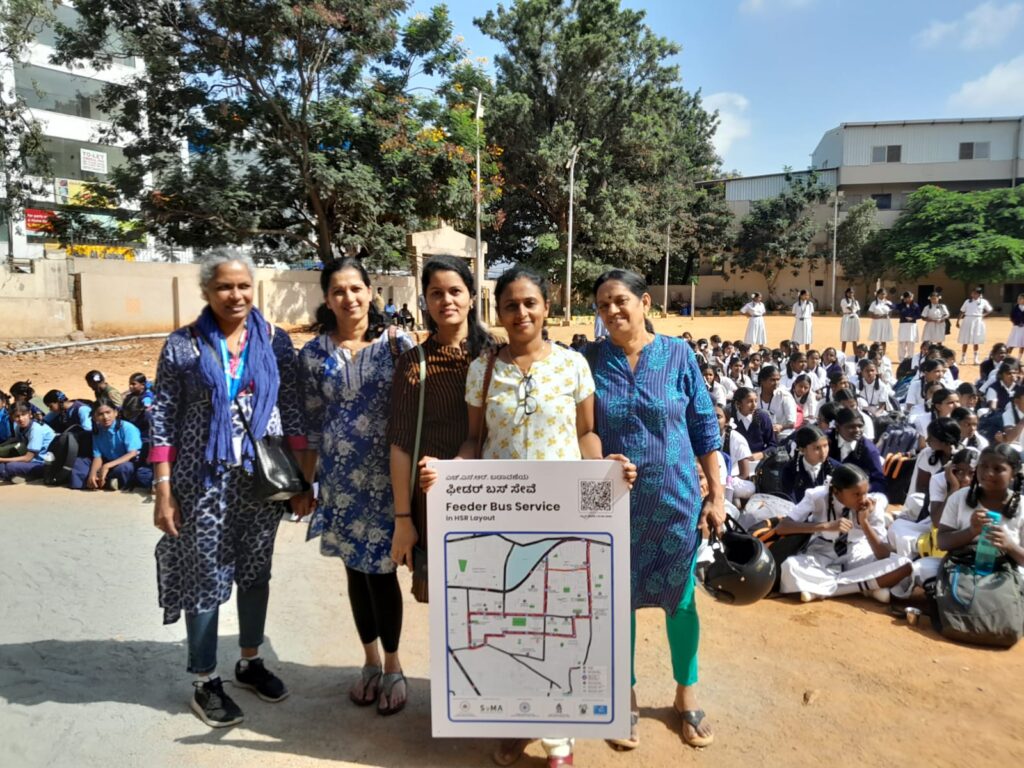
For the first 100 days, the HSR Citizen Forum ran an intense awareness campaign. Information about the service was played through BBMP waste collection autos, reaching residents street by street. Volunteers visited schools, colleges, temples and public events to explain the service. Posters and social media posts spread the message further. Even local businesses helped display route information. The effort worked.
When the feeder service started, only about 300 passengers used the buses daily. Today, the number has grown to over 6,000 passengers a day. “This shows that the need was always there,” says Jayanthi, “During peak hours, the buses are often full. Riders include students, domestic workers, senior citizens, and employees working in nearby tech offices.”
The service became an affordable option for intra layout travel. With fares as low as ₹10, residents can travel across the layout without depending on autos or private vehicles. Women travel free because of the Shakti Yojana scheme.
The model has also received national recognition. The project was awarded by the Ministry of Housing and Urban Affairs for community engagement in public transport planning. BMTC received the Award of Excellence in Urban Transport under the category ‘City with Best Record of Public Involvement in Transport’.
“Without the support of citizens this wouldn’t have been possible,” says Prabhakar Reddy, CTMO of BMTC. In the initial days, BMTC used to earn ₹7 to ₹10 per kilometre, while the cost was ₹70. “DULT supported us by providing viability gap funding for a year and a half,” Prabhakar tells us, “In a year of starting the service we were able to stabilise. With this kind of support we may be able to replicate such services elsewhere as well.”
Read more: Cities for women: This Women’s Day, let’s look beyond the numbers
Expanding the service
As the initial routes picked up, residents in the surrounding localities like Hosapalaya and Somasundarapalya felt the need for expanding the reach. These areas had poor last mile connectivity and the closest bus stop, the NIFT bus stop, was more than two kilometres away. “Many people ended up using autos or personal vehicles because of this last-mile gap,” says Lalithamba. So, citizens requested BMTC to extend the HSR Feeder Bus Service to HSR-KEB junction.
An additional route of 1.1 kilometre was added and the service expanded in July 2025 to provide the missing last-mile connectivity for people in the farther areas. But there was again a need to spread awareness about this expansion. “We put up posters at key landmarks about the feeder bus service, educated people on the importance of public transport, and engaged with students, RWAs, and corporate employees to promote its use,” says Lalithamba.
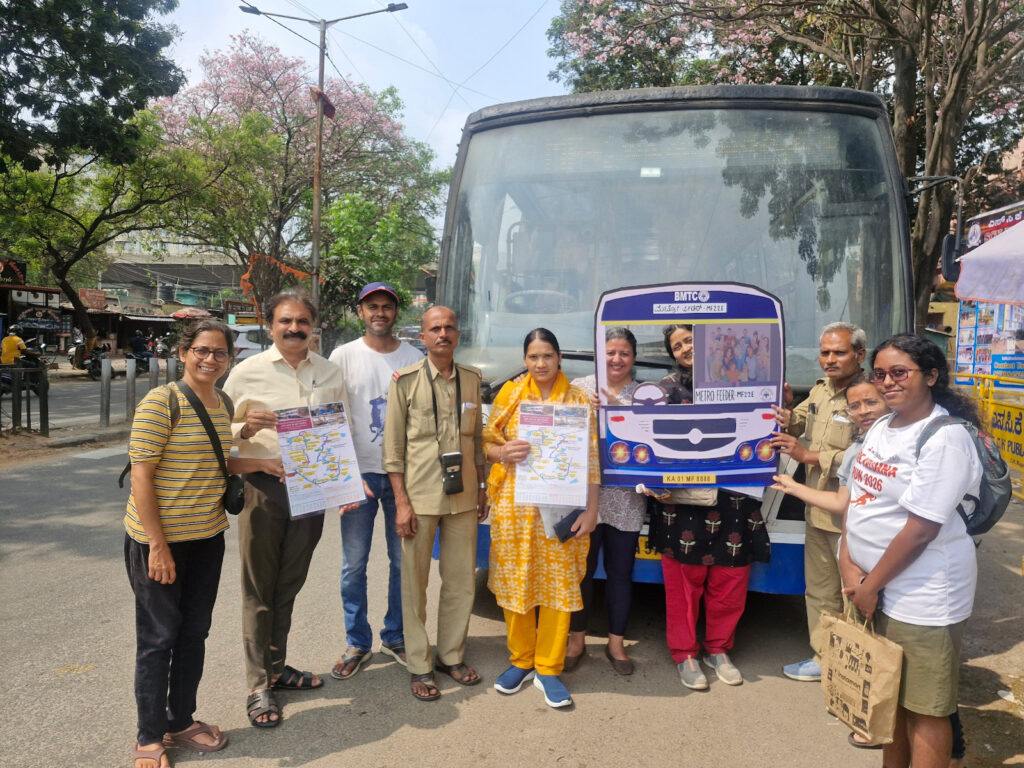
An idea for the future? Metro Feeder bus takes off
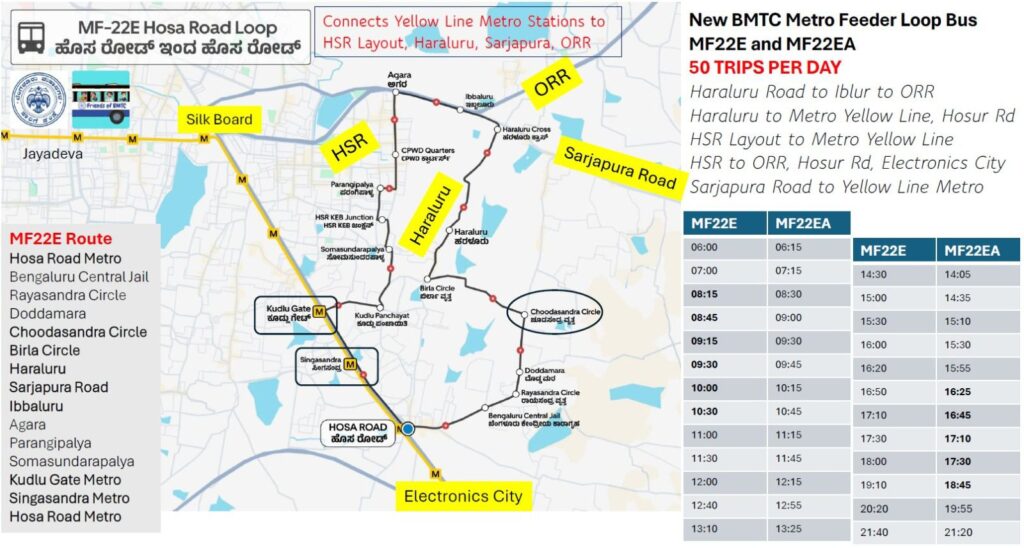
In August 2025, the yellow line of Namma Metro was also operationalised. Metro stations like Kudlu Gate, Singasandra and Hosa road run closer to areas including HSR Layout, Haraluru, Ibbaluru, Sarjapura, etc. There was a demand from many for a metro feeder bus which would help people from these areas reach the nearest Metro stations easily. Along with BMTC, Lalithamba and other citizens participated in the route survey to understand and analyse the need.
On March 9th, 2026, citizens welcomed new metro feeder buses, connecting yellow line metro stations to HSR Layout, Haraluru, Sarjapura and ORR. Through sustained efforts of citizens, the metro feeder bus is now running. “But we still have work to do,” says Lalithamba. She is now working on spreading awareness and promoting the metro feeder bus service.
“This metro feeder bus service will be more useful once the blue line metro becomes operational,” Prabhakar points out.
In HSR Layout, what failed twice as a top-down plan succeeded when citizens took the lead. For the HSR Citizen Forum, the lesson is clear. Public transport projects cannot succeed unless planned with a real ground-level understanding of local travel patterns. In HSR Layout, citizens helped collect data, design the solution, and promote its use. Their involvement did not just start the service. It helped make it work.
“Scaling up of intra-layout bus services is possible in bigger BDA developed layouts,” says Prabhakar. “If citizens and residents welfare associations come forward and if agencies like DULT support us, we will initiate such services in other areas as well.”