Have you ever organised a party, and discovered that you have a lot of extra food at the end of it? And did you hate seeing that food go to waste?
There are organisations in Bengaluru that collect excess food or dry rations, and redistribute it to those in need. Some of these organisations are purely run by volunteer efforts. If you want to donate food or volunteer for the cause, here are some organisations that may interest you.
The Robin Hood Army (RHA) collects excess food from restaurants, parties and other events, and redistributes it. Founded in Delhi in 2014, the RHA now has chapters in over 50 Indian cities, including Bengaluru. Across the world, they have over 140 chapters. Its volunteers, sporting green T-shirts, are called ‘Robins’.
G Nagaraj, known as Bengaluru’s plogman, has been volunteering with RHA for the past year and half. Plogging is the practice of picking up trash while jogging. Nagaraj says he came to know of RHA when he first saw Robins in their green T-shirts. “One day, as I was travelling, I saw some people wearing green, distributing food in slums. I was keen to do environment-related work such as tree plantation and plogging. And I saw RHA as a platform bridging the gap between excess and shortage,” he says.
Arunkumar Bojan was one of the early volunteers at the Bengaluru RHA chapter. He joined the organisation after watching a news report about it on TV in 2014, just a couple of months after the Bengaluru chapter had taken off. Bojan was able to complete his first drive in February 2015. A drive comprises picking up food from a location, transporting it to a slum, and distributing it to the residents there.
Bojan says RHA collects enough food to serve an average of 5000 people a week – a number that could be much higher had there been more volunteers. According to both Bojan and Nagaraj, there is so much excess food in the city that RHA is not able to collect it all. “We need a huge number of volunteers; we get so many alerts. Majority of our volunteers are full-time employees, and some are students,” Nagaraj explained.
The organisation also has an academy associated with it – the ‘Robin Hood Academy’ – that aims to make education more accessible to children in slums. What started as volunteers spending quality time with the children they delivered food to – spontaneously playing games with them and celebrating birthdays – eventually turned into an initiative to teach them, says Bojan.
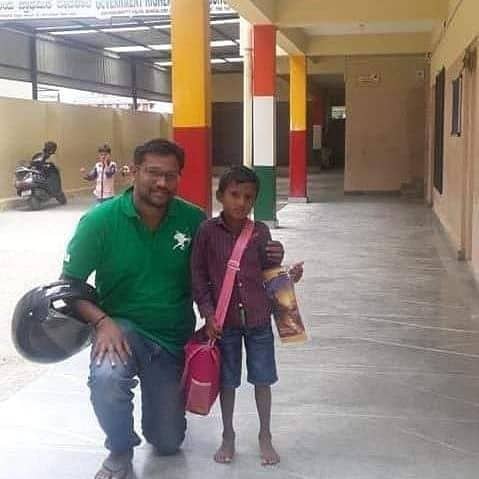
A child who was supported by Robin Hood Academy to enrol in school. Pic: RHA Instagram page
“Many of these little kids were school dropouts. We wanted to bridge the gap between kids and schools, to make kids feel comfortable with learning, so that they can go back to school,” he said. The academy equips children with primary level education, and also helps with the paperwork required for them to go back to school.
“Obviously, a hungry child cannot read. We try to connect with them over food, and then try to take it to the next level,” Nagaraj adds.
Another international hunger-relief organisation active in Bengaluru is Rise Against Hunger, formerly known as Stop Hunger Now. Unlike the RHA, Rise Against Hunger does not collect excess food. Instead, its volunteers package nutritious but inexpensive meals for the hungry. The NGO was established in the US in 1998, and took off in Bengaluru in March 2015.
Its teams of volunteers typically host ‘meal packaging events’. At the event, the volunteers raise the money needed to fund a specific number of meals, and then pack the meals themselves following an assembly line system. Each meal is priced at Rs 21. So, for example, if your volunteer team wants to arrange meals for 100 people, your team would pay Rs 2100, and also pack the meals. The dehydrated meals can be stored for up to two years, and are donated to schools, orphanages, nurseries and medical clinics.
The meals are priced based on the economic complexities involved in transportation, cost of acquiring raw materials, and so on. The NGO has also delved into other areas of life-saving aid. After the 2015 Nepal earthquake, it had initiated a global campaign to package and send at least 1.2 million meals to the affected communities.
Here are organisations in Bengaluru that accept excess food, groceries or volunteer effort to feed the hungry. If you know of more of these, do let us know!
| Organisation | Who they are | What they accept | How to reach them |
| Robin Hood Army (RHA) | Volunteer network | Excess food | Email: info@robinhoodarmy.com
Contact via Facebook page |
| Rise Against Hunger | Volunteer network | Volunteering | Ph: 080 2542 6948 |
| Sumanahalli | Works with people with disabilities | Dry ration, groceries and toiletries. Find more information here | Ph: 94810 85727 |
| Missionaries for Charity | Cares for orphans and the aged | Food items like daal, rice, fresh fruits and vegetables | Ph: 080 25474993 |
| Shishu Mandir | Works with children | Groceries, vegetables and fruits | Ph: 93792 71391 |