With a surge in dog bite incidents across Chennai, the Greater Chennai Corporation (GCC) has intensified measures to ensure responsible pet ownership. The civic body has set November 23 as the deadline for all dog owners to get a pet licence, failing which, they will face a fine of ₹5,000 starting November 24.
Though mandatory pet licensing began in 2023, very few complied. Now, GCC is enforcing it more strictly, with penalties, to ensure public safety and improve the management of community and domestic dogs.
“We have survey data on pet dogs in Chennai from previous years, but no way to verify it. This initiative helps authenticate the details of pet dogs in Chennai through veterinarians, and the system has been designed to facilitate that process,” said M Niranjan Kumar, Project Manager at Exhilar Innovative Solutions Pvt. Ltd., a system integrator company that works with the GCC on pet licensing.
According to last year’s data, there are approximately 1,80,000 community dogs in Chennai. The GCC has procured around 200,000 microchips and is currently implanting them in about 600 community dogs every day.
To simplify the licensing process, the GCC has introduced an integrated digital platform that allows for the identification and end-to-end management of both community and pet dogs. The system comprises a dedicated online portal for public access and a mobile application exclusively designed for GCC staff.
Through this digital system, every registered pet will be traceable, enabling authorities to monitor vaccinations, prevent abandonment, and address community dog management more effectively.
Pet owners’ experiences reveal gaps in awareness
Despite the push for compliance, many pet owners remain unaware or confused about the process.
Aishwarya Lakshmi, a resident of Chromepet, says, “I came to know about the pet licence requirement only through recent news coverage. Six months ago, we tried applying by emailing the GCC, but we did not receive any response. I am still uncertain about how to proceed.”
Similarly, A Francis, President of the Federation of Thuraipakkam Residents Welfare Association, said he recently registered his dog but found the process unclear. “The portal shows my application as pending. I am not sure what steps to take next. I have vaccinated my dog with the Anti-Rabies Vaccine (ARV), but I’m not sure how to get the microchipping done. Some of my friends also experienced glitches while registering,” he explains.
“There is no glitch in the system. Since this is a new system, the old login credentials will not work,” clarified Niranjan.
All pet owners in Chennai are required to create a new account through the updated web portal. “Even if they already hold a pet licence, they must create a new account to register their pet details. This will enable them to renew the licence when it expires. However, when GCC officials conduct their survey from November 24th, pet owners who already possess a valid licence can present the existing one and will not be fined,” he notes.
“So far, roughly 8,500 people have registered their pets on the new portal. Veterinarians have completed the authentication process for several applicants, and about 400 pet owners have received their licences,” says Niranjan.
“We have instructed GCC staff to contact all registered pet owners to inform them of the next steps,” he adds.
Francis urged the GCC to issue clear guidelines for pet licence applicants to prevent penalties caused by procedural confusion. Although he opposes microchipping pets, he feels forced to do it as it is mandatory, and non-compliance attracts a fine.
Read more: Addressing pet dog attacks: A balance between regulation and compassion
How to apply for a pet licence
To assist pet owners in meeting the new mandate, here is a detailed guide to the registration and licensing process.
Step 1: Create an account
Visit the official Greater Chennai Corporation website and navigate to the ‘Online Services’ section, where you will find the Pet Animal Licence option.
Choose the ‘Pet Owner’ category (other categories include veterinary doctors and GCC officials). This will redirect you to the registration portal.

All user must sign up by entering their name, contact number, email address, and residential address.

An address proof document in PDF format, such as an Aadhaar card, rental agreement, or property tax receipt, must also be uploaded. The phone number is mandatory, as future communication will be made via SMS. Once these details are submitted, your account will be created.
Step 2: Register your pet’s details
After creating an account, log in and click on the ‘Add Pets’ option.

You will then be prompted to provide key details, including your pet’s name, photograph, identification marks, species, breed, gender, and colour.

Step 3: Apply for the licence

You must then fill in details about the hospital and the veterinarian responsible for your pet’s vaccination and microchipping.
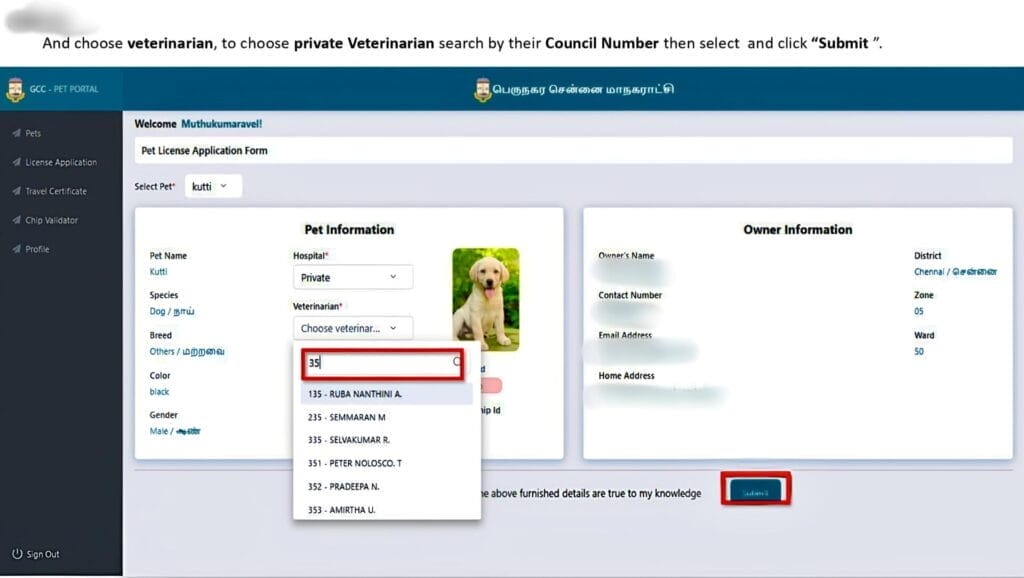
After this step, the application will redirect you to the payment gateway, where you must pay a ₹50 licence fee. The application will then be sent to the listed veterinary doctor for verification.

Step 4: Visit the veterinarian
Pet owners must next take their dogs to the specified veterinarian. The doctor will implant a microchip and update the microchip ID and ARV details in the online application.
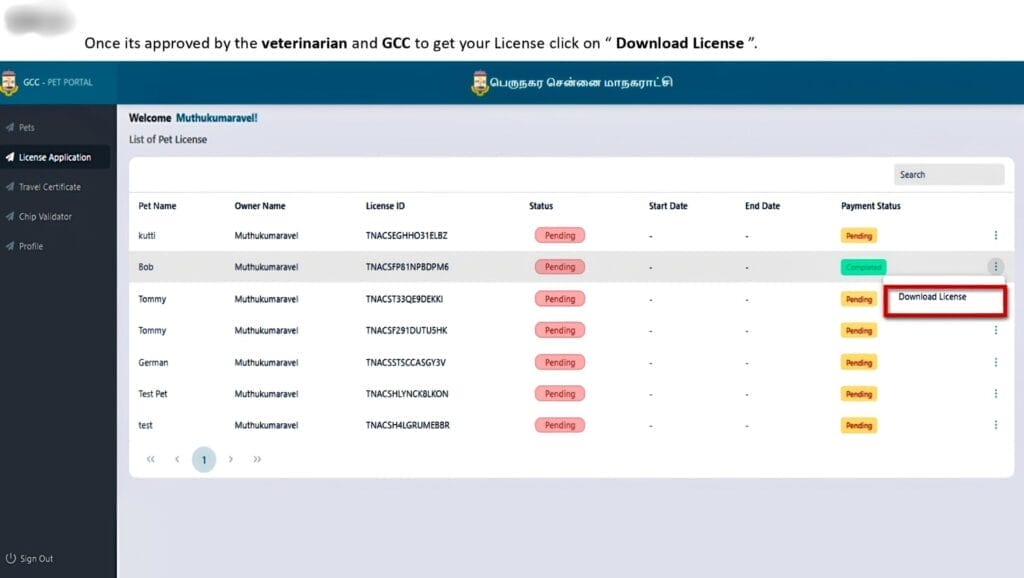
The licence validity corresponds to the date of the pet’s most recent Anti-Rabies Vaccination. Reminders will be sent one month, one week, and one day before expiry. Failure to renew within the specified time may lead to further penalties.
To simplify pet licensing, the GCC is holding camps at six clinics on three consecutive Saturdays from November 8. Pet owners can also visit these clinics on other days, with staff available to assist them.
Helpline support
Citizens can also contact 1913, where GCC staff will provide guidance and support regarding the registration process. “For any issues during registration, a dedicated helpline is available at 63850 99884, which also functions as a WhatsApp support number. “Complaints or queries raised through WhatsApp will be addressed within two hours,” notes Niranjan. This facility is open to all stakeholders, including pet owners, veterinarians, and GCC officials, he adds.
Read more: How Vadodara managed to sterilise 80% of its street dogs
Pet ownership transfer made simple
The online portal also allows pet owners to initiate and accept ownership transfers digitally. The transfer is completed through OTP verification between the existing and new owners, ensuring transparency and traceability.
Why microchips and vaccination are mandatory
The GCC’s emphasis on microchipping and ARV stems from both safety and accountability concerns.
“Each microchip contains the pet’s identification details, vaccination history, and owner’s information. This allows authorities to track pets, discourage abandonment, and assist owners in locating lost or stolen dogs. Additionally, the online system allows users to raise ‘lost dog’ complaints, helping officials trace missing pets through their embedded microchips,” explains Niranjan.
Mandatory vaccination protects pets against rabies while keeping the community safe. Importantly, the licence validity is tied to the vaccination date, ensuring that pet owners do not neglect timely revaccinations.
The GCC offers free microchipping and vaccination services at six veterinary hospitals: Nungambakkam, Kannamapettai, Lloyds Colony, Meenambakkam, Pulianthope, and Thiru Vi Ka Nagar. These centres operate without waiting periods, encouraging the public to make use of cost-free services.
Penalty for non-compliance
Beginning November 24th, GCC teams will conduct door-to-door inspections to identify unlicensed dogs. Officials will carry RFID readers, devices that detect microchips and retrieve stored information wirelessly. “If a pet is found unregistered or not microchipped, and the owner has not even initiated the registration process, a ₹5,000 fine will be imposed immediately,” notes Niranjan.
Monitoring of community dogs
While enforcing strict measures for pet owners, questions remain about how the GCC plans to manage community dogs.
Francis expressed this concern, stating, “The GCC is imposing clear rules for pet owners, but what measures are being taken for community dogs? These details should be made public.”
In response, Niranjan explains that dog catchers will continue to capture community dogs and take them to Animal Birth Control (ABC) centres. At these centres, dogs will be sterilised, vaccinated, and microchipped before being released back to the same location, in accordance with legal mandates.
“Dog catchers are now equipped with a mobile application that records the exact GPS location where each dog is caught and released. The app allows the process to be completed only once the dog is returned to its original area, ensuring accuracy and accountability,” he adds.
The use of RFID readers will also enable dog catchers to monitor vaccination schedules and conduct follow-ups effectively, thereby improving the welfare of community dogs and preventing repeated or missed vaccinations.
The GCC’s new digital pet licensing system promotes transparent and responsible pet ownership in Chennai. If implemented effectively, this initiative could inspire similar efforts in other cities.
Steps for registering pet and applying for license, superbly articulated.
Very helpful. Would never have been able to navigate the site without it.
it is useful