
BG Sreedhhar is a rather well-known personality in the Whitefield Rising Facebook community. For starters, he draws. Most people can draw, one would say. Sreedhhar’s art is a little different. His one-page cartoons are a satire on the many situations that Whitefielders find themselves in. No harm in looking for humour in adversity, right?
On your commute to office? Here’s an apt one.

Illustration: BG Sreedhhar
Considering purchasing a property in Whitefield? Here’s another.
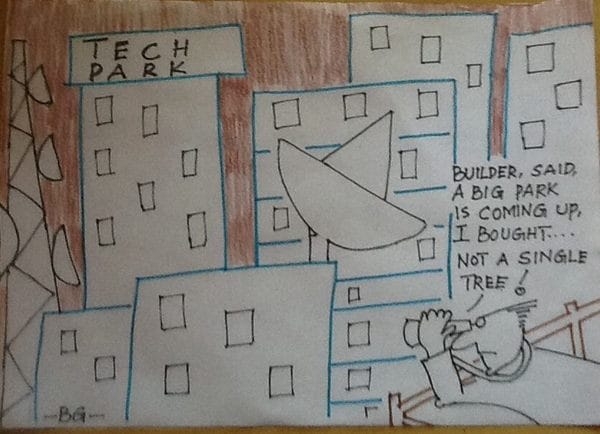
Illustration: BG Sreedhhar
Missed ISRO’s announcement about a new Space Park in Bengaluru? He’s got that covered too.
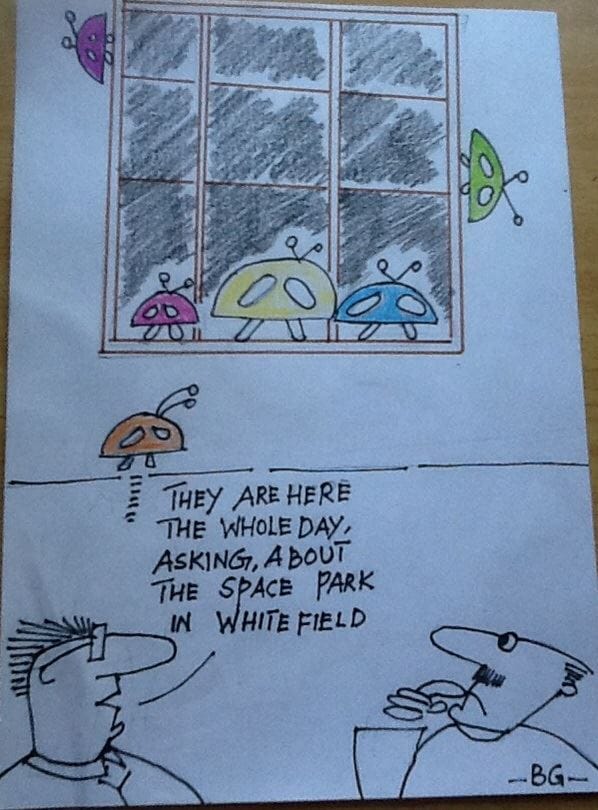
Illustration: BG Sreedhhar
Sreedhhar, a landscape designer by profession, says, “I’ve been doing these cartoons for the last five months. Living in Bengaluru, one can’t but help notice the glaring gaps in infrastructure or the problems that the community faces. I try to document what I see in my cartoons.”
Most pictures are posted with the tag, Chow Chow Bath. Sreedhhar adds, “Though Chow Chow Bath may sound like Chinese to a non-Kannadiga, it is a much-loved dish in Bengaluru, and something that many people can relate to. So I decided to tag my cartoons under that name.” You can view more of Sreedhhar’s cartoons here: Chow Chow Bath.
Everybody can speak Kannada
Since the start of 2016, Sreedhhar has expanded his repertoire to include Kannada lessons too. For a little more than a week, he has been posting basic conversational Kannada lessons on the Whitefield Rising group.
While this long-time resident of Bengaluru confesses that he cannot read or write the language, his spoken Kannada is on par with the locals. He says, “I’ve noticed that there are many people in Bengaluru who cannot speak Kannada. And I thought that these small lessons could help them pick up the language.”
Starting off with basic phrases like dayavittu (please) and dhanyavadha (thank you), Sreedhhar appeals to his audience to comment and converse using the phrases. The words for the day typically include commonly-used Kannada words, pleasantries and slang.
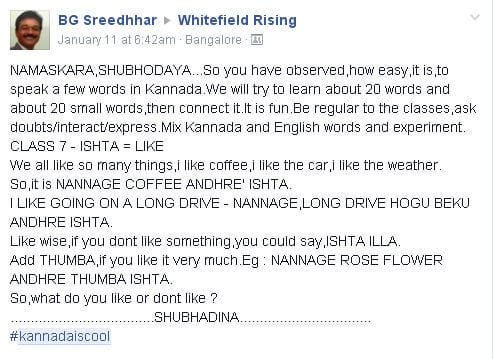
A screenshot of the classes on Facebook
The number of likes and comments that each of his posts garner are a reflection of its popularity. Group members, both local and out-of-towners, have nothing but praises for him. Asmita Phani from Kolkata expresses her gratitude in the comments section, “Thank you for taking the time to teach (us). This is very helpful.” Preya Mohan from Ernakulam says, “From now on, I will try to speak.”
Help people learn the local language
Though Bengaluru has always been a melting pot of various cultures, it has become more so with many people from across the country moving here on work. And whether out-of-towners should learn Kannada has been a long-standing debate in Bengaluru. Very often, we see a conversation on social media turn ugly when someone complains about being in a difficult situation as a result of not being able to speak the local language. And in many of these conversations, it is not too long before someone says, ‘Learn the language or get out’.
Sreedhhar says, “What people should understand is that so many out-of-towners have chosen to stay in Bengaluru and they should be welcomed. While I think it is important they pick up the basics of the local language, the typical conversations on the topic are so negative. What is the point of threatening or antagonising them? Shouldn’t we be helping them?”
He adds, “My classes have a more inclusive approach. Through my classes, I hope that people pick up some of the words that are essential for their interaction with local vendors, the authorities and even their neighbours.”
Ask what he has in store next, and Sreedhhar says, “After these classes have picked up a bit, I would like to start clubs in apartments where those who know the language can teach those who want to learn.”
Tips to learn quickly
Here’s Sreedhhar’s advice for those looking to pick up the local language.
-
Write down the new words you learn with their meaning till you are able to remember them.
-
Start using the words in your daily conversations with people. Once you do so, you will get more confident and start using them more often, even in difficult situations you may find yourself in.
-
Watch Kannada TV channels daily for about 20 minutes, and you could pick up new words from there.
To follow Sreedhhar’s daily classes, follow the hashtag #kannadaiscool.
Before you close the window to get started on the Kannada lessons, here’s yet another cartoon that beautifully captures the spirit of the Whitefield Rising community and Sreedhhar’s too.
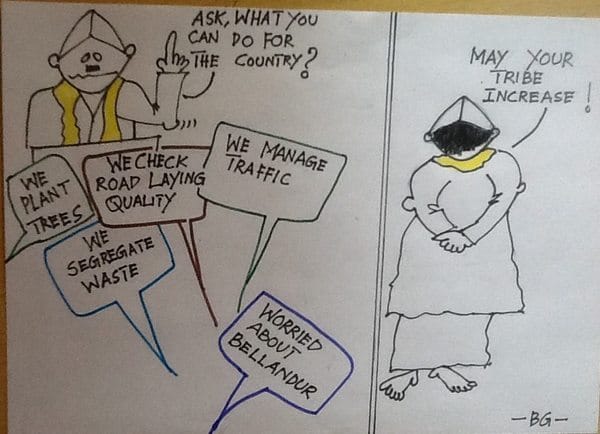
Illustration: BG Sreedhhar
Yes, like he said, may his tribe increase!
Related Articles
Not knowing Kannada: Does it mean disrespect to Kannada?
Here’s why a few directors think non-starrer Kannada movies have a future!
Learning Kannada: It’s not as tough as you think!
Thank you! Sometimes, it’s just a matter of stumbling through a language to learn it. Does anyone know where I can buy a phrase book? I don’t see many resources out there for learning the language.
Not sure about phrase books, but you’ll find some resources here: http://m.bangalore.citizenmatters.in/articles/how-to-learn-kannada-bangalore-kannada-classes-online
Thank you!