Horamavu Agara Kere Habba 12th Sep 2015

Another Kere Habba this Saturday! The Horamavu Parisara Abhivruddhi Samiti (HPAS) – formerly Save Horamavu Lakes, in association with Namma Bengaluru Foundation is organising the Horamavu Agara Kere Habba on Saturday, 12th September 2015, from 7 a.m. to 12 noon at Horamavu Agara Kere. The exact location of the lake can be seen at this link goo.gl/maps/LYjmV.
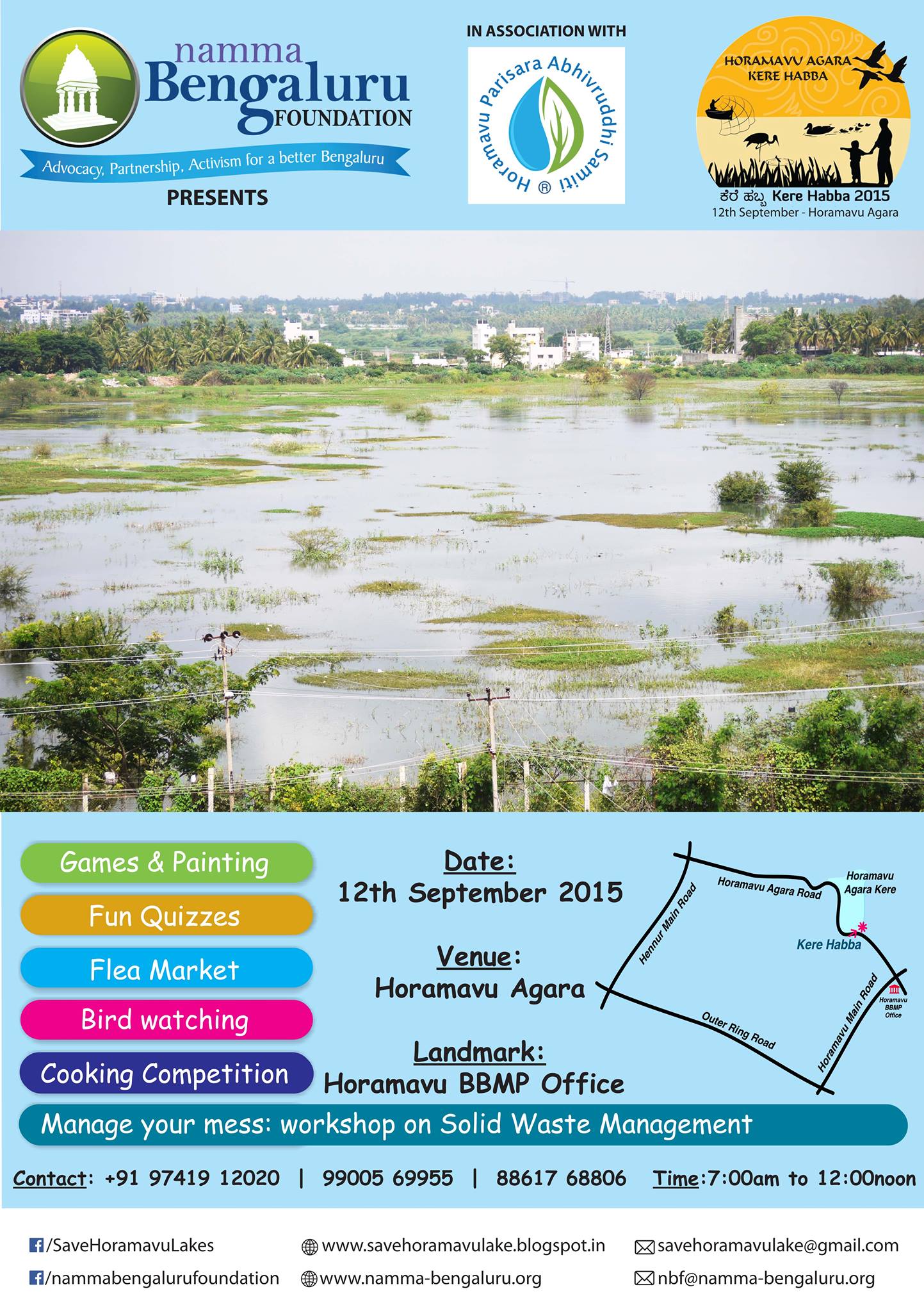
Kere Habba is an initiative of Namma Bengaluru Foundation (NBF). Habbas are held periodically at different Bangalore lakes, to create awareness about the importance of our lakes, and encourage citizen participation in their preservation. Reports/information about the previous four Kere Habbas can be seen on these links – Kere Habba at Kaikondrahalli LakePuttenahalli Kere Habba, Madiwala Kere Habba, Chellakere Habba.    

Picked off the Facebook event page

“Last June we called volunteers to clean up around the lake. This time around, we invite you for a bunch of fun activities by the lake side !!

The objective of the Kere Habba, or Lake Festival, is to let us residents reconnect with the water body near our home, simply because if this lake is dirty, our tap water will be equally dirty. Similarly, if this lake gets dried up, our borewells will dry up too!

So let’s cherish our lake ! 

Your massive presence is a vote for cleanliness and eco-consciousness. Each one of us who turns up for the event will be another ‘yes’ to more migratory birds and another ‘no’ to sewage dumping.

Bring friends, family and colleagues, there will be fun for all age groups. Hope to see you there in numbers, determined to reclaim your lake :)”

Leave a Reply

Your email address will not be published. Required fields are marked *

Similar Story

Why concrete lakes are pushing away Bengaluru’s waterbirds

As natural shorelines vanish and extensive restoration destroys habitats, city lakes see a sharp decline in special wetland bird species.

Since Bengaluru’s lakes were formed by damming water flowing down valleys, they are typically wedge-shaped, with a gentle slope and a deep basin towards the embankment. This promotes the growth of diverse vegetation and animals, each adapted to a particular water depth. The result is a natural zonation – reedbeds and shoreline vegetation at the edges, floating and submerged vegetation in the middle, and open water at the deepest end. During the Open City biodiversity datajam held in December 2025, our group examined the ecological trends around Bengaluru’s lakes. In an earlier article, we examined how migrant and resident waterbirds…

Similar Story

Can cool roofs beat Chennai’s heatwaves? A look inside the state’s Green Schools push

Amid heatwaves, the cool roof initiative is being implemented across Chennai schools. But experts warn that it cannot be the single solution for urban heat.

Over the past few years, maths teacher Usha found her classroom sweltering during her usual 12.50–1.50 pm period, on the second floor of Perunthalaivar Kamarajar Government Girls Higher Secondary School. “It was so difficult to take class during the peak hours,” she says. But this year, she mentions that it feels slightly bearable, and attributes this to the shade of the trees, the wind blowing through the building, and the latest addition — solar-reflective paint on the roof. Data from a state government and UNEP Cooling pilot project at the Ambattur school shows that reflective coating brought the classroom’s internal…