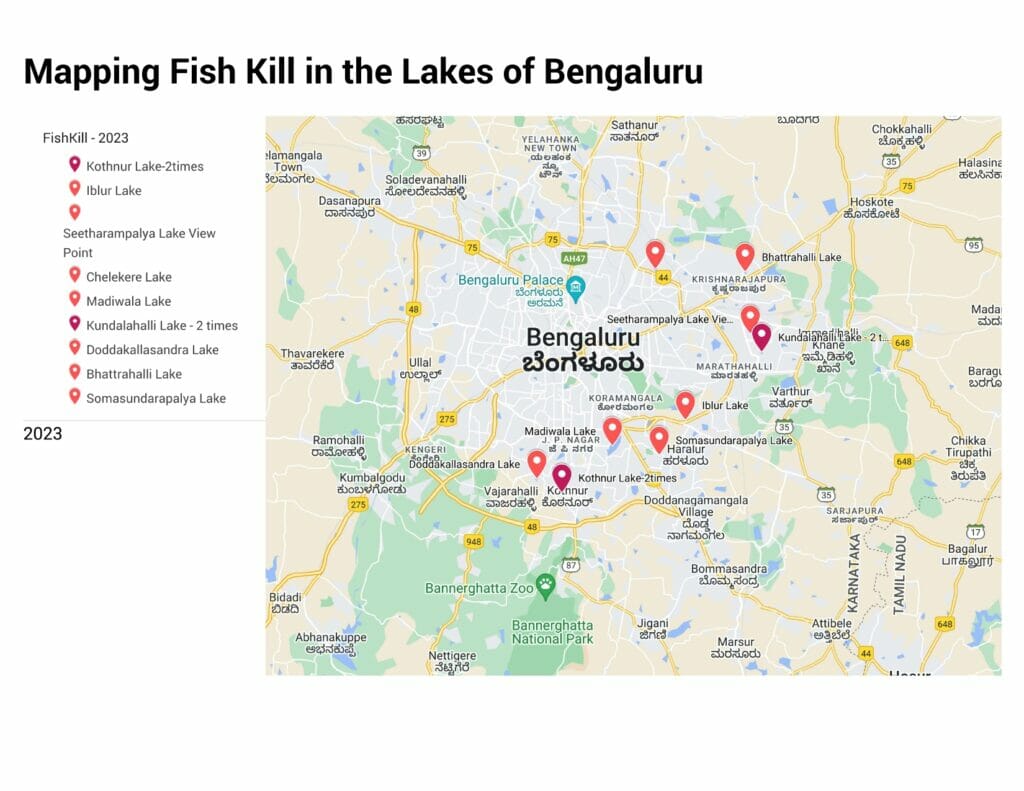
Citizens and lake enthusiasts have reported more incidents of fishkill this year than in 2022. There have been reports of 11 fishkill within six months of 2023.
While 16 fishkill incidents were published in the media from January to December in 2022, a whopping 11 incidents were reported on July 7th. This has led to concerns over the quality of water of Bengaluru’s lakes.
Fishkill in Bengaluru gets reported due to the efforts of aware citizens, who bring up the issue on social media. Many citizens also take it up with the concerned officers of BBMP’s Lake Department.
| Sl. No. | Date | Lake |
| 1 | 08-02-2023 | Kothanur Lake |
| 2 | 30-03-2023 | Iblur Lake |
| 3 | 02-04-2023 | Kothanur Lake |
| 4 | 08-04-2023 | Seetharampalya Lake |
| 5 | 22-05-2023 | Chelekere Lake |
| 6 | 25-05-2023 | Madiwala Lake |
| 7 | 01-06-2023 | Kundalahalli Lake |
| 8 | 18-06-2023 | Doddakallasandra Lake |
| 9 | 20-06-2023 | Bhattarahalli Lake |
| 10 | 21-06-2023 | Kundalahalli Lake |
| 11 | 23-06-2023 | Somasundarapalya Lake |
Fishkill in Bengaluru’s lakes. Graphic courtesy: Raghavendra B Pachhapur
Read more: Why pre-monsoon showers lead to fish kill cases in Bengaluru’s Lakes
Water quality classification
Central Pollution Control Board classifies water on the basis of Designated Best Use method in the following ways:
Designated Best Use | Class of water | Criteria |
| Drinking water source without conventional treatment but after disinfection | A | Total Coliforms Organism MPN/100ml shall be 50 or less pH between 6.5 and 8.5 Dissolved Oxygen 6 mg/l or moreBiochemical Oxygen Demand 5 days 20C 2 mg/l or less |
| Outdoor bathing (Organised) | B | Total Coliforms Organism MPN/100ml shall be 500 or less pH between 6.5 and 8.5 Dissolved Oxygen 5 mg/l or more. Biochemical Oxygen Demand 5 days 20C 3 mg/l or less |
| Drinking water source after conventional treatment and disinfection | C | Total Coliforms Organism MPN/100ml shall be 5000 or less pH between 6 to 9 Dissolved Oxygen 4 mg/l or more Biochemical Oxygen Demand 5 days 20C 3 mg/l or less |
| Propagation of Wildlife and Fisheries | D | pH between 6.5 to 8.5 Dissolved Oxygen 4 mg/l or more Free Ammonia (as N) 1.2 mg/l or less |
| Irrigation, Industrial Cooling, Controlled Waste disposal | E | pH between 6.0 to 8.5 Electrical Conductivity at 25 C micro mhos/cm Max.2250 Sodium absorption Ratio Max. 26Boron Max. 2 mg/l |
Graphic courtesy: CPCB
Lakes/water bodies need to be maintained under Class-D, suitable for Wildlife & Fisheries.
BBMP, the custodian of the lake, has a larger responsibility along with the Karnataka State Pollution Control Board (KSPCB) in maintaining water bodies to make it conducive for wildlife and fisheries. This will ensure ecology in urban spaces.
Unfortunately, both the institutions have failed in maintaining water quality.
Dissecting fishkill in Bengaluru lakes
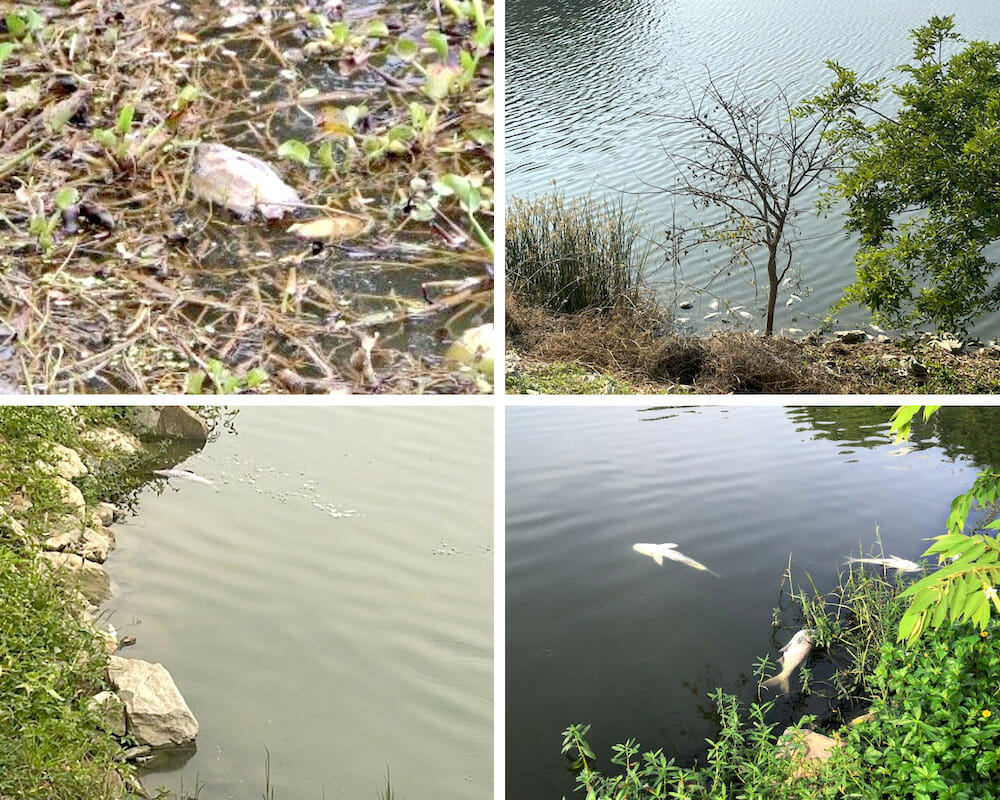
Findings:
- Class-E Water quality, a common factor among all the fishkill in lakes
- Kothanur, Seetarampalya, Chelekere, Madiwala and Somasundarapalya Lakes have been classified under Class-E more than three times in the last 12 months
- Chelekere and Seetharampalya have five times and four times, respectively, classified under Class-E
- Only two lakes Kundalahalli & Bhattarahalli have STP facilities
Observations:
- Except for Doddakallasandra Lake (up to March) other lakes have reported Class-E more than once shows that the water quality in these lakes had already deteriorated earlier.
- Water Quality analysis reports give a clear picture of the activity happening at the lake. If no action is taken by either the water monitoring agencies such as KSPCB or the lake custodian (BBMP), then it then fishkill can occur.
- Lakes need regular vigil on entry of pollutants. Monitoring water quality is an added protection to detect pollutant entry at the initial stages. Taking corrective measures would help stabilise the water quality in the coming days.
- It is also to be noted that the fishkill has occurred in lakes in 110 villages, except Madiwala lake.
| Name of the lake | Class-D | Class-E |
| Kothanur Lake (Twice) | 9 | 3 |
| Iblur Lake | 11 | 1 |
| Seetharampalya Lake | 8 | 4 |
| Chelekere Lake | 7 | 5 |
| Madiwala Lake | 9 | 3 |
| Kundalahalli Lake (Twice) (STP facility) | 11 | 1 |
| Bhattarahalli Lake (STP facility) | 11 | 1 |
| Somasundarapalya Lake | 9 | 3 |
| As per February & March reports of Doddakallasandra Lake, there has been an increase in Total Coliform levels- 18 times and 11 times more than the prescribed 5,000PMN/100mL. | ||
KSPCB water quality data June 2022 – May 2023
Read more: Why fish die in Bengaluru lakes, and what you can do to prevent it
KSPCB & BBMP must work in coordination
The KSPCB can identify entry of any bio or chemical material into lake waters in their monthly water quality analysis. So, as an organic next step, would be to stop contamination to prevent further deterioration in water quality.
Steps to be taken up by KSPCB:
- First Level Warning notice: KSPCB needs to start raising an alarm/warning to the custodian of the lake as soon as there is a breach of more than 10% noticed in any parameter.
(The commonly noticed parameters are: Total Coliform, Fecal Coliform, Biochemical Oxygen Demand and Chemical Oxygen Demand.) - Second Level Penalty Notice: KSPCB should issue a penalty notice to the custodian of the lake every time water quality turns to Class-E.
- Coded form of Water Quality Analysis Reports: KSPCB should simplify the water quality analysis reports. They need to provide parameter-wise reports of lake water quality analysis within seven to ten days like Telangana and other states. The present form of ABCD&E (DBU format) is confusing and doesn’t help in lake water conservation efforts.
Steps to be taken up by BBMP, the custodian of lakes in Bengaluru:
Firstly, BBMP should strengthen its monitoring of lakes:
- Lake maintenance should include upkeep of inlets and diversion channels before, during and post monsoon.
- All the harvested grasses and solid waste collected from the lake wetland or water should be disposed of within a week’s time.
- Quick response to untreated water entry into the lake.
- Lake information boards need to be installed at every gate. The boards should contain details of the lake, biodiversity, and contact details of the people responsible for security, maintenance, the name of the BBMP official in-charge of the lake, and complaint numbers. This information will help any lake user to get back to the concerned person for issues/emergency situations that arise. This will increase transparency in lake governance in the city.
There is a need of shift in perspective from Engineering to Ecology within the BBMP cadre. It is not just about civil engineering works but also about protecting life forms. They need to show concern and care for the lake ecosystem.
BBMP engineers should coordinate with KSPCB in accessing reports of lake water quality and start effectively monitoring the lake waters.
BWSSB officials need to quickly respond to sewage entry into the lake due to UGD malfunctions / sewage overflow etc.
Workable solutions
I believe understanding water quality is not a rocket science and there is no magic wand to stop fishkill. BBMP-Lakes Department has a dedicated home guard for 12 hours a day, who needs to keep a vigil on the entry of pollutants through the rajakaluve. BBMP also has a maintenance contractor whose duty is to oversee the inlets, outlets, diversion channels, harvest macrophytes from lake water. The Assistant Engineer supervises the lakes.
All that is required is for BBMP to strengthen its monitoring mechanisms and BBMP representatives (Guard & Contractors) of lakes to respond to situations quickly.
What citizens can do
- Local community monitoring is the key for lake conservation. Citizen volunteers such as lake enthusiasts /lake groups/RWA members should keep a vigil on lake inlets/ streams that bring pollutants into the lake.
- KSPCB conducts monthly tests and collects water samples from 100 lakes in Bengaluru and uploads the results on their website under Environmental Monitoring Link. The result of lake water quality indicates what is happening with the lake waters.
- Based on the report, citizen volunteers need to identify the pollutant source and stop it from entering the lake. Conserving lake water quality will help improve lake ecosystems and biodiversity .