When a 30-year-old man from Karnataka felt overwhelmed by suicidal thoughts and a deep sense of hopelessness, he reached out to a government-run tele-counselling helpline. On the other end of the line was a trained counsellor from Tele MANAS, India’s national tele-mental health programme. The counsellor listened patiently, offered emotional support, and guided him to a nearby mental health hospital under the District Mental Health Programme (DMHP) for further care.
In another case, a 17-year-old student, anxious about his upcoming exams, called the same helpline. He received practical advice, study tips, and daily motivation. Two years later, he called back — this time to share the joy of his exam success.
These are just two of the many lives touched by Tele MANAS. Since its launch on World Mental Health Day in 2022, the programme has supported over 28 lakh people across India. Born out of the urgent need for mental health support during the COVID-19 pandemic, Tele Mental Health Assistance and Networking Across States (Tele MANAS), which has the National Institute of Mental Health and Neuro Sciences (NIMHANS), Bengaluru, as its apex nodal body, builds on the success of the earlier National Psychosocial Support Helpline, which handled over six lakh calls.
Tele MANAS is more than a helpline — it is a portal to accessible mental health support. Here’s how it works, and why it matters.
Tele MANAS programme’s reach
In September alone, the helpline received 1.40 lakh calls, providing services in 20 different Indian languages. Mental health is still a taboo, especially among Indian men. So, it is heartening that the helpline has facilitated greater reach among men, as 52.59% of the callers were male.
Nearly 70% callers fall within the 18–45 age group, indicating that working-age adults and students are the primary users of the service. Dr C Naveen Kumar, Professor of Psychiatry and Principal Investigator of Tele MANAS, says that 80.52% of these calls were about routine mental health concerns such as anxiety, stress, and sleep difficulties. The rest were information, emergency, and prank calls.
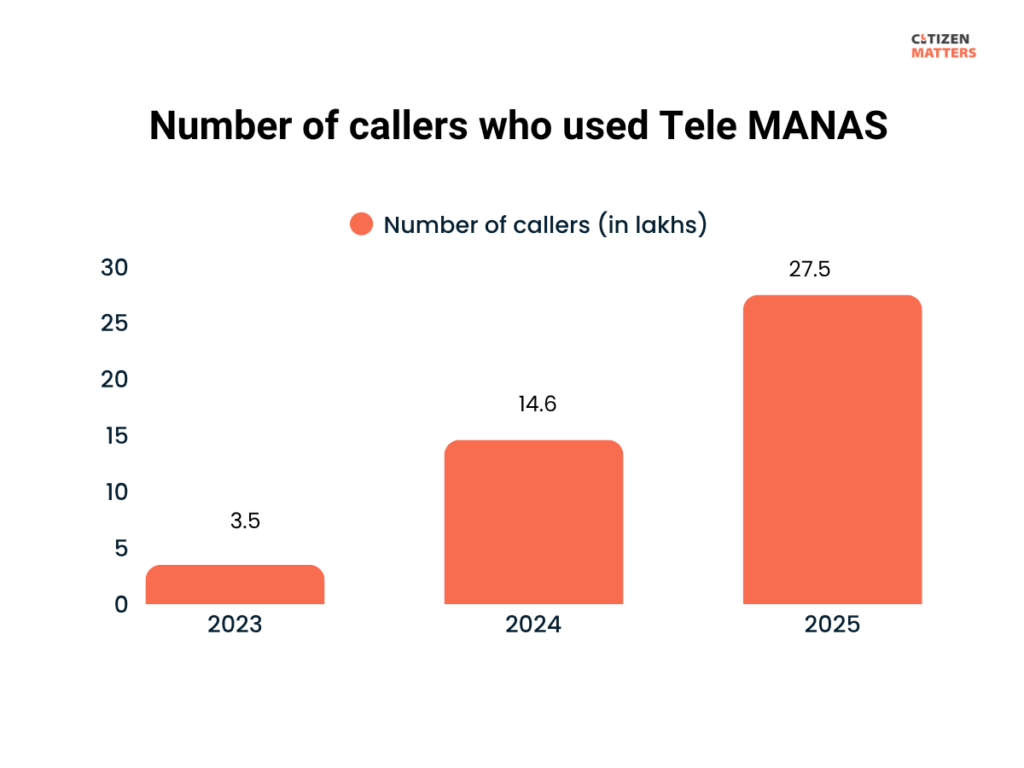
Dr Pratima Murthy, Director of NIMHANS, says that the programme has been highly successful, reaching a large number of people. “The initiative has helped in preventing suicides and ensuring timely emergency assistance for those in need,” she notes. “The programme is especially significant because mental health services are often unavailable in non-urban areas, and the number of trained professionals remains limited.”
Aim of the programme
Dr Naveen explains that Tele MANAS aims to provide universal access to equitable, affordable and quality mental health care through 24/7 tele-mental health services. As a digital arm of the central government’s National Mental Health Programme (NMHP), it operates across all States and Union Territories. The idea is simple yet ambitious — to scale up mental health services, build a robust service network, and reach vulnerable and hard-to-reach populations.
More than just counselling, Tele MANAS connects people to video consultations with specialists, offers e-prescriptions, follow-ups and links to in-person care. “The initiative aims to uphold mental health as a basic human right,” says Dr Naveen.
Dr Pratima says the focus now is on improving accessibility and expanding reach. The Tele MANAS app will soon be available in multiple languages. “Training and accreditation of mental health counsellors is a key focus; accreditation ensures quality and appropriate support,” she adds.
The programme also plans to strengthen mentoring institutions and regional centres, and link Tele MANAS with other national health platforms, so people can access confidential counselling or connect with professionals through the app or services like e-Sanjeevani. Awareness and information campaigns are helping popularise the service. “The initiative also seeks to share its learnings with other South Asian countries facing similar mental health challenges,” informs Dr Pratima.
Accessing the Tele MANAS helpline: What to do
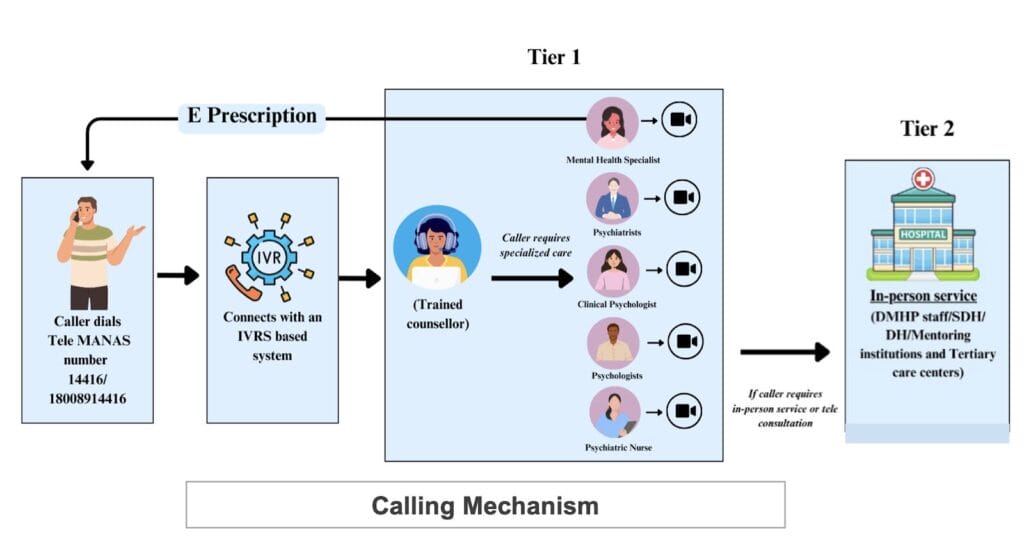
To handle callers as per need, Tele MANAS follows a tier-based structure, ensuring appropriate triaging and continuity of care.
Here’s a quick guide on how to access and navigate the Tele MANAS support system:
- Step 1: Make the call.
- Dial the toll-free number: 14416 or 1-800-891-4416.
- Step 2: Receive initial support (Tier 1).
- A trained counsellor or psychologist will answer the call.
- They will provide initial psychological support, assess the caller’s current needs, and determine the next steps.
- Step 3: Escalation for specialised care (Tier 2 – If needed).
- If the caller’s situation requires it, the case will be escalated to a senior mental health professional (including psychiatrists, clinical psychologists, or psychiatric social workers).
- They will provide a specialised assessment or therapy.
- Step 4: Consider a video consultation (Tier 2 – If needed and consented).
- With the caller’s consent, the mental health professional can initiate a video consultation.
- A secure link will be shared with the caller via SMS for easy and confidential access.
- Step 5: Receive medication
- If the caller requires medication, a psychiatrist will issue an e-prescription.
- Step 6: Referral for in-person care
- If the caller’s condition requires a detailed in-person evaluation, medication management (beyond the e-prescription), or community-based support, they will be referred to the nearest appropriate physical services.
- These services include the care by DMHP teams, medical colleges, and mentoring institutes.
- Step 7: Schedule follow-up.
- Follow-up sessions can be scheduled with the caller’s consent.
- These follow-ups will be done through a callback initiated by the Tele MANAS team.
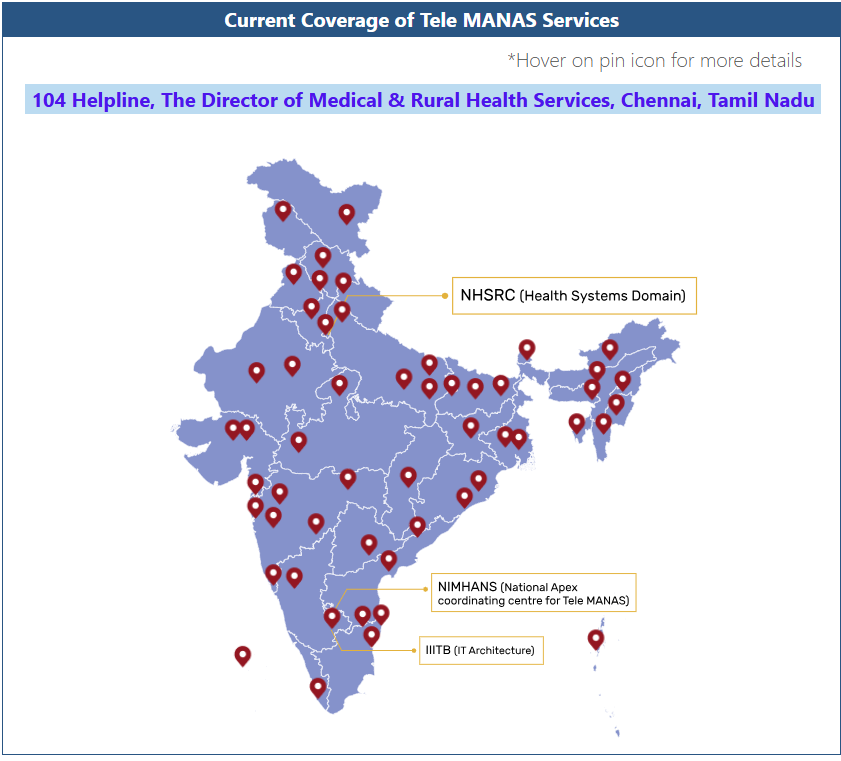
This two-tier system is supported by 53 State Tele MANAS Cells, 23 mentoring institutes, five regional coordinating centres, and coordinated nationally by NIMHANS. “Through this seamless call flow, the individuals receive responsive, confidential and comprehensive mental health support,” says Dr Naveen.
Nature of the calls handled
The majority of calls relate to depressive symptoms such as sadness, hopelessness, or loss of interest, followed by stress related to exam/workplace/relationship.
Other common issues include:
- Sleep disturbances
- Generalised anxiety, panic, and phobia related symptoms
- Symptoms suggestive of losing touch with reality
- Symptoms related to bio-socio-occupational dysfunction.
- Substance abuse and behavioural addiction related.
To handle high risk situations, the programme also has a Standard Operating Procedure (SOP) to handle high risk situations. High risk calls include suicidal ideation, harm to self/others, drug-related emergencies, medical emergencies, wandering mentally ill.
In these cases, the counsellor,
- Assesses immediate safety (access to sharps, corrosives, aggressive persons etc).
- Keeps the caller engaged and advises safer locations if needed.
- Transfers call to Tier 1 mental health professional at the State Cell for further management.
- Alerts local police/ambulance and informs family/caregiver of nearest hospitals, if necessary, hence ensuring safety, timely intervention, and continuity of care.
Read more: SCARF’s 40-year journey in Chennai shows how mental healthcare has evolved
Improving access and bringing down stigma around mental health
The telephonic nature of Tele MANAS offers confidential support, encouraging individuals to seek help even in high-stigma contexts. “This is particularly important in a country like India,” says Dr Naveen.
He adds that the Tele-MANAS initiative plays a crucial role in reducing mental health stigma through several important mechanisms:
- Anonymity and accessibility: Video consultations make Tele MANAS more accessible and inclusive. By connecting callers to local mental health services, it ensures continuous care — from immediate support to regular follow-ups and long-term management.
- Confidentiality and privacy: Tele MANAS does not record calls, and it shares information only in rare cases, such as when someone is at risk of self-harm or harming others. By protecting privacy it makes seeking help safe and discreet, and reduces the fear that asking for support shows weakness.
- Normalising help-seeking: Tele MANAS promotes mental well-being as an essential part of overall health. By offering an official and easily accessible platform, it helps people see counselling as normal and acceptable.
- Reaching underserved and diverse communities: Through regional language services and remote access, the programme enables people in rural, underserved, or conservative areas to connect without fear of social scrutiny. Its culturally sensitive and inclusive approach makes it easier for individuals to take the first step toward help, even in communities where stigma is stronger.
- Early intervention and referral pathways: The tier-based system encourages early intervention, stopping distress from turning into a crisis and reducing the shame and isolation that often come with untreated mental health issues.
Ensuring inclusivity
“Tele MANAS emphasises being inclusive of individuals who are differently abled, children, adolescents, the elderly, etc,” adds Dr Naveen. To achieve this, counsellors and mental health professionals participate in a structured, multi-stage training programme. The training includes both theoretical modules and practical exercises focused on supporting special populations.
Read more: Making mental healthcare more accessible for students
Reach among the rural population
Though mental health support is often seen as an urban concern, Tele MANAS is steadily changing that perception. Nearly 52% of its calls have come from rural areas. “This reflects the significant reach and impact of Tele MANAS in these communities,” Dr Naveen says. He notes that 24/7 toll-free services, decentralised state-led operations, low resource needs, community outreach, and local collaborations have all contributed to this success.
At the grassroots, Tele MANAS is promoted through PHCs, All India Radio, Doordarshan, and school mental health programmes, helping spread awareness and encourage early help-seeking. Many states have launched rural outreach and local-language IEC campaigns to familiarise people with the helpline and its benefits. Broader state and national awareness efforts, community engagement, and partnerships with programmes like Ayushman Bharat and DMHP further expand its reach.
“We reach rural populations through ASHA workers, community health officers, NGOs, and hospitals, ensuring that support is not limited to cities,” says a counsellor with Tele MANAS, who did not want to be named. The experience has been deeply enriching for her. “Interacting with callers has improved my communication skills, reinforced emotional boundaries, and strengthened my counselling techniques,” she adds. Collaborating closely with psychiatrists and other mental health professionals has also fostered personal and professional growth.
Dr Naveen believes taking quality psychiatric care to people’s doorsteps is the programme’s greatest achievement. The goal now, he said, is to handle around 10,000 calls a day — reaching even more individuals in need.
In case you need mental health support, please reach out to the following mental health service providers:
- Tele MANAS – 14416 / 1-800-891-4416
- SCARF India – 91 – 44-2615 3971 / 91 – 44-2615 1073
- SNEHA 044 – 24640050
- Institute of Mental Health Chennai – 044-26425585
- iCall – 9152987821
- Rainbow Helpline: 9639630202