The Ejipura to Kendriya Sadan Flyover has been in the works for more than five years now. Over a period of time, many parties have been involved in this, namely, the BBMP, the Karnataka State Government, the Honourable Karnataka High Court, the contractor and the hapless citizens of Bengaluru. This article is just a way of venting for one such citizen of Bengaluru. No interviews were conducted and no specific research was undertaken for the writing of this article.
Even without research or study, the piteous condition of the road underneath is enough evidence for everyone to see. Barricades have been placed haphazardly and one can see Construction and Demolition (C&D) waste dumped indiscriminately throughout and some spots are used for dumping and clearing of municipal solid waste (MSW) as well.
The idea behind the Ejipura Flyover
This flyover to nowhere starts near the Ejipura traffic signal and ends at Kendriya Sadan. Neither the start nor the end is yet visible as the works are mostly incomplete specifically in the start and end locations. I believe that this flyover was envisaged to ease the pressure on the road below as this would have helped commuters avoid at least four signals and several crossroads as well in between. While avoiding all the signals and crossroads, we can imagine that drivers could literally fly over till they reach the next signal at Hosur Road, thus concentrating all the traffic in a single location rather than being spread across multiple signals on the 100 feet road.
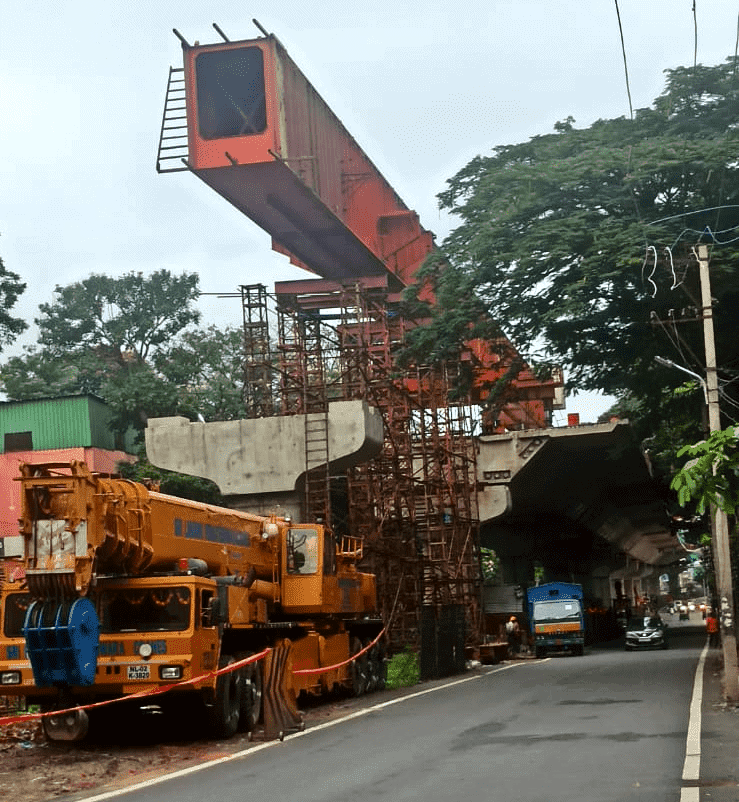
Of course, this is a poor argument in every sense. Many flyovers across the city have helped to spread the traffic on flyovers and the roads underneath thus giving us an aggravated sense of space availability. Why bother investing in public transport and infrastructure that would benefit the ordinary citizen when one can invest in a flyover of 2.5 km to benefit a few.
Well, I can go on and on about this – instead of investing in decent and coordinated public transport, the singular focus on building and rebuilding roads does not lead us anywhere. Even with all the building of roads and flyovers we see all around us, the condition of our roads is pathetic and it doesn’t take more than one rain for us to find out the strength of such roads.
Building a robust public transport system is the need of the hour. A system with good last-mile connectivity that all citizens can utilise and benefit from. With BMTC, BMRCL, Indian Railways, auto-rickshaws, taxis etc. falling outside the purview of BBMP, there is only so much this urban local body can do. The only thing BBMP can perhaps control is the location of the bus stops! Ask any commuter and one can hear a sorry story about these as well.
But, I truly digress. I am here to rant about the flyover to nowhere. While the Honourable High Court of Karnataka, BBMP, the Karnataka state and the contractor sort out the construction of the flyover, something else has happened.
Bengaluru’s own Angkor Wat
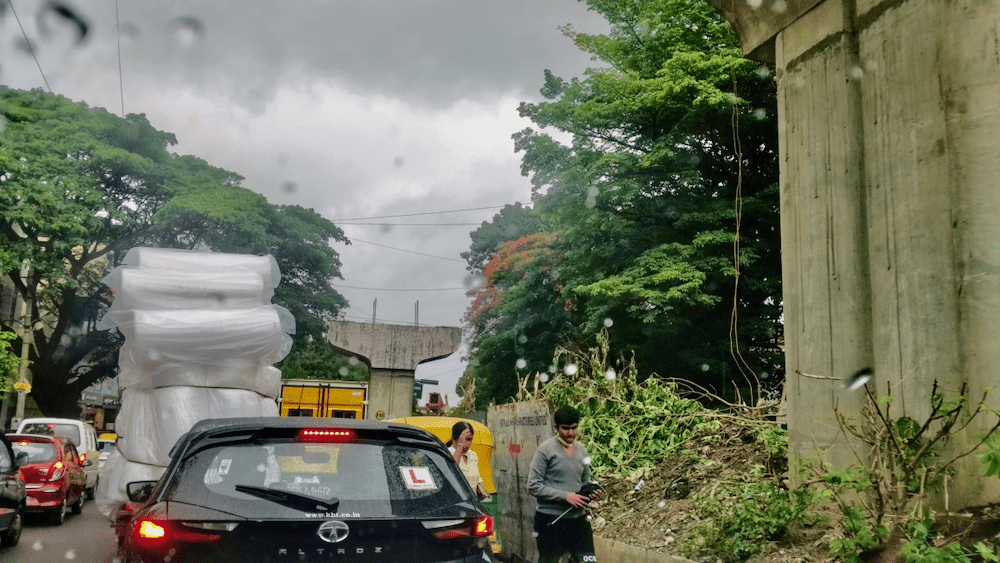
Without anyone noticing, nature has taken over. In several sections, one can find saplings of trees growing such as African Tulip, Raintree, Ashoka and even a fruit-bearing Papaya plant. The lovely Raintrees on either side of the 100 feet road form a beautiful canopy over the would-be flyover.
Read more: Multiple mega-projects meant for Bengaluru yet to take off
This is truly a scene to behold however miserable the commuter on the ground may be. A flyover can never match the shade and the cooling effect the trees provide. One just needs to observe one’s thoughts while stuck in traffic under the hot sun on the Inner Ring Road and the difference when one is stuck in similar traffic in a shaded area with trees.
This monumental error of a flyover can be left to rest as a monument for future generations to see. Let the trees run wild and maybe we will have our very own AngKor Wat within the city. What the BBMP can do is remove the barricades, the construction debris underneath the flyover and repair the hundred feet road and its footpath. It will pull many citizens out of their day to day misery. The flyover to nowhere can stay the flyover to nowhere.