The irony was too stark and tragic to ignore. Along with millions of fellow countrymen, I whooped with joy and pride at India becoming the first nation to land its Chandrayan 3 lander safely on the moon’s southern polar region.
Unfortunately, the day’s newspaper was lying next to me and I could not help notice the headline that stared back at me. A young girl had suffered serious injury as an electric pole fell on her. Just a day or so earlier, the same newspaper had carried a similar headline. Then again, the victim, a young man, had been grievously injured by an electrical pole falling on him.
Both the incidents happened in Bengaluru, where ISRO is headquartered and telecast to the world the success of its Chandrayan 3.
As I said, the irony was too tragic not to think about. The city with the people, knowledge and skills to successfully launch and land a payload on the moon is also a city where the engineers of its civic governance bodies cannot erect an electric pole that is safe for people walking next to it!
Read more: Explainer: When can you sue your municipal body for accidents due to potholes?
The tragedy of our daily lives
The successful moon mission will likely have many commercial hi-tech spinoffs. Unfortunately, none of them will be available to make Bengaluru safe for its citizens, especially pedestrians.
Danger lurks at every turn. Roads and supposed pedestrian walkways are of poor quality and unsafe. The pathway outside my home is one example, where my wife and I, returning from the hospital, took a toss when one of us slipped on the muddy, uneven surface and loose gravel.
I marvel and bask in the reflected glory of what the ISRO team has achieved. But at the same time, I cannot but ask myself this question: how a city that played such a big part in reaching the moon, cannot make a safe pathway for me and my wife, both aged 72, to walk from my gate to my car.
Read more: White topping work enforces a lockdown worse than pandemic times
I am not being petty or small-minded here. Just pointing out some stark realities of this city.
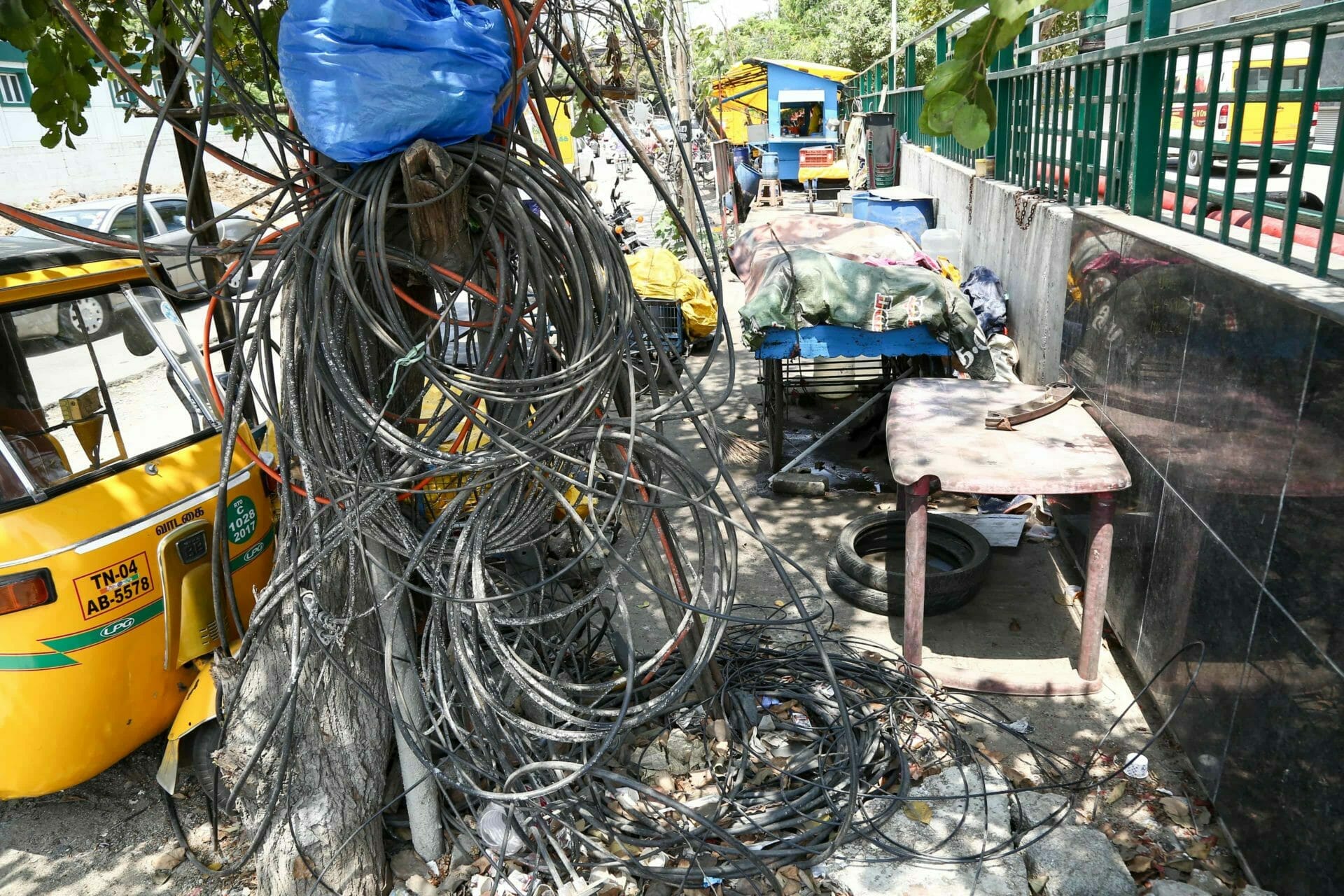
Like the hazard posed by loose wires hanging all over the city. Which are also the reason for the collapse of the electric pole as the hanging wires got caught in moving trucks. People have been electrocuted by such wires as there is no way of knowing if it is live or not. Metro pillars collapse without warning, killing people standing under it. In one really tragic case, killing a mother and one of her twin children while her husband and other child were just a little distance away and watched in helplessness.
Excellence is a mindset
The difference in quality and commitment between these ISRO engineers and the so-called engineers employed by Bengaluru’s civic agencies is simply too stark to ignore. No one expects the civic agency engineers to learn rocket science. Just how to install an electric pole and the wiring that goes with it, or a metro pillar, in a manner that is safe for the people around it.
I am reminded of a conversation I had with a senior civil services officer at the inauguration of a cancer institute. The lady was the chief guest and was herself a cancer survivor. After sitting through a painfully mediocre presentation, the lady turned to me and said “We have forgotten how to celebrate excellence”.
Which got me thinking. Is the word excellence ever associated with the planning, design and work done by any of Bengaluru’s civic agencies? If not, why not?
Two simple answers. One, they lack any commitment to ensure quality. Two, they do not learn from the past and take no preparation. I can only recommend to them the words of Commander Abhilash Tomy, the first Indian to circumnavigate the world solo.
His mantra was simple. “Prepare, prepare, prepare, then execute”. Which is what the ISRO team did for four years. Design, test, review, every component, every phase, every manoeuvre. For four years. That is how they achieved excellence and success.
Excellence is not just a word. It is a quality that will always be in short supply, and fickle, and eccentric. It is a mindset, a culture that has to be nurtured. It needs cajoling and flattery. In the end, it needs recognition.
Examples of excellence are not lacking in India. Both individual and institutional. But they are few and far between. And not many of us hear of it. But they are there for us all to find and learn from.
So let’s ponder on this for a start. We build world class cars that we export to many countries. But in Bengaluru, the civic authorities are unable to build quality roads that are safe for them to drive on. And safe pavements for people to walk on.
So be wary of that electric pole, next time you venture out.