On February 5 this year, an important public hearing was held at Perungudi’s Ward 184 office on Panchayat Office Road to discuss the fate of a large chunk of the Pallikaranai Marshland. The Greater Chennai Corporation (GCC) organised the hearing to assess public opinion towards an eco-park set to come up on the Perungudi dump yard located in the marshland area.
News reports about the eco-park first started to appear in 2023, as the next step after a process of biomining, which was a means to clear up the legacy waste dumped for three to four decades in the marsh area. The biomining has been ongoing since 2022, at a cost of ₹150 crore, with the aim of completion by March 2024. The promise of biomining was in response to widespread protests held by residents — part of welfare associations, federations and unions — to clear up the dump yard and undo the state’s encroachment into the now heavily concretised marshland, home to IT parks, residential complexes, the dump yard, and more.
Out of the ₹150 crore allotted for biomining, around ₹50 crore is going into the planning and construction of the eco-park. Eco-parks have been a rather popular measure in restoration schemes in Chennai — take the Tholkappia Poonga to conserve the Adyar Creek, or the eco-friendly walkways and park areas mentioned in the plans for the Cooum and Buckingham Canal restorations.
Read more: Ramsar Tag secured, what is the way ahead for the Pallikaranai marshland?
Yet, given the concretisation and construction that such projects entail, it is important to question whether these eco-parks, in their attempts to conserve nature, are yet another intrusion into the ecologically sensitive areas they aim to protect.
The biodiversity park — a temporary measure
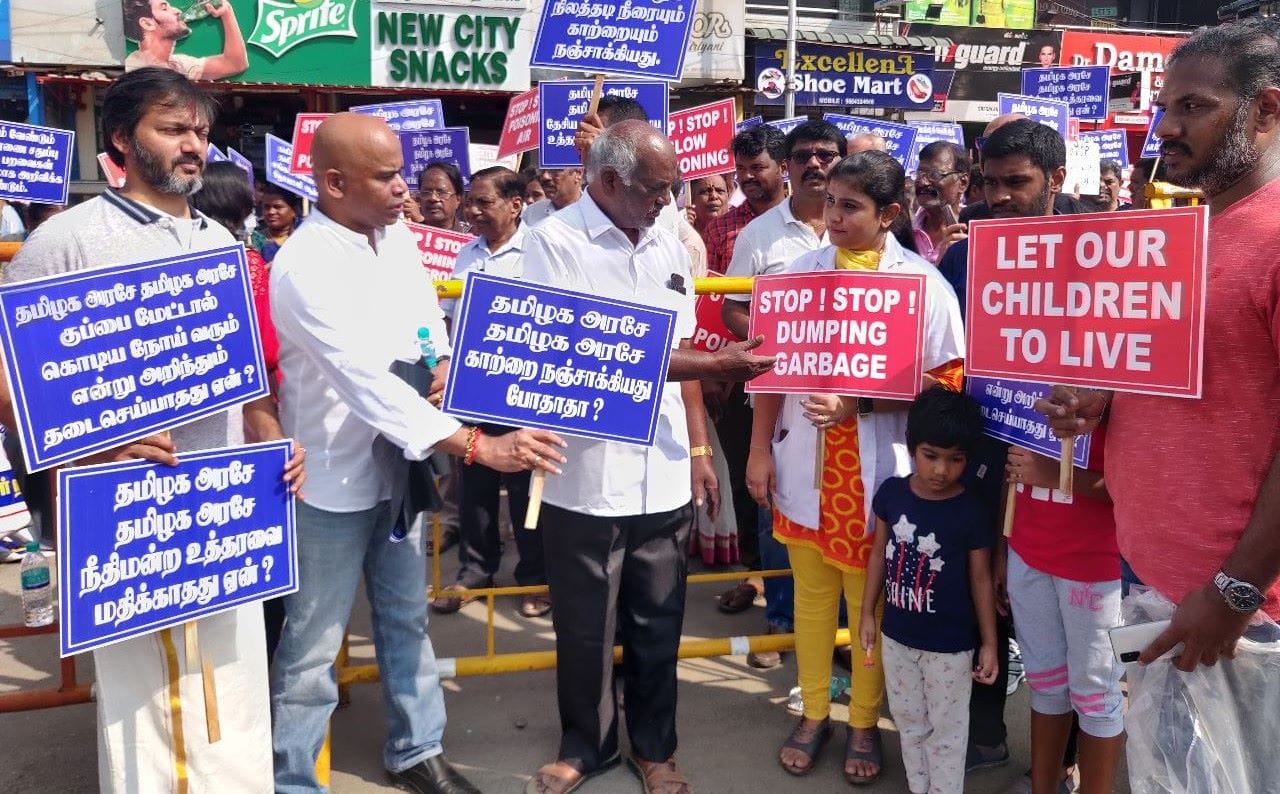
According to the GCC, the biodiversity park is a means to conserve the marsh; it is supposed to be a step towards ensuring its safe restoration. Once the biomining is completed, the eco-park will be removed after 12 years, leaving behind the marsh area.
The park will have a concretised walkway, bird-watching towers, public toilets, leisure spaces for the public, security guards and more. Limestone, red brick and granite will be the materials used in the construction of the park. Along with this, trees will be a crucial component.
As proposed by the GCC, the eco-park is a means of ‘bioremediation’, whereby trees will be planted to “absorb toxins” from the groundwater — a gradual process that would take up to 12 years. In addition, the trees would allow for increased biodiversity in the area, after which the land would be ready to be reconverted to a marsh. Interestingly, the tree species will be selected and planted on a trial-and-error basis.
However, the civic body’s definition of bioremediation doesn’t quite match the typical process of bioremediation. Rather than trees, the process has usually involved an introduction of microbes into the wetland area. These microbes are first multiplied as strains in a lab; these are commercially available as soil and water probiotics. They have the capacity to absorb toxins, ultimately accelerating the natural process of toxin removal.
Could the wetland survive this eco-park?
Planting trees could also harm the marsh owing to the unique ecosystem of wetlands. Three main ecosystems come under wetlands: marshes, swamps and mudflats. Mudflats usually do not have any plants, while marshes house a variety of grasses. Swamps are the only wetlands with woody plants and trees, however, these trees are unique to that particular ecosystem. For example, mangroves can be found in coastal swamps, but these are difficult to plant artificially in a non-coastal swamp ecosystem. Not all terrestrial trees can grow on these wetlands. Pallikaranai comes under the marshland category, which is home to various types of grasses including our rice variety, Oryza sativa.
Read more: Chennai wetlands key to flood mitigation: Are we doing enough?
What happened at the public hearing
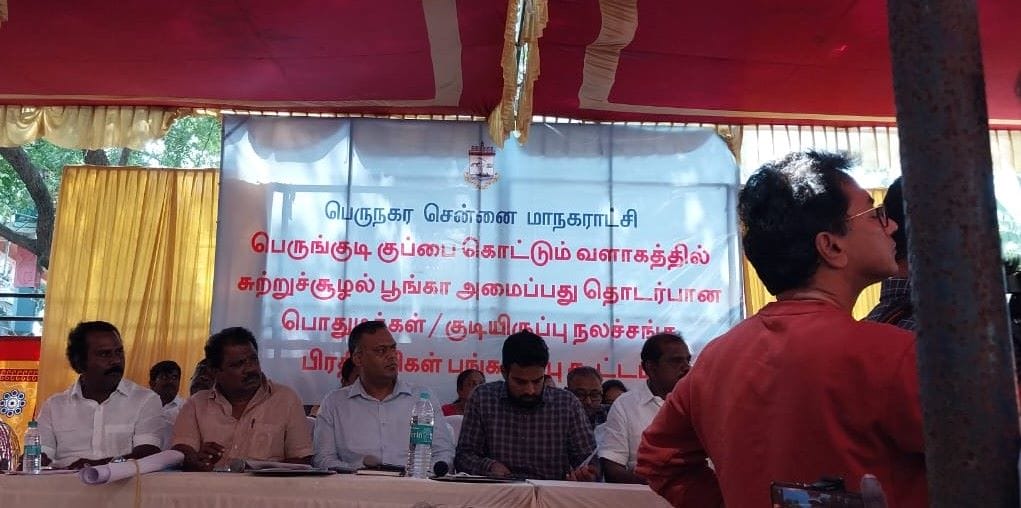
Coming back to the hearing, the Mayor and GCC commissioner were supposed to chair the event. Instead, Revenue Divisional Commissioner South and DC Health chaired the session along with the sitting MLA and Chairperson of zone 14. Council members of zone 14 also shared the dias except for a council member of Pallikaranai, as he was not happy about having this session in Perungudi.
The Detailed Project Report (DPR) was presented by an architect on contract with the GCC to plan the park. Members of the public, who attended the hearing vehemently opposed the project report as they said the DPR should have been prepared only after getting the public’s consent. Resident Welfare Associations (RWAs) across the city were present including those from Velachery, Taramani, Thazambur, Sholinganallur, Adyar, Madhavaram, Anna Nagar and Thiruvanmiyur.
Interestingly, in January of this year, the Southern Bench of the National Green Tribunal ruled that the GCC find another location to construct the eco-park, allowing the marsh to be “restored to its original condition.” The public hearing held after the ruling thus appears to go against the NGT’s orders. When this was raised during one of the speeches, the GCC representatives had no response to give, quickly diverting the topic.
The extent of the marsh’s degradation and possible solutions
Over the years, the marsh has been concretised to give way for MRTS stations and railway lines, middle and high-income real estate projects, IT parks, and more. Given rivers and lakes from four districts: Chengalpattu, Kanchipuram, Chennai and Vellore drain their water into the marsh, the concretised areas get heavily flooded during rains — putting residents and workers in the area at grave risk.
Many of the residential areas, government institutions and the IT park have even been identified as encroachments by the NGT, which had ordered the GCC to remove the buildings which did not have proper land titles and relocate them with adequate compensation. The marsh has also been fragmented by radial roads that connect outlying neighbourhoods.
While it might not be possible to remove all of these, many of the roads that cut through the marsh could be replaced. For example, the radial road that connects Thoraipakkam to Pallavaram could be replaced with a hanging bridge, with minimal pillars. This way the south and north side of Pallikaranai could still be connected, with minimal damage to the marshland.
At the hearing, the opinion of those attending appeared unanimous on the matter of avoiding the eco-park altogether — a hopeful moment of solidarity among the public. The consensus at the hearing highlights how the public is growing more aware of how the history of Chennai’s development has had an adverse effect on natural ecosystems. However, given that the GCC has gone through with the plans for the park despite the NGT’s ruling, only time will tell if the state body will listen to the public’s opinion on this matter.