Every afternoon around 2 pm when school ends, nine-year-old Rian looks forward to playing basketball. The neighbourhood park near his home does not have a basketball hoop, so he often uses a tree as an imaginary net. A few months ago, his doctor advised his mother, Geeta Kohli, to ensure he plays daily to help manage his childhood obesity. However, during Delhi’s unforgiving summers, the heat often disrupts this routine.
Rian’s tuition classes start at 5.30 pm and in the afternoon, the outdoor temperature hovers around 45 degrees Celsius, making it difficult to go out and play. By the time it cools down, he has to leave for class. “The doctor said playing is important for his health, but before tuition, it is simply too hot. We keep wondering when he is supposed to play,” says Geeta.
Even going to the park requires preparation. As there are no drinking water facilities, Geeta carries water from home. “Whenever I take him out, I always carry a water bottle because there’s no place to access drinking water on the way if he asks for it,” shares Geeta.
Rian’s family is not alone. As Delhi’s summers get hotter, the few comfortable hours for outdoor play now coincide with tuition classes, homework and other evening routines. Children are left with little time to play, walk or enjoy the outdoors.
Public spaces offer little to no protection from extreme heat
Even when they go out to play, public green spaces hardly offer respite. In New Friend’s Colony, near Rian’s home, the neighbourhood park comes alive for a few hours in the evening, as children play on the swings and slides, and parents occupy the benches. During the afternoon or early evening, however, the neighbourhood’s public spaces remain largely empty.
The children’s play area is almost entirely exposed to the sun. Trees line the edges of the park, but their shade barely reaches the swings and slides. Concrete benches are scattered across the grounds, none protected by overhead cover.
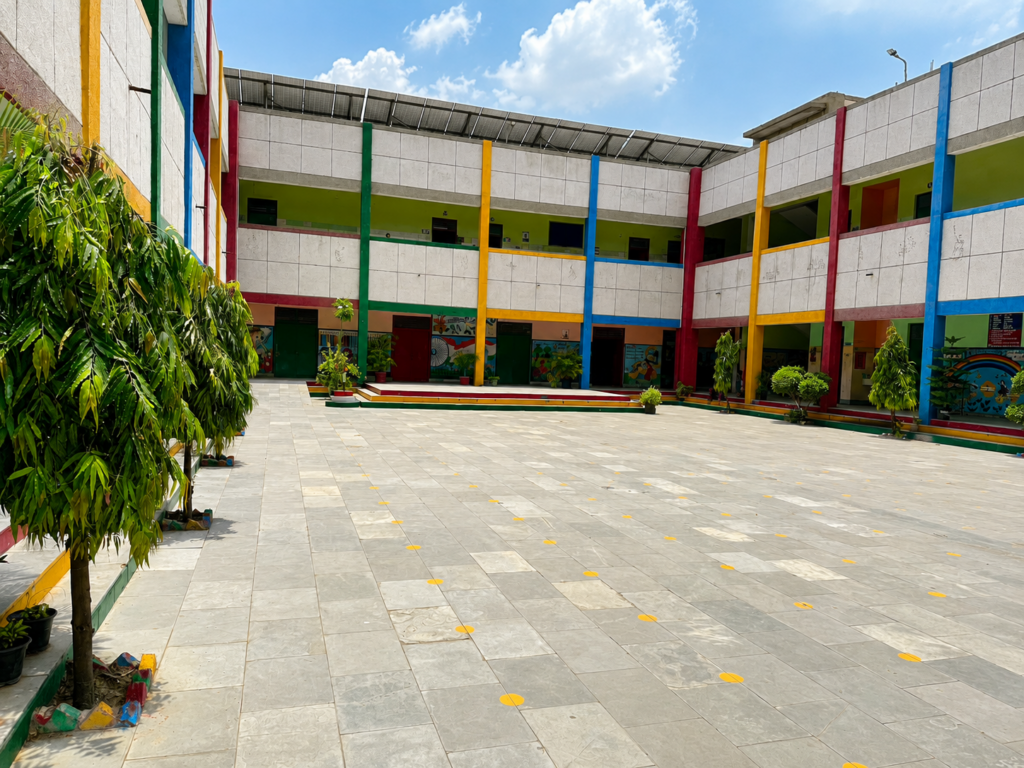
The park has neither a drinking-water facility nor a public toilet, and only a few patches of grass remain. The surrounding footpaths are exposed to direct sunlight and few shaded spaces exist, where families can stop and rest. Even the nearby Municipal Corporation of Delhi (MCD) school playground has little tree cover and no grass, leaving children exposed to the heat during outdoor activities.
Eight-year-old Rajni rarely visits the park before evening. Her mother, Bhagvati Devi, says the afternoon heat leaves children with little choice but to stay indoors.
“The sun becomes so harsh that children simply cannot stay outside. We used to wait until evening before bringing her to the park. But these days, many of her friends don’t come anymore. Their mothers say they get exhausted after playing nowadays, so I usually just bring her here for an evening walk,” she says.
People who have spent years around the park say the neighbourhood has changed in other ways too.
Ved Prakash, a street vendor who has run a small stall outside the park for nearly 15 years reiterates that the park lacks basic facilities. “There isn’t any drinking-water facility inside the park, so children and their parents often come to my stall asking for water.” He adds that because of the heat, children spent less time there even during school holidays.
Read more: Facing intense heat, children in Chennai’s Ramapuram are becoming the city’s climate stewards
When heat takes away play
For fourteen-year-old Roli, spending less time outdoors means not just missing an evening at the park, but also less time with friends. Her mother, Seema Devi, says the difference is noticeable.
“Earlier, children would spend hours playing outside together. Now, they mostly stay indoors until the weather cools,” she adds.
Clinical psychologist Dr Tushita Srivastava says these everyday moments of play are an essential part of childhood.
“Play is not just about physical activity. It is how children develop social skills, learn to solve problems, regulate emotions and build confidence,” explains Dr Srivastava. “When extreme heat repeatedly keeps children indoors, they don’t just lose time in the park; they also lose opportunities to interact, explore and develop independently.”
Dr Srivastava believes schools and communities can help by creating safe opportunities for play even during hotter months, whether through shaded outdoor spaces or indoor physical activities. But in the long term, she says, cities themselves need to become more supportive environments for children.
The United Nations Convention on the Rights of the Child recognises every child’s right to rest, leisure and play. In addition, the WHO–UNICEF–UN-Habitat Guide to Creating Urban Public Spaces for Children states that “safe, inclusive places to play and gather are fundamental to children’s health, development, learning and social ties, and are a core right.” So, a playground that remains unusable because of extreme heat is not merely an infrastructure issue, it limits children’s access to spaces that support their well-being.
Supreme Court Advocate Raghaev R says that protecting children’s access to public spaces is a matter of fundamental rights. “Children’s growth is the country’s growth,” shares Raghaev. “Protecting childhood and ensuring every child enjoys a healthy life is the responsibility of the State.”
The impact extends beyond playgrounds
Extreme heat affects children beyond the neighbourhood park. It reaches into classrooms and disrupts everyday routines at home.
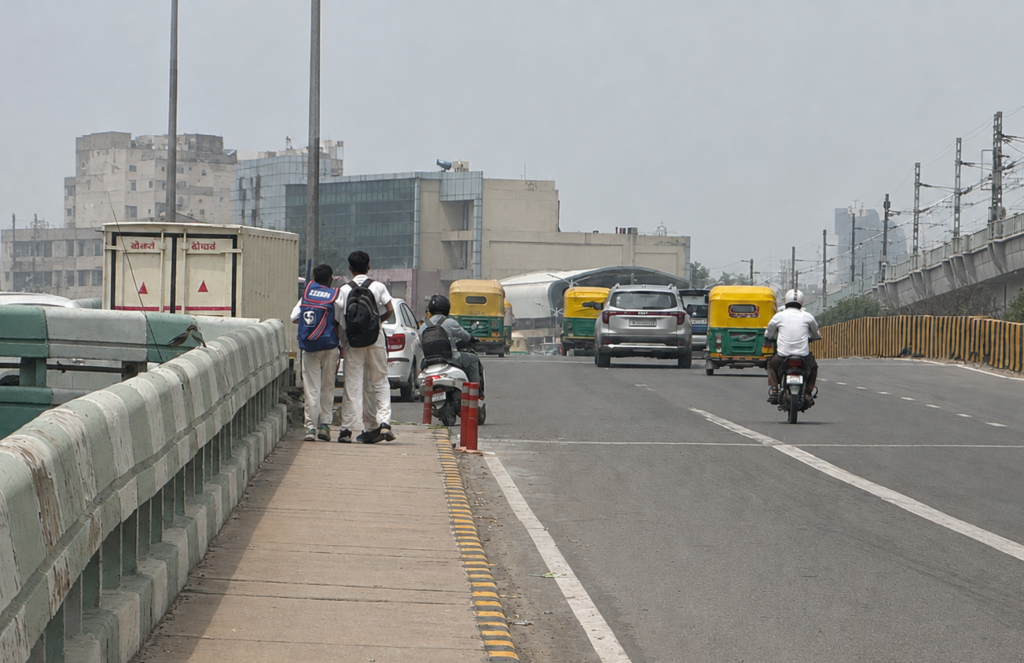
Brijesh Kumar Sharma, father of a nine-year-old, says outdoor activities are now planned as carefully as school schedules. “Children need to play, but during peak summer we are constantly worried about dehydration and heat-related illness. Our home is only about 800–900 metres from my child’s school, but even that short distance is grueling as the footpath lacks shade. I usually take an auto because he gets exhausted walking in the heat.”
Teachers say the challenges continue once children reach school.
Almas Sultan, a science teacher at a Municipal Corporation of Delhi (MCD) school, says nearly 400 students rely on limited drinking-water facilities during the day. The school playground has little tree cover and no grass, leaving children with few shaded spaces for outdoor activities.
“During summer, children often return to class exhausted after spending time in the heat. We see cases of dehydration and heat-related discomfort much more frequently,” she says.
Many of her students also come from migrant families who leave Delhi during the summer vacation and do not always return immediately after schools reopen. “When children come back after long breaks, it takes time for them to settle into classroom learning again. The weather has become another factor affecting their routine,” she says.
Why Delhi’s neighbourhoods are getting hotter
Delhi-based climate expert Vaishali Upadhyay explains that children suffer in parks not just from rising air temperatures, but from how cities trap heat.
“Weather forecasts measure air temperature,” she says, “but people feel heat radiating from roads, concrete, buildings, and metal playground equipment, surfaces that retain and release heat long after sunset.”
This Urban Heat Island effect leaves dense concrete neighbourhoods much hotter than green, shaded areas. To understand how extreme heat affects daily life at the neighbourhood level, Vaishali shared that during a thermal mapping exercise and community heat walk in Delhi, participants took nearly 30 minutes to cover just 500 metres due to the intense heat. Along the route, they found sparse shade and virtually no reliable access to drinking water.
Recognising the need to make cities more resilient to rising temperatures, the India Cooling Action Plan (ICAP) identifies “Thermal Comfort for All” as one of its broad goals. It promotes reducing cooling demand through sustainable cooling measures and integrating passive cooling strategies into buildings and urban planning. For children, this translates to cooler schools, shaded streets and parks that remain usable even during the hottest months.
Moreover, the Delhi Heat Action Plan identifies children as vulnerable to heat-related illnesses. It calls for public awareness, coordinated action across government departments, protection of vulnerable groups and measures to ensure adequate potable water supply during heatwave conditions. Yet, for many children, neighbourhood parks, school surroundings and walking routes still offer little shade, limited access to drinking water and few places to cool down.
For Vaishali, adapting to hotter cities cannot rely only on seasonal advisories asking people to stay indoors.
“We need to redesign neighbourhoods so that people can continue using public spaces safely,” she says. “That means more shade, more trees, better public transport, drinking water, cooler public spaces and planning that treats heat as a permanent urban challenge rather than a temporary summer problem.”
What would a child-friendly city look like?
For urban planner Prabaldeep Gautam, the solution does not begin with building more parks. It begins with making existing neighbourhoods easier and safer for children to use.
“A child-friendly city is one where children can move safely, play freely and reach schools, parks and other public spaces without barriers,” he says. “As cities become hotter, this also means designing shaded streets, planting more trees, creating drinking-water facilities and ensuring parks remain usable during summer.”
Many of these ideas already guide global urban planning. UNICEF’s Child Friendly Cities Initiative encourages local governments to place children’s rights, needs and perspectives at the centre of urban planning and governance, ensuring that neighbourhoods are safe, inclusive and accessible for every child.
Several cities have begun putting these principles into practice.
In Barcelona, the Superblocks programme has transformed neighbourhood streets into safer public spaces by reducing traffic. Rotterdam has redesigned public spaces with climate adaptation in mind, using trees, green infrastructure and water-sensitive design to keep neighbourhoods more resilient to extreme heat. Meanwhile, Singapore’s 10-minute neighbourhood model integrates parks, schools, housing and community facilities so that children can reach everyday destinations on foot.
Gautam believes Delhi does not need to replicate these cities. Instead, it can adapt the ideas to its own neighbourhoods.
For parks like the one in New Friends Colony, simple improvements such as increasing tree cover, creating shaded seating, improving walking routes and providing drinking water can make a marked impact.
Urban researcher Ujjawala Krishna says children should also become part of this conversation.
“Climate education should begin with the neighbourhood children live in,” she says. “When they start noticing why one street feels cooler than another or why some parks remain comfortable while others do not, they begin to understand that cities can be designed differently.”
(With inputs from Rishabh Shrivastava.)
[This article is written as part of the Art & Media Fellowship under the Cities on Fire Initiative in Bangkok, Colombo, Jakarta and Manila and ‘Cooler Cities. Healthier Children. Brighter Futures.’ Initiative in New Delhi.]