In the latter half of November 2017, as bulldozers razed some unauthorised religious structures that stood tall on Chitlapakkam Lake for years, hordes of curious onlookers gathered on the streets, pausing their daily chores. Led by senior IAS officer P Amudha, the Public Works Department demolished a few temples, a mosque and a church that residents have been emotionally and spiritually connected to, for decades.
What warmed the officials’ hearts were the smiles on the faces of the people, many of whom lauded the speedy action. But, can we expect similar action in all the water bodies of Chennai?
Religious structures on arterial lakes
Structures of worship, illegally erected on water bodies in Anakaputhur and Sembakkam, continue to draw crowds of worshippers. Allegedly maintained by those with political and extremist connections, eviction of these structures should be done in a phased manner, say officials from the Public Works Department.
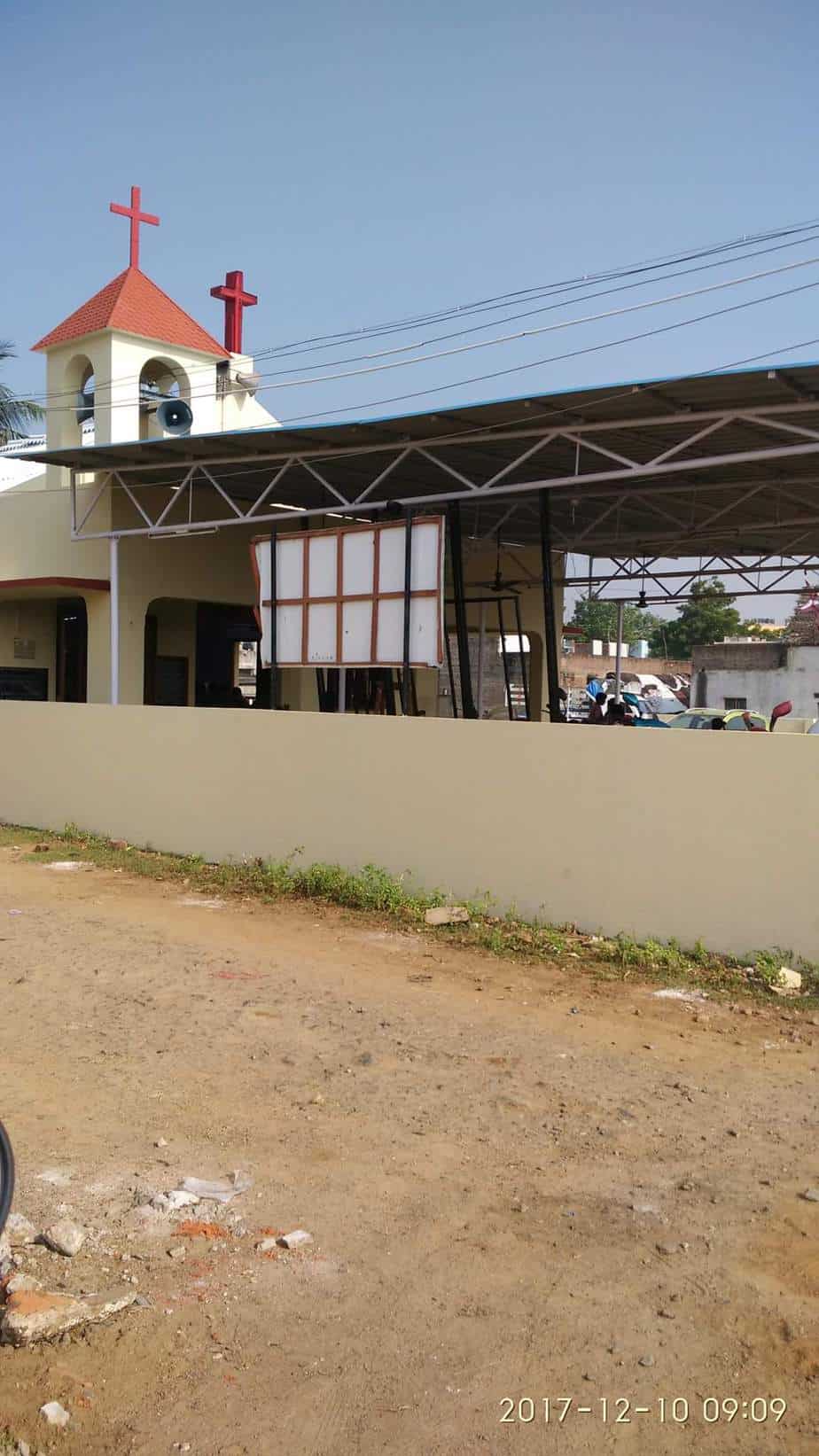
An ECI church constructed on the premises of a water body in Anakaputhur. Pic: David Manohar
On the banks of a water body in Anakaputhur, an ECI church has found space since many years. A large portion of the lake was encroached upon by the Anakaputhur Municipality itself when it constructed overhead water tanks, parks and public toilets.
Explaining the pattern of encroachment, David Manohar of NGO Arappor Iyakkam says, “An entire residential locality emerged on the water body, after which a church was constructed. No objections were raised against the religious structures as they are partners in crime. Religious emotion plays a role too.”
On the banks of Sembakkam lake, Shanthi Durgai Amman temple maintained by SVV trust is a long time encroachment. Such encroachments have led to considerable shrinkage of the water bodies, reducing capacity. Not only are people from the Trust unconcerned about ecological destruction, some of them are up in arms against activists pushing for eviction and restoration of the lake.
How Chitlapakkam paved the way
What inspires hope, however, is the fact that except for a few extremists abusing activists and officials for damaging temples, the move in Chitlapakkam brought no uprising among the general public. A 15-year-old Ayyappan temple with an attached wedding hall, a Saibaba temple with a library, the 30-year-old Nagavalli Amman temple and the Sri Gayathri Kalyana Mandapam with a small temple were the religious structures that were initially demolished in the Chitlapakkam lake.
A week ago, a mosque and a church that encroached the canal of the lake were also brought down, after service of reasonable notice period.
“While the mosque encroached over 30 feet of the canal, the church on the east side of Periyar street occupied around five feet. They were evicted after days of demarcation by the revenue department,” said S Vaidyanathan, an advocate who filed a public interest litigation to evict the encroachments in Chitlapakkam lake this February.
A set of people connected to the religious structures cornered the activists for spearheading the campaign on eviction. “When Ayappan temple at Chitlapakkam lake was demolished, people played the cards of Hindutva, and abused me for acting against their religious structure. Despite being a Christian, I had also complained against the unauthorised church here. Religion plays no role, as it is about saving our water bodies,” said David Manohar.
In a similar case, a Hanuman temple that was constructed on the bunds of Peerkankaranai lake was also demolished, after days of demarcation and issuing notice.
Social media connected the dots
Deities who were listening to people’s prayers were no more. Though a majority of people were frightened and confused over the move a few years back, a wide change was witnessed. It was a collective effort at Chitlapakkam, as a set of people were educating the people over social media, while others were filing PILs and meeting officials.
Chitlapakkam Rising, a public group with over 3,128 members posted pictures of inundation and encroachments, thus wiping off the non logical religious thoughts from the minds of public. “Sustained social media campaigns and audits brought change. Besides, it was the people who had suffered the most during the recent rains, with their residences flooded up to 4 feet. The demolition happened at the right time and the public was in fact cheerful,” said Sunil Jayaraman of the Chitlapakkam Rising group.
“Which god would want to be present in encroached space, in a way that harms nature? It is unfair to make god a reason for people’s woes (floods),” said R Lakshmy, an ardent Ayyappa devotee.
Yes it’s a huge task for us to evict religious encroachments which is to be handled like a walk on the rope as it’s a most sensitive issue. Our respectable madam Tmt Amutha ias MO, P. PONNAIAH IAS COLLR KPM gave guidance to evict watercourse encroachments this time in a firm manner. This gave confidence to us. We Revenue pwd police officers jointly discussed the arising situation and had peace talk,explained with all concerned religious trust members.Finally all religious eviction also done peaceful – Chandrasekaran, Revenue Divisional Officer Tambaram
Nice write up.
Good work and nicely done. Please also arrange to clear all garbages near the Chitlapakkam lake and identify some other place for it. You will have to vacate the families who stay there near the lake. And help to maintain cleanliness all the time.
What about the deities which were in the IYYAPPA TEMPLE ?
Any body knows where are they now reinstalled / kept?
Please share the information.