Broken footpath puts students at risk

Hundreds of college students risk their lives everyday walking on the busy ORR in Nagarbhavi, thanks to broken footpaths.

A 600-metre stretch of footpath, along the Old Outer Ring Road in Nagarbhavi, has become a nightmare for pedestrians. This stretch starts from the main gate of Dr Ambedkar Institute of Technology (Dr AIT), a leading engineering college, and ends at Kengunte Circle. The Indian Institute of Plantation Management (IIPM), an educational institution under central government’s Ministry of Commerce and Industry, is also located along this stretch.

This stretch of footpath is perilous for the thousands of students and staff of IIPM and Dr AIT, and the general public, who use it everyday. It is ever-filled with vast volumes of garbage, which even overflows onto the ORR.

There are also many obstructions on the footpath, preventing free movement of the public. For example, the footpath was recently dug up to lay Optical Fibre Cable, but was not professionally closed.
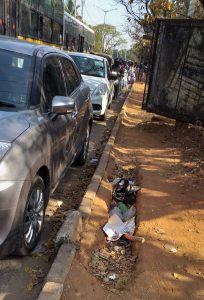
OFC and other obstructions on the footpath. Pic: Gundappa Srinivas

Because of these obstructions and garbage, and unevenness of the footpath, pedestrians end up walking on the very busy ORR, risking their lives. When vehicles stop at the traffic signal at Kengunte Circle, pedestrians get jammed up on the road, unable to walk freely.

Under the circumstances regular commuters are really crying out for authorities to:

  • Build a slip-proof footpath from Dr AIT to Kengunte Circle, that is accessible to both the elderly and people with disabilities
  • Have zero tolerance to garbage, with strict monitoring, to keep the footpath clean
  • Remove obstructions on the footpath, especially ugly structures like the BDA layout plan displayed close to Kengunte Circle, so that there is space to walk
  • Build spacious, disabled-friendly bus shelters at Kengunte Circle

Leave a Reply

Your email address will not be published. Required fields are marked *

Similar Story

Cycle city no more? Audit reveals only 11% of Pune’s roads pass the test

Pune is set to host the 2026 Grand Tour, but a Parisar audit reveals unsafe, narrow, and encroached cycle tracks across the city.

Children and adults pedalling to school, work and play — this was a common sight on Pune's streets not so long ago. Once known for its vibrant cycling culture, the city still has many groups and communities that promote non-motorised transport. However, with the rise of motorised vehicles, cycling has not only taken a back seat, but has also become unsafe and inconvenient due to poor infrastructure. This is despite Pune having dedicated cycle tracks and lanes. The decline in cycling infrastructure is reiterated by a recent audit, which found that only 11% of cycle tracks in Pune fell in…

Similar Story

Why accessibility remains elusive at Bengaluru’s bus stops and terminals

Our reality check of the city's major bus stops revealed that most do not adhere to MoRTH guidelines, excluding persons with disabilities.

Bengaluru is racing to bridge the gap between first-mile and last-mile connectivity in public transport, but for people with disabilities, the journey is riddled with obstacles. Inaccessible bus stops and terminals in the city keep them excluded. “I have been travelling on muscle memory alone. There are no supportive facilities or infrastructure in bus stops or terminals,” says Mohan Kumar, a visually-impaired person who has been commuting in Bengaluru buses since 2012.  The exclusion starts at the bus stop. “Even if buses are inclusive, it is nearly impossible to reach the bus stops in Bengaluru due to poor design and…