Over the last few decades, we are witnessing how in the name of development our communities are being destroyed and our neighbourhoods transformed. This stems from the negligence and continued apathy of public officials and crippling of government institutions.
Cities exist for its citizens, and all modern cities work on that fundamental principle. It is thus imperative that we, citizens of Bengaluru, have to take up on ourselves; to fight against massive corruption and institutional failure, misuse of public assets, deeply entrenched vested interests and the nexus of builders with public officials.
Swarajya in association with Namma Bengaluru Foundation and Public Policy Club of IIM-Bangalore, today hosted a one-day Urban policy conclave, ‘Swarajya Cityscapes – Reclaiming Bengaluru’. An impressive array of thought leaders—influential policy analysts, practitioner, commentators and policy makers that included Rajya Sabha MP Rajeev Chandrasekhar, D Roopa (IPS), R Jagannathan (Editorial Director, Swarajya), G Raghuram (Director, IIMB), Deepak Malghan (Dept of Public Policy, IIMB), Dr. TV Ramachandra (IISCc), S Vishwanath (Expert, Rain water), Yellappa Reddy (Former IFS), Nitin Sheshadri(RWA), N S Mukunda(Urban Expert), Prakash Belawadi (Actor, Activist) and others had attended the workshop.
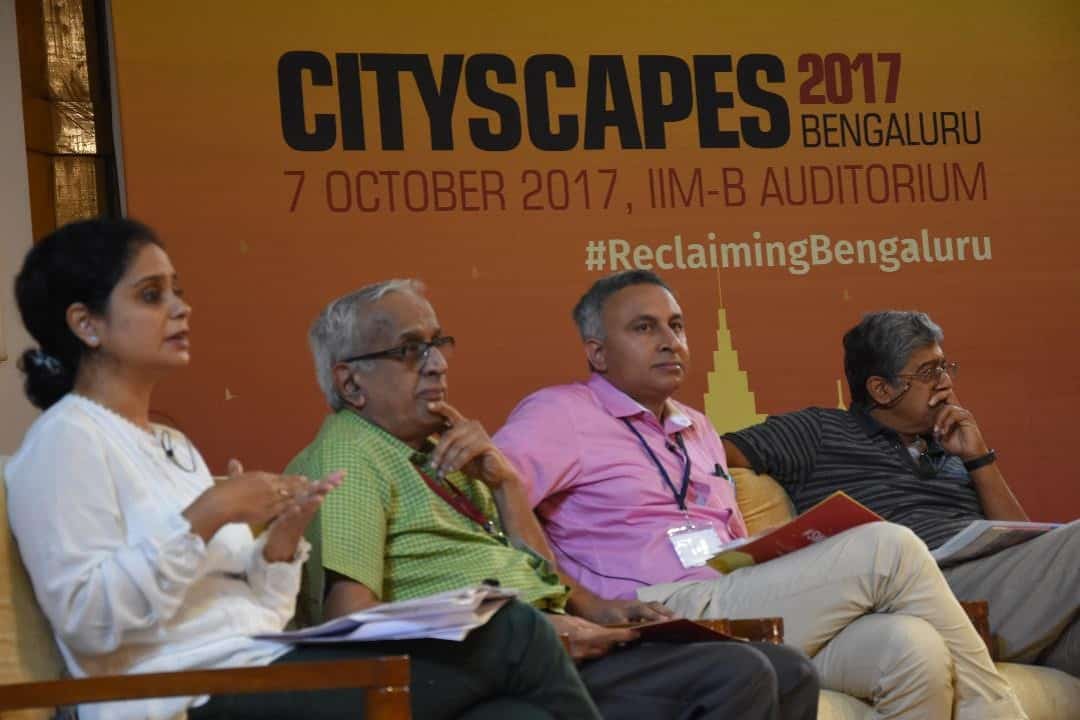
Sneha Nandihal, N S Mukunda, Nitin Seshadri, Vijayan Menon deliberating on Common Zoning in Bengaluru Pic: NBF
The themes were Citizen’s Role in Reclaiming Bengaluru, Water sustainability in Bengaluru – Way ahead; Urban Planning – zoning and enforcement; Swaccha Bengaluru – Garden, Not Garbage city; Beyond Bangalored – How can India’s IT capital Maintain its Pre-eminence as a Tech and Innovation Hub; Re-imagining Urban Transport- Roadmap to a sustainable model; Making Bengaluru a 21st Century Smart City; among others. Professors at IIMB also presented case solutions on Land Titling, Real estate, Solid waste management and Transport.
The deliberations and conclusions will also be shared with the government and other public bodies.
Rajeev Chandrasekhar, MP, Rajya Sabha said, “Ever since I entered politics, I have addressed many problems and challenges of the city to ease the life of citizens. The crises of the city are the real one and it is urgent one, we have to get rid of ‘Ok Chalata Hai’ attitude. The current state of the city whether its floods due to rains, garbage, pollution is due to years of neglect. The collective citizens apathy has allowed the government to conveniently forget and ignore the city.
The biggest crook today are not the corrupt officials, greedy builders or the useless government, but it is our collective apathy that is allowing all this. We don’t stand up for the things that we want to be right, rather we just get used to it and allow it to grow. Citizens of Bengaluru are always in a state of war with the government as the public is not consulted while planning projects like steel flyover, metro or the road widening.
We live in a city with finest educational institutes like IIM-B, IISc and others, we have world class health facilities, most of the fortune 5 technology companies have offices in Bengaluru but still we lack basic facility.”
Prof. Raghuram, Director, IIM Bangalore said, “Bengaluru has contributed so much globally and has made a name for itself. But the issues like traffic and pollution is taking its charm out. If we don’t address these issues now, we will be city the death of this beautiful city. We are here to discuss the issues and see how public can get involved in addressing these issues.”
Dr. T V Ramachandra said, “Bengaluru needs proper planning to survive, as few decades back 70% of Bengaluru had green covered and today due to the growth it has reduced to 20 – 30%. To ensure that this population survive, we need to have enough water. But these days most of the water bodies are vanishing due to encroachment by influencers and ground water level is also depleting and in some areas, it is also getting polluted. To solve this, we need to decongest the city and to do this all the experts should come together under one roof and plan for the city.”
Yellappa Reddy, Former IFS and Chief Conservator said, “Most of the industries in Bengaluru have taken things for granted and it is going to an extent that they are deciding the policies and no one is questioning them. Pollution level is lakes have reached to its peak and we know what is the status of Bellandur and Varthur lakes. Only way to protect our city is, citizens must come together and fight for it.”
D Roopa, Commissioner, Road Safety and Traffic said, “People come to me complaining about traffic but I myself am a victim to traffic inspite of being the commissioner of traffic. During Motor Vehicle Amendment Bill discussion in Bengaluru we had presented few suggestions and one of them was to impose criminal liability on the road construction authority like National Highway Authority, State Highway Authority and the municipal corporation for accidents due to pot holes. Because we see most of the accidents are caused due to potholes and these agencies constantly ignore the potholes.”