Recent news has it that the Greater Chennai Corporation has decided to take steps to counter the menace of posters in Chennai. A battle that our city has been fighting probably from the time when print became a possibility. The latest in the various rather ineffective measures our city fathers (and mothers) have decided upon is to levy a fine of Rs. 200 on those responsible, if the poster is on a wall, and Rs. 500 in case it is on a signboard, provided that a police complaint is made.
It must have been quite clear to those who approved this measure that it is toothless even at inception.
Read more: Why Chennai has not been able to get rid of illegal street hoardings
Political parties’ posters abound in Chennai
Just consider the facts. Firstly, the biggest offenders as far as this nuisance is concerned are the political parties themselves. In fact, all our elected councillors fought and won using posters that they liberally had pasted on the walls of buildings, both public and private. Who in their right senses is going to go about registering a police complaint against a local politician, whose favour will probably be needed in future and who in all likelihood will make life difficult for those who rub him/her the wrong way?
Secondly, it is very evident as you go around the city that the bigger the politician the more the number of posters on the personality. In which case it is up to these senior politicians to instill discipline into their followers so that they desist from putting up posters at all available places extolling the virtues of the former, both real and imaginary.
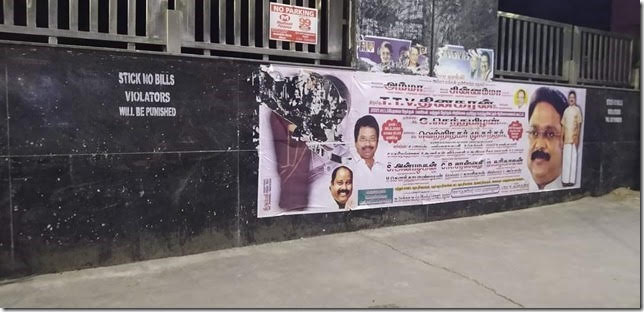
On the contrary what is prevalent is that the areas surrounding VIP politician residences are the worst affected by posters. Of course, the leader’s house walls remain clear of such things, and it is the neighbours who pay the price.
So, for a start, why does the Chief Minister, his family members and members of his cabinet not resolve to put a stop to posters extolling them? It is far easier to simply appeal to the public ‘to co-operate in controlling this menace’ is it not?
Of course, it is not just politicians who print posters. The film and entertainment world is another offender. Even Tamil media is not immune – most Tamil periodicals print posters of their forthcoming issues and splash them all over city walls. Add religious events, funeral notices and quack medical remedies and you have a full hand. Not everyone can be tracked and punished.
Punitive steps to curb posters in Chennai
If such self-discipline is not possible, the next best option is to use technology. With cameras ubiquitous now, surely it will be possible to identify poster-pasting activity as and when it happens. All it requires is for the police to be empowered to remove the posters and also warn off those who come to paste them that they should not be seen pasting posters in future in that area. The patrol too can be given this responsibility.
There is also the Tamil Nadu Open Places (Prevention of disfigurement) Act, 1959, which actually empowers the police to take action. It is just that nobody seems interested in making this happen.
Read more: Banners and hoardings to be back on city streets, much to citizens’ dismay
Regulatory measures the way forward
The truth is that posters are a business by themselves. There is an entire ecosystem that depends on this industry and a blanket ban in all likelihood will affect many lives. It will have the same impact that the blanket ban on large outdoor hoardings had when it came about a decade or so ago. What is needed in reality is a regulated approach to posters.
The Corporation may well consider putting up large concrete wall spaces in some public areas where posters can be permitted. The location in each area can be decided in consultation with the local councillor. Violations need to be dealt with strictly, with the political party/organisation being fined with regularity and a list of repeat offenders being published.
But such discipline is very hard to impose unless there is political will, failing which, it is all posturing.
As of now, the Corporation can take satisfaction in the Rs 16 lakhs or so it collects each year by way of fines – a small amount when you consider the volume of posters.
[This story was first published on Madras Musings and has been republished with permission. The original article can be found here.]