COVID: Post-COVID care centre at Omandurar, Covishield vaccine trials enter second phase
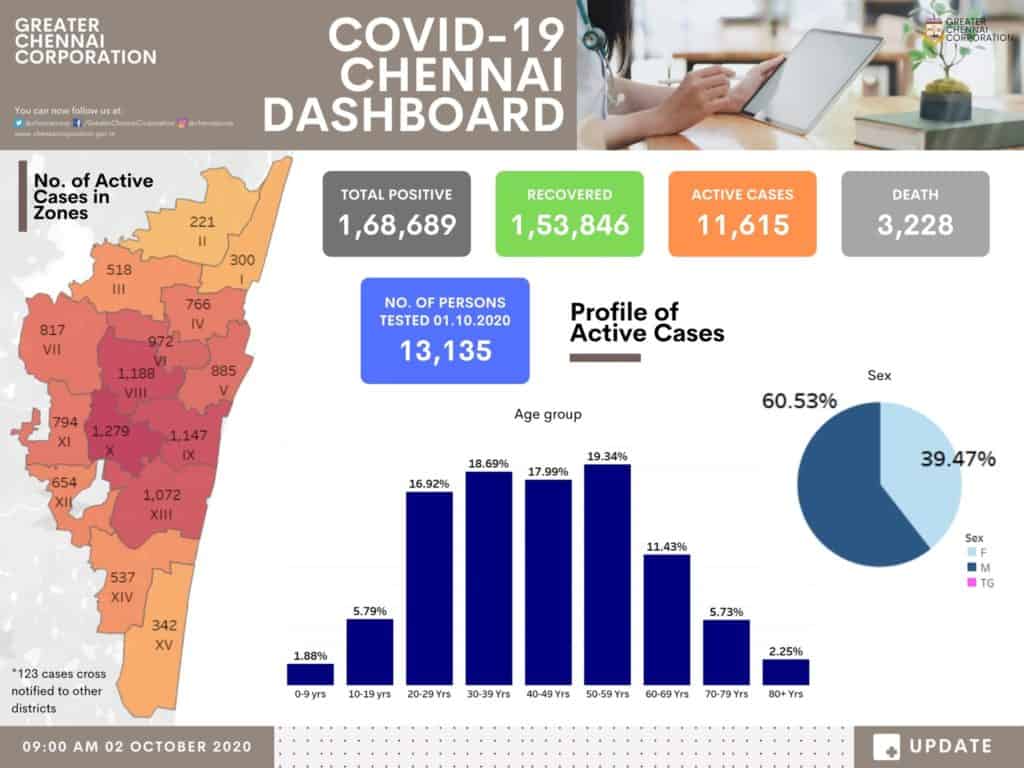
On October 1st, 1,289 fresh COVID cases were registered in Chennai. The day also saw 1,000 recoveries and 18 deaths.
In a bid to offer post-COVID care for recovered patients, the state health department inaugurated an exclusive facility at the Government Medical College Hospital, Omandurar Estate. The centre will have the following facilities: automatic body mass index machine, spirometry for assessing lung function, a six-minute walk test to detect SPO2 (oxygen saturation) levels, a CT scan, an automated cell counter for blood test, physiotherapy, static cycle and step test to estimate the impact of COVID-19 on heart, ECG, psychiatric counselling, medication. There will also be a service that provides guidance of practicing yoga.
The clinical trials of the COVID-19 vaccine ‘Covishield’ has entered the second phase in Chennai. Jointly conducted by the Indian Council of Medical Research and the National Institute for Research in Tuberculosis, the trial is being carried out at the Rajiv Gandhi Government General Hospital and Sri Ramachandra Institute of Higher Education and Research. Around 300 volunteers would be injected with the vaccine in the second phase.
Source: The Hindu
New master plan to focus on calamities caused by climate change
With technical aid from the World Bank, the Chennai Metropolitan Development Authority (CMDA) is drafting the city’s new master plan with key focus on dealing with the impact caused by climate change induced natural calamities.
Climate and disaster resilience study, geo-spatial mapping, analysis of the river drainage basin and flood plain mapping will be carried out in preparation for the master plan. The groundwork to formulate guidelines has already begun with help from GIS Expert and Climate Resilience and Environmental Specialist.
As part of the new plan, urban planning mechanisms including land use will be strengthened. Affordable housing will be another focus area in the master plan that will chart out a plan for the city’s growth until 2046.
Source: The New Indian Express
Suburban trains to resume from October 5th
Beginning October 5th the suburban train services will be back on track in Chennai. However, the service is intended only to cater to essential service providers as of now. The trains have been called the ‘workmen special trains’. The commuter will be accredited by the state government for entering the station premises with special permission cards with details such as name, designation, department /office etc. Upon providing special permission and the photo ID card issued by their workplace, the personnel will be permitted to travel.
The Southern Railways stated that the train coaches will be sanitised from time to time. Passengers are mandated to wear a mask, maintain distance and will be screened upon entering the railway station.
Source: The News Minute
Report reveals presence of bacteria and chemicals in Velachery lake
A detailed report submitted by state authorities to the National Green Tribunal (NGT) revealed the presence of bacteria, chlorides and total dissolved solids (TDS) in Velachery Lake and the storm water drain (SWD) network connected with the water body.
To handle the situation, the Chennai Metro Water Supply and Sewerage Board plans to block the sewage from entering the lake by constructing weeping weirs. This will direct the sewage to one of the treatment plants instead of into the lake. The Water Resources Department (WRD) is also set to clear 1,100 encroachments along the lake, de-silt and strengthen the lake bund.
Source: The Times of India
Mandaveli eviction stalled till October 13th
While hearing the petition filed by Pennurimai Iyakkam, the Madras High Court bench of justices — MM Sundresh and R Hemalatha — have ruled that the Tamil Nadu Slum Clearance Board (TNSCB) cannot evict 300 residents of Mandaveli tenements until October 13th. The residents sought time to relocate and an allowance for the move as many have taken ill or lost jobs during the pandemic.
The petitioner has requested the postponement of any development activity until the academic year to ensure the hundred-odd children living in the tenements are not impacted. The counsel representing the petitioner stated that the TNSCB defied the natural laws by not issuing a prior notice. The bench has directed the TNSCB to submit a detailed report in two weeks.
Source: The New Indian Express
[Compiled by Bhavani Prabhakar]