Covid-19: TN reports 18 new cases, active total rises to 77
On Tuesday, 18 individuals in Tamil Nadu tested positive for COVID-19, contributing to a cumulative total of 77 active cases. Among the newly reported cases, Tiruvarur recorded nine, while Chennai documented five, Tiruvallur two, and Coimbatore and Villupuram each reported one case. A thorough examination of 230 samples took place across the state. As of the latest available data from Monday, Tamil Nadu’s overall test positivity rate was registered at 2.3%.
Source: The Hindu
Rare venomous marine life surfaces at Chennai’s Besant Nagar beach
At Chennai’s Besant Nagar beach, beachgoers recently observed the presence of two venomous marine organisms typically found in deep-sea environments. The Blue Sea Dragon (Glaucus atlanticus), a nudibranch or sea slug, and colonies of Blue Button (Porpita porpita) washed ashore in large numbers. Discovered on December 17 by Srivatsan Ramkumar, a local and member of the Environmentalist Foundation of India, these organisms, although capable of injecting venom, are not considered lethal to humans. Blue Buttons, named for their button-like appearance, form colonies of small predators called hydroids. Blue Sea Dragons, known for their striking appearance, are a rare sight as they usually inhabit the deep oceans.
According to Joe K Kizhakudan, a scientist at the Central Marine Fisheries Research Institute (CMFRI), sightings of blue dragons are rare, but historical records indicate their presence near Kovalam shores. While blue dragons are slightly venomous, they pose a potential threat to beachgoers. They feed on venomous siphonophores, violet snails, and the dangerously venomous Portuguese man o’ war. The blue dragon stores the man o’ war’s stinging nematocysts, and contact with them can cause pain. However, Kizhakudan notes that they cannot survive in daytime heat, urging caution for those swimming in shore waters.
Source: The Newsminute | The New Indian Express
Read more: COVID second wave in Chennai: What to do if you test positive
Chennai Metro Rail grants contract for platform screen doors installation in Phase-2 elevated sections

Chennai Metro Rail has granted a contract to ST Engineering Urban Solutions Ltd for the installation of half-height platform screen doors at 36 stations in two elevated sections of phase-2. These sections cover the Sholinganallur Lake to Sipcot 2 on corridor-3 and Grain Market to Elcot on corridor-5. Valued at ₹159.97 crore, the project aims to enhance passenger and operational safety by implementing the half-height platform screen doors system across the specified elevated stations.
Source: The Times of India
Chennai Metropolitan Development Authority’s vision for comprehensive expansion
The Chennai Metropolitan Development Authority (CMDA) is undertaking an ambitious initiative to establish self-sustaining and comprehensive neighbourhoods in anticipation of a five-fold metropolitan area expansion. With the inclusion of suburban areas like Gummidipoondi, Arakkonam, Thiruthani, Kancheepuram, Tiruvallur, Mamallapuram and others, the CMDA’s jurisdiction is set to increase from 1189 to 5904 square kilometres. To facilitate this expansion, an economic study will be conducted to inform the development of new localities, focussing on improving living conditions in key areas such as health, education, lifestyle, infrastructure, employment, connectivity and investments
Source: The Times of India
Read more: Making Chennai safer during infrastructure development work
Chennai Corporation dispatches relief material to flood-hit South Tamil Nadu
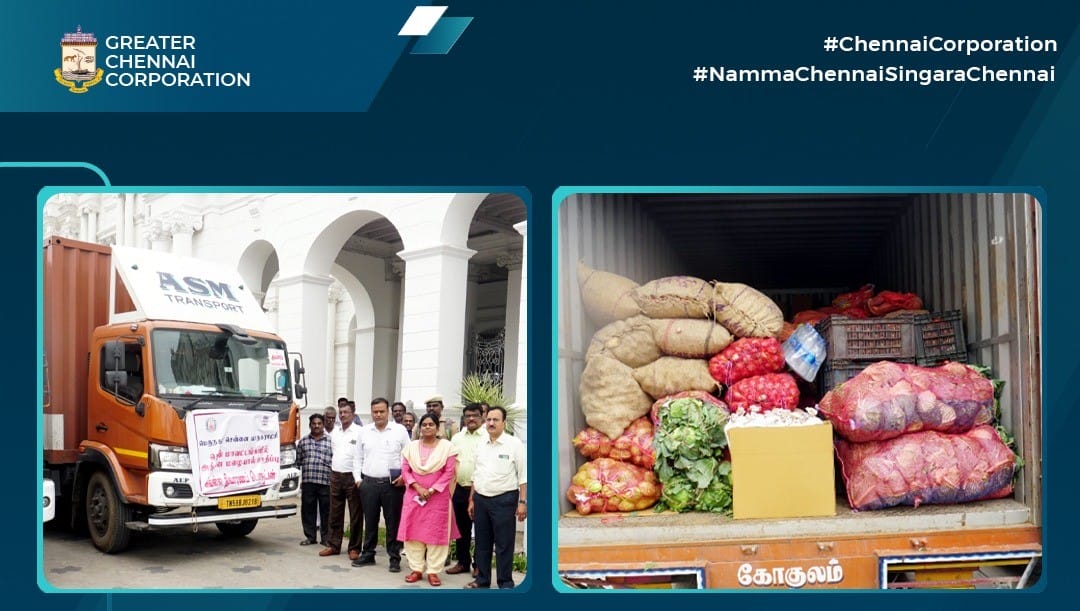
The Greater Chennai Corporation has sent relief material valued at Rs 37 lakh to flood-hit districts in South Tamil Nadu. Intended for 1,000 families, the aid package includes essential items such as rice, oil, sugar, salt, milk powder, dal, spices and biscuits, along with mattresses, bedsheets and pillows. Four trucks carrying these supplies are scheduled to reach Tuticorin, Tirunelveli, Tenkasi and Kanyakumari by the end of the day.
Source: The Times of India