Elliot’s Beach in Besant Nagar is one of the most abused natural spaces within the city.
The beach was in pristine condition until the early 1980s, with sparkling sand with two prominent structures, the Karl Schmidt Memorial and the governor’s Guest house with terracotta tiled roof. It was a scenic beach with scattered Ipomea patches.
Uca crabs could be seen busy de-silting their burrows at the same time being vigilant about their safety from their predators and humans.
There would be three rolls of ropes, used for dragging the net, stacked neatly in a circular pattern by the well-disciplined fishers. They had great respect for this Neithal space.
Many times kids, as well as adults who visited the beach, would not return home without collecting colourful shells of various shapes.
The public enjoyed the sand, the waves and the salty breeze irrespective of age.
But much has changed in recent times.
Read more: Playground or public convenience? Doomingkuppam’s sanitation woes
Changes to the Besant Nagar Beach
Over the past decade, the sand has lost its sheen. The beautiful governor’s guest house is now invisible and the sea view has been lost due to the uncontrolled increase of eateries on the beach and high raised wall-like structures installed by a private amusement park to cordon about 10% of the total sandy beach.
The Uca crabs can no longer be spotted in numbers.
The eateries had taken its lion’s share of about 30%, converting the beach into a food court with open kitchens. Some spots have turned out to be open bars and urinals.
A few years ago, under the central government project “Swadesh Darshan”, at a cost of nine crore rupees, beautification of the beach was undertaken.
This included a concrete promenade for people to walk and sit on the slightly raised wall covered with granite tiles bordering the promenade.
A garden on the beach with Arabian tent-shaped umbrellas was installed so that people can sit and enjoy the sea view.
Installation of toilets at Besant Nagar Beach
As part of the beautification efforts, the authorities also installed two fibre-made bio-toilets permanently just on the promenade at the midpoint of Elliot’s Beach in 2013.
It was then removed from that location after strong objection and a signature campaign conducted by the residents’ collective SPARK.
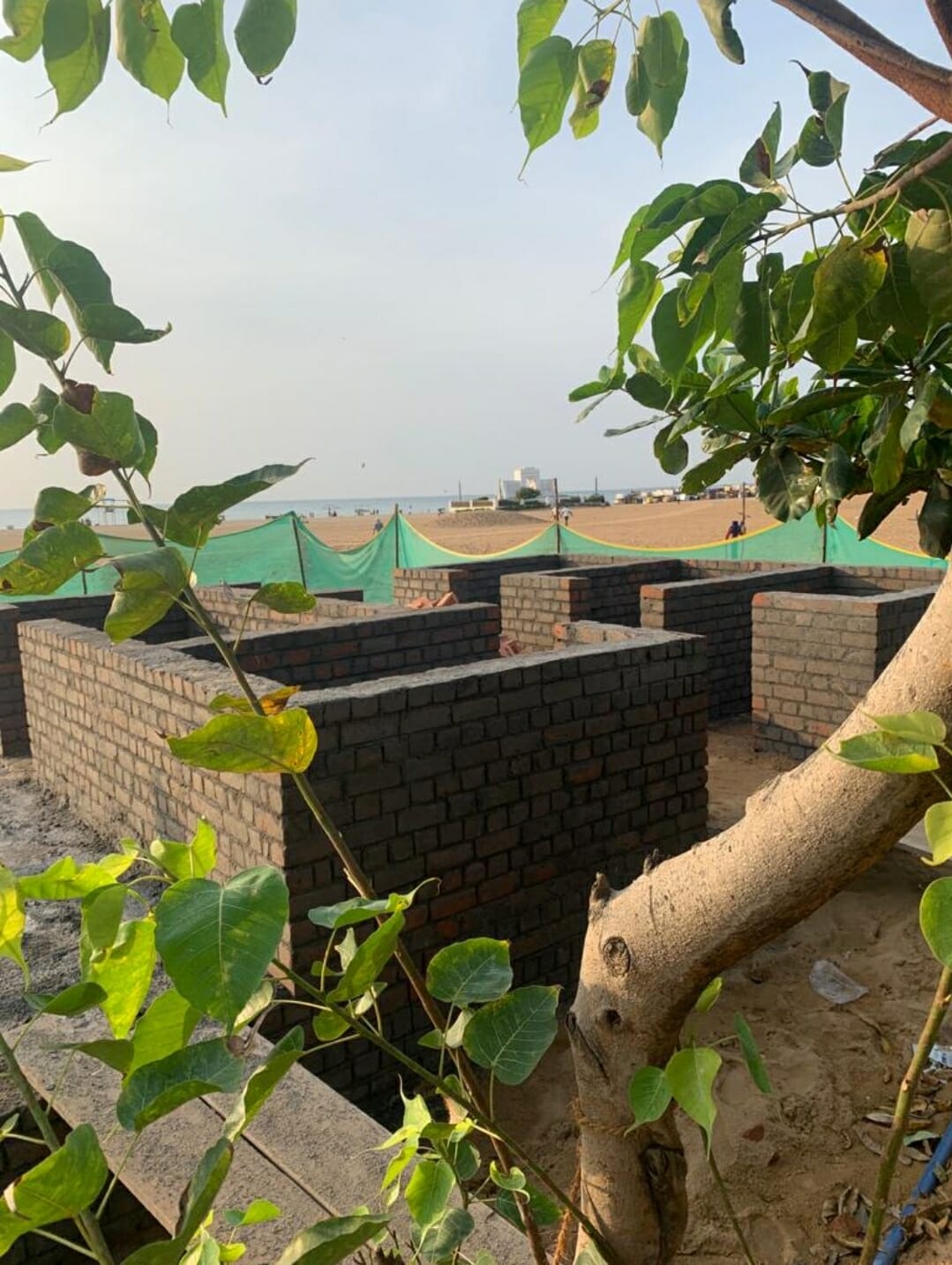
Despite knowing the objection of residents, ten years after the first campaign against toilets on the beach, the Councillor of Ward 174 has initiated the construction of conventional public toilets (six compartments) in the very same location on the sand blocking the sea view.
If it is allowed then people who sit on the walls of the promenade will not be able to sit there as they can only see the toilets in front of that location. This not only blocks the view but also violates the CRZ rules which say no concrete structures should be created on the beach.
This has been constructed within 200 meters of high tide.
Not only does the construction of the toilets spoil the aesthetic of the beach, but it also has an adverse impact on the environment around it.
There is no dearth of alternative sites for the public toilets which are a necessary feature in an area that sees a high footfall. There is a metro water pumping station space opposite the beach on the same road. The toilets can be built in the periphery of that space. Another unit could be constructed in the alignment of the Balwadi School that is being operated on the northern end along the road that enters Urur Kuppam.
Read more: Revamping the public toilets of Chennai
Efforts by residents to relocate toilets from Besant Nagar Beach
Once the plans for the new toilets were made public, residents – through SPARK, have raised their objections to the project. A signature campaign was conducted and visitors to the beach to were sensitised on the matter. We secured signatures from about 300 visitors to the beach – which included local residents, the common public and also tourists from other districts and states. They were all shocked to know that a toilet is being constructed at the midpoint of the beach.
A petition along with the signatures was submitted to the GCC Commissioner J Radhakrishnan. It was forwarded to the Joint Commissioner Sameeran. We were then assured that the construction work on the toilets would be stopped and the toilets will be relocated. In parallel, RDC South Region Chennai was also requested to take action.
The issue was also brought before Mayor R Priya during the Makkalai Thedi Mayor programme in Zone 13. We were once again promised a quick resolution to the issue.
The construction of the toilets has now been stopped. The local residents now want the half-constructed structure to be demolished as a course correction.
A repeated mistake of not consulting the public by the Greater Chennai Corporation (GCC) has been observed when amenities are created for the public.
The GCC needs to be more cautious while executing such projects in the precious natural space, to ensure the conservation of the beach without any adverse impact and at the same time to provide proper amenities which would be used and maintained properly.
Through collective action, we were able to avert long-time damage to the beach. But repeated moves such as this will put a strain on the fragile ecosystem of the beach.
Stakeholder meetings and consultations with experts must be undertaken before the civic body is to announce any such projects in the city.