Bengaluru is at a historic juncture today. The State Government has recently made some big-ticket announcements as far as the bus is concerned, announcements which if followed up with their implementation as announced, will change the face of Bangalore. This Saturday, December 7, will see a discussion on what all is needed to transform Bangalore Metropolitan Transport Corporation’s (BMTC) public service into one which serves all and serves well.
Bengaluru’s transformation from the laid back garden city with a pleasant climate into a massively built up concrete megapolis of people and vehicles infamous for its traffic happened to a large measure, due to the urban mobility policies the city adopted under successive governments. Road widening, signal free corridors, indiscriminate building of flyovers and underpasses and elevated corridors have dominated the mobility approach in Bengaluru. The only new public transport was in the form of a single costly infrastructure project, the Bengaluru Metro which continues to be ill-equipped to address the city’s needs while adding considerably to its woes. The consistent demands from a section of activists and mobility experts and ordinary people of the city for sustainable and equitable mobility with the bus playing the central public transport mode mostly fell on deaf ears.
Details
Date: December 7, Saturday
Time: 3.30 PM
Venue: Institute of Agricultural Technologists, Queens Road (Next to Congress Office), Bengaluru
But all of this is set to change. Bengaluru suddenly has an opportunity to make a turn around and find its way back to a calmer and peaceable and healthy city with the humble bus suddenly getting a lot of attention. This started with the govt announcing dedicated bus lanes on 12 high density corridors in the city, followed by the announcements about reducing bus fares and introducing 6000 more buses. While the pilot bus priority lane of 22 kms is now operational between Baiyappanahalli and Silk Board, we are yet to see concrete steps taken about fare reduction and fleet increase. Nevertheless, this is a big moment for Bengaluru as we are at a juncture where we can make a paradigm shift by embracing the bus wholeheartedly.
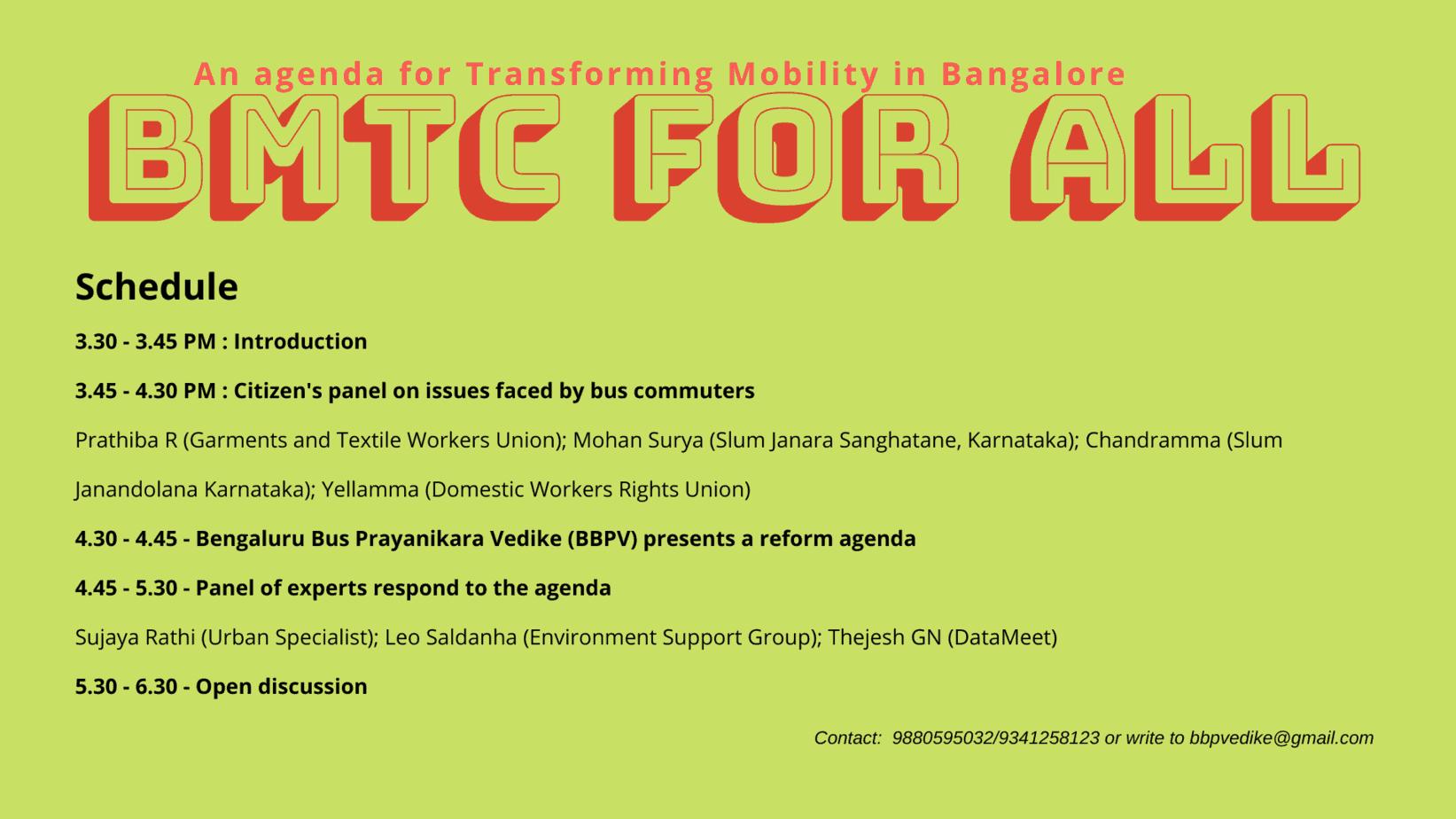
In this public discussion, we examine what further measures are needed to enable BMTC to play the central role as mobility service provider for the city. A panel of ordinary citizens and commuters share their experiences of using the bus. Bangalore Bus Prayanikara Vedike (BBPV) presents an overarching set of reforms needed to bring about this shift, including aspects of fixing the fares and adding more buses. A panel of experts will respond to the agenda of reforms. This will be followed by an open discussion.
The discussion will look at the following the questions that are essential for making the public bus service a success in the city:
- What is required to make BMTC’s public bus service realize its full potential as the primary mode of mobility for all?
- What is required to make bus travel in Bengaluru an affordable, accessible, safe and comfortable service, which meets the commute needs of the city?
Panel discussion schedule
Please the discussion, spread the message widely and get your friends and family to come along. Make your voice count, let us make Bengaluru livable again!
[This article is based on a press release from Bangalore Bus Prayanikara Vedike (BBPV), and has been published with minimal edits]