Bengaluru has seen many citizen-driven campaigns around sustainable mobility. Notable among them was the ‘Bus Day’ campaign spearheaded by the non-profit Praja RAAG. Subsequently, several volunteer groups have campaigned for effective, efficient and reliable public transport. The BMTC (Bangalore Metropolitan Transport Corporation) has also launched several initiatives – Pink Buses, Vayu Vajra Volvo, G8 buses and so on – to promote the use of public transport.
On July 9, Citizen Matters and Radio Active hosted a Twitter chat where experts and citizens discussed the past, present and future of public transport in the city.
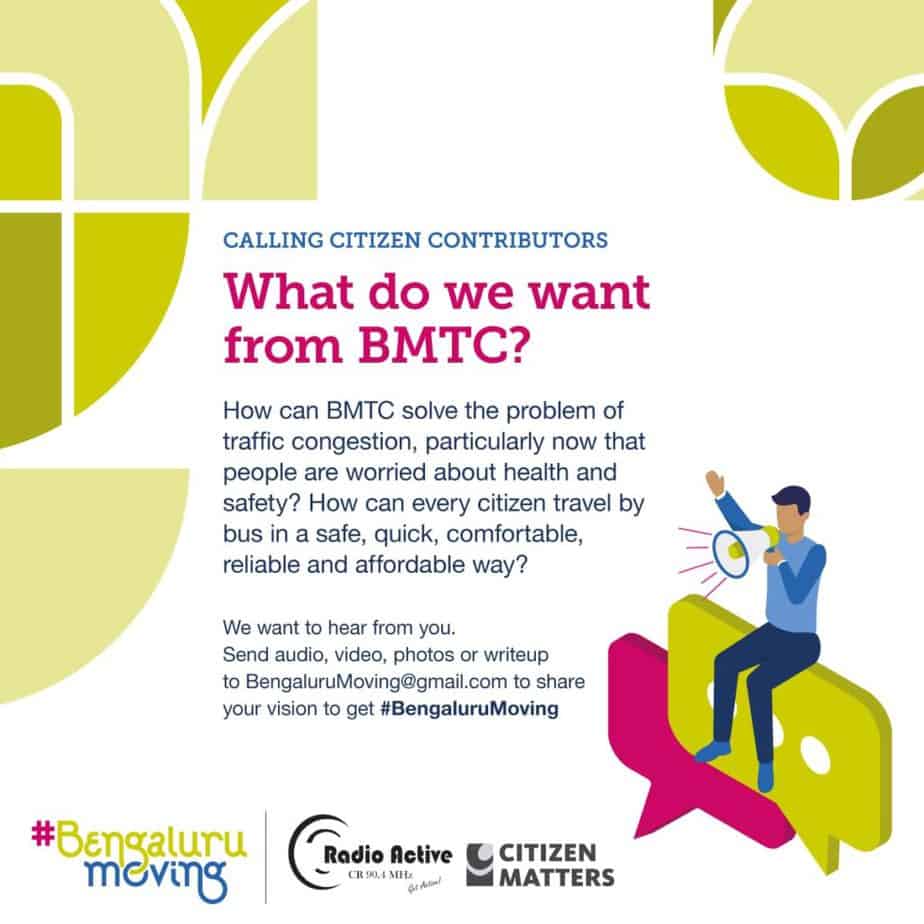
As the COVID crisis worsens and people are worried about their health and safety, how can BMTC solve the problem of traffic congestion? Can physical distancing be maintained in our public transport? How will overcrowding be managed? How often should buses and bus stops be sanitised? How can technology help reduce human interactions? What will you be comfortable with? How can BMTC revamp existing bus services, and improve last-mile connectivity? Will every citizen be able to travel by bus in a safe, quick, comfortable, reliable and affordable way?
These are only a few among the many questions BMTC commuters now have.
We want to hear from you. Share with us an audio, video, article or photos explaining your vision to get #BengaluruMoving. From the elderly, school and college students, to working professionals, we welcome every Bengalurean to participate. Email us at BengaluruMoving@gmail.com.
Have single door for entry & exit, no conductor required.. payment through electronic channels
There should be a QR scan code for buying the tickets and there should be a passes chan be checked using sime AL model conductor don’t have to do any of these things only for those who are having any difficulty conductor can help and there should be only obe person in a set the driver should not stop the bus if there are around 0 people in the bus. That can be counted as anyone scans the pass it should count 1 for that person or buy ticket as the no. of oassengers shown.
By re-structuring itself as @ http://praja.in/en/blog/murali772/2019/07/16/outline-most-equitable-public-bus-transport-model . Meanwhile, to reduce car usake for work-day commute, govt should facilitate bus aggregator services, like Shuttl