How and why. Greater Chennai Corporation (GCC) officials seem to be deliberately ignoring these two important questions, while executing the infrastructure projects. The ill-planned beautification work at Besant Nagar only bears that out.
Besant Nagar (or Elliots) beach, with its fragile sandy coastal ecosystem, stares at destruction, thanks to all the work being carried out in the name of modernisation. Having received funds from the Tourism Ministry under the Swadesh Darshan scheme, the civic body is all set to develop the beach as a mini tourist destination. The resulting slew of ongoing construction activities at Bessie appears to be disorganised and unscientific.

A canopy cover constructed under the Central Government scheme. Pic: Laasya Shekhar
The problem
At the core of it lies the inadequate thought given to the process. Even though the Central government granted funds for the development, selection and implementation are in the hands of Chennai Corporation, according to a response from the Tourism Ministry. Chennai Corporation received funds to modernise the beach, but never consulted the citizens and other stakeholders of Besant Nagar, who are aware of environmental and other requirements and could have advised the authorities on suitable infrastructure for development in a coastal locality.
With a planned concrete path that thwarts rain water seepage, children’s play area, likely food courts that will inevitably lead to littering, unsuitable flora that would soon cease to thrive, the project is full of flaws, except perhaps the fancy umbrellas that provide shade. Citizens also oppose the construction of a gym and lawn, even though there is mixed response to the soon-to-be opened first aid and RO water planting centres.

Tax payers’ money converted to rubble: Recently repaired tiles of the promenade have been damaged during the beautification project implementation. Pic: T D Babu
Another problem is planting five banyan trees on the beach, within a stretch of six feet. Marine biologists are worried that the move is nothing but a mere waste of public money “Each banyan tree spreads over acres, which is evident from the famous Adyar Banyan tree in Theosophical society. It is not reasonable to plant five saplings over a distance of just six feet. Secondly, they are not the right species for a small beach like Bessie,” points out T D Babu, a resident and marine biologist.
The biggest drawback in the project is concretising the sandy beach. “The sandy jogger’s walk has been concretized and they would soon be laying tiles on it, thus preventing rain water from percolating into the soil. A play area and gym in the beach will only promote food stalls. Can the Corporation assure cleanliness? First aid centres and a water fountain constructed in the middle of the beach block the sea view. These facilities could have been provided near the existing police booth,” says Kamakshi Subramaniyam, Co-founder of Spark.

A first aid room. Pic: Laasya Shekhar
Surrounded by residential areas, Bessie is also famous as a prominent nestling ground for the endangered olive ridley turtles. As in any other beach in the country, littering has anyway been a major concern at this beach too. Instead of crabs which belong naturally to this habitat, rats infest the beach due to constant littering of food.
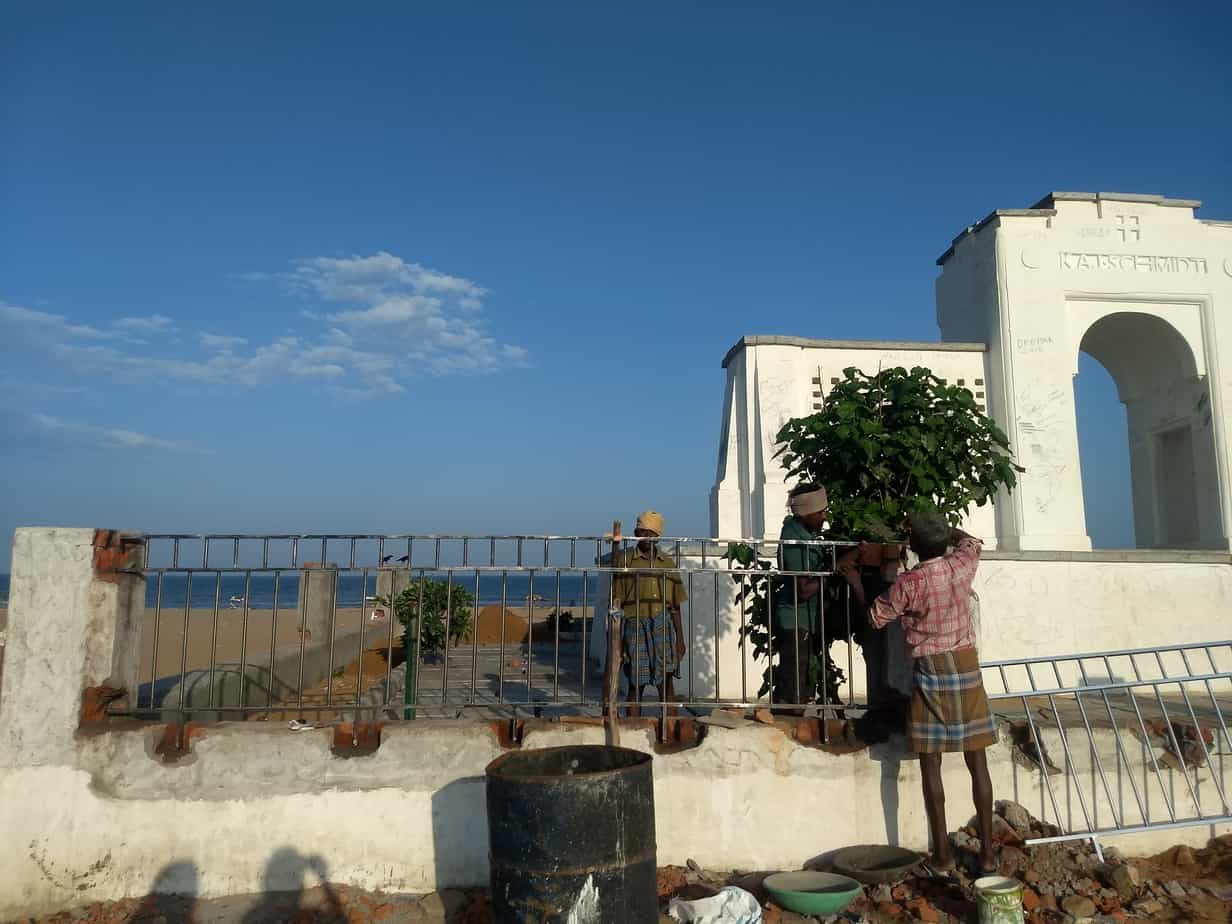
The Karl Schmidt Memorial at Bessie beach is being renovated. Pic: Laasya Shekhar
Dire consequences
“Besides reducing the beach’s percolation area, the project will facilitate water stagnation, cause ecological damage and enhance soil erosion and pollution. Instead, they could have declared the beach as litter free zone, removed encroachments (including the amusement park), streamlined the eateries by confining them to a particular area and provided proper infrastructure for hygienic sale of fish, increased police patrolling,” suggests T D Babu.
A corporation official in-charge mentioned that suggestions by locals would be considered. However, as Babu points out, a citizen movement against the project has only encouraged the corporation to speed up the work.
It is in the power of Corporation Commissioner D Karthikeyan to propose changes to the central government project that is implemented across India, said a Corporation official, seeking anonymity. However, the commissioner has not responded to our calls.