In this series, individuals, citizen groups and RWAs explain how they have dealt with the COVID-19 crisis in a constructive manner. In this second part of the series, a resident of Sadashivanagar, Bengaluru, describes the measures he took.
Here’s something that just three people – my friend Sumir Hinduja, my daughter Amala, and I – managed to do in our locality Sadashivanagar. There are many construction sites in this area as old homes are brought down to build new apartment complexes. As a result, several migrant workers reside in this area. Most of them have not received their pay for a while and have no money to buy rations. They can do their own cooking and so don’t need cooked food. Their need is simple – dry ration.
After the nationwide lockdown was imposed, here’s what the three of us did:
- Cycling through the streets: We stopped at every construction site we passed and asked the people there if they had any trouble procuring food. We found out that
- They had no money to buy rations because they had not been paid, or
- They had money but there was no place nearby where they could go buy ration from
- Noting down the needs: If the workers had a problem securing food, we took down more information to follow up
- Their address
- Number of adults and number of children
- Whether they ate rice or wheat, or both.
We made this exercise systematic by noting the above information in columns. See sample below:

- Survey completed in three hours: Our survey of over 25 streets was complete in three hours. Here’s what we learnt from our survey:
- There were 100 adults and 30 children.
- Each site has anywhere between 2 to 15 people living there.
- Most people are from North Karnakata, Uttar Pradesh, Bihar and Tamil Nadu.
- Most of them ate both chapati and rice – half and half.
- Pooling resources: We pooled in money and resources using Whatsapp and bought dry ration that was enough to last a week. A post was created and shared, inviting people to help us. As a result, we received enough ration that enabled us to provide for 10 days.
- Making of ration list: A list was made of items to be included in the ration required by one person per week at a cost of Rs 200 approx. Here’s the list we made and supplied:
- Rice: 2 kg
- Godi Hittu: 2 kg
- Togare Bele: 0.5 kg
- Potato: 1 kg
- Onion: 0.5 kg
- Cooking Oil: 0.5 kg
- Salt: 250 g
- Chilly Powder: 50 g
- Corriander powder: 50 g
- Turmeric: 50 g
- Matchbox: 1
Distribution: Once all the ration was secured, we loaded it all in a car and drove to all the sites we had made note of. We assured the people there that we would return in a week with a fresh week’s supply.
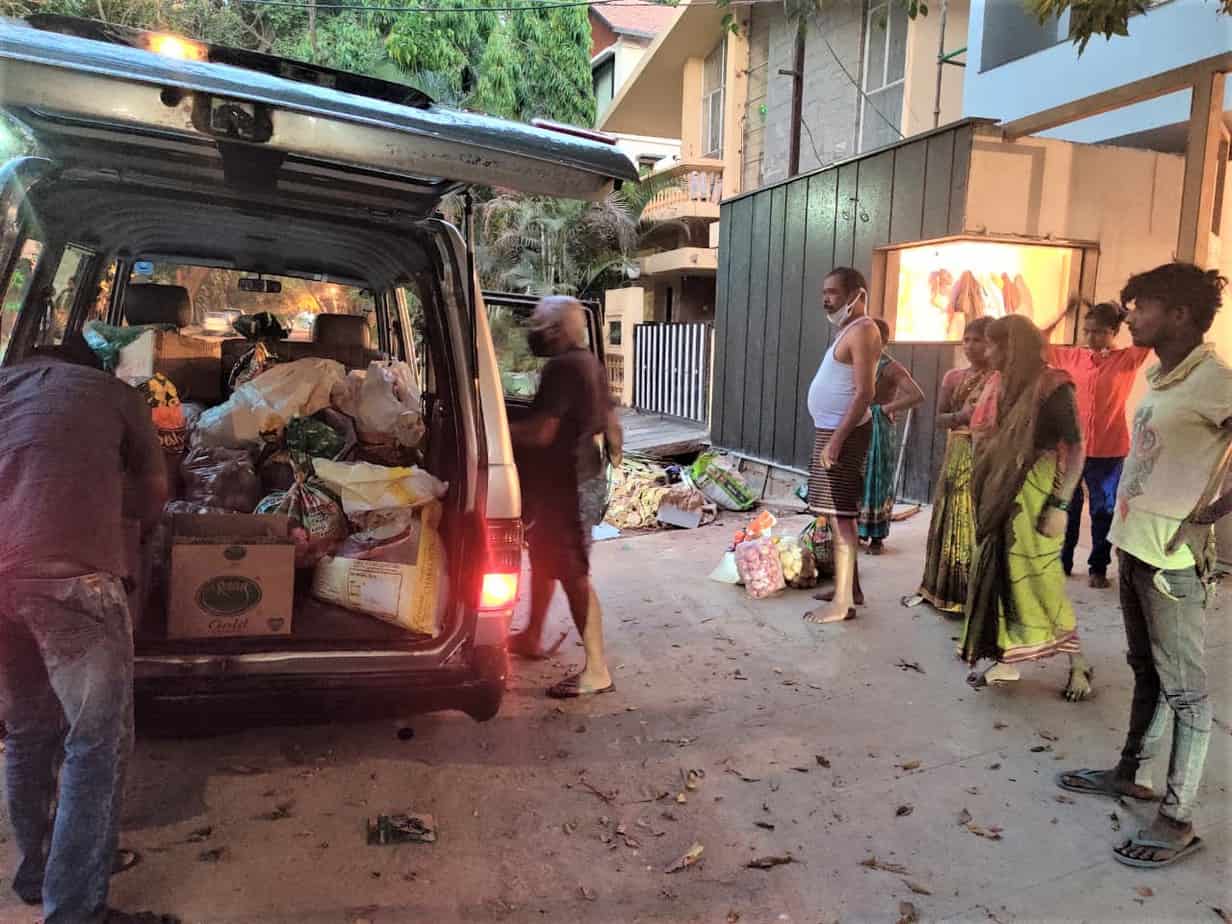
Delivering ration to migrant workers and their families at a construction site. Pic Credit: G V Dasarathi
So here’s what you can do to help migrant workers in your locality:
- Do what we did: Target your entire locality. If you don’t want to do this every week, provide rations for 2 or 3 weeks. Get friends and relatives to contribute. People want to help now!
- Adopt one construction site: If you don’t have the time or resources to do this for the entire locality, just target a single construction site near your home, and do this for the people living there.
Sumir, Amala and I are deeply grateful to Fr. Francis of St Joseph’s and Sandeep from Hunger Helpline for providing a substantial part of the ration, and to Brinda Adige of Global Concerns India for putting us in touch with these donors. I’m deeply grateful to Sumir for initiating this project.
It’s also important to note that when the Labour Department and the Police came to know of what we were doing, they were open to discussion and promised they would provide the rations. However, this didn’t happen and since some of the workers were running out of food, we didn’t rely on government agencies and continued what we were doing on our own.
After a few days, we were left with some undistributed ration that we had bought, from Hunger Helpline and St. Joseph’s. This we decided to send to Hebbal Kempapura where there are a few hundred labourers in need. The person on the left in the picture below is Alamgir, who lives in Hebbal Kempapura. In normal times he is a ragpicker who collects dry waste from my home, but in this difficult time, he too came forward to help in his personal capacity.
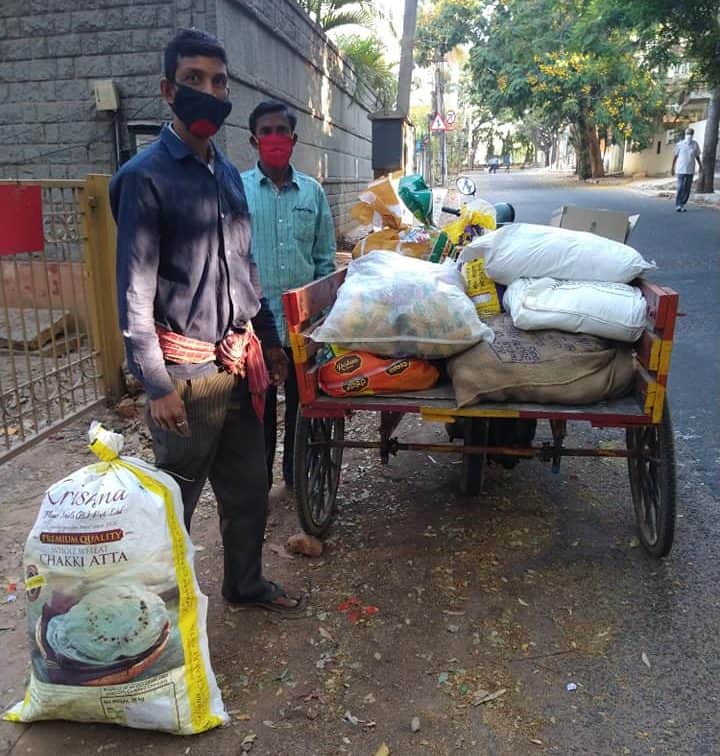
Pic Credit: G V Dasarathi
Our appeal to you is, if you live around Hebbal Kempapura, please start a hunger project there. If you know of people or institutions there, please pass on this message.
No time, or can’t go out? You can make a generous donation to the account below which is handled by my friend, Brinda Adige.
| Name: Global Concerns India Bank: State Bank of India, St Mark’s Road, Bengaluru Current Account Number: 37212110862 IFSC: SBIN0000813 MIRC: 560002057 |
For a family of six people, the ration required for a week is:
- 5 kg rice
- 2 kg dal
- 1 litre of cooking oil
- 1/2 kg sugar
- 1/4 kg tea leaves
- 2 kg atta
- Vegetables: potatoes, onions, tomatoes
[Read Part 1 of the series here.]