The ongoing case at the National Green Tribunal (and the frequent fires!) has helped keep the Bellandur lake in the news. The hearings on the petition filed by D Kupendra Reddy and another suo moto case when the fires happened some months ago, have resulted in a number of directions to the respondents including the state, and agencies like KSPCB and KLCDA.
In its latest order on April 19, 2017, the NGT said: “All local authorities shall ensure that no untreated sewage water is permitted to enter into Bellandur Lake” – sounds familiar?
Here is the chronological summary of developments at Bellandur kere from the 90s. More recently, in April 2017, NGT ordered the closure of industries near the lake; KSPCB sent notices to 448 units. BBMP fined one contractor Rs 5 lakhs for dumping of garbage on the banks.
NGT’s latest direction to clean up the lake within a month showed the court’s frustration with the state agencies not doing their work. However, State government’s response is that one month is not sufficient.
True, cleaning up a lake which gets wastewater from 40% of the city, is monumental work. But then, a valid question to ask is, what successive governments have done over the years, even with several court orders and deadlines, and multiple agencies being involved in the process.
The KSPCB told the court they issued consent for establishment for 278 apartments in around Varthur and Bellandur lakes with an estimated wastewater generation around 40 MLD. Now, it is not rocket science to fix STPs. Many apartments know it only takes a few months to revamp them. If the apartments have not done it yet, the government can penalise them by all means – for every day of non-compliance.
The instruction given to builders and apartments from Urban Development Department (UDD) Secretary Mahendra Jain to take untreated water to BWSSB’s Nayandahalli STP is not a feasible solution. No apartment will take it up because it will be outrageously expensive – imagine carting tankers of sewage across the city everyday! Obviously the money can be better-spent in actually treating the wastewater!
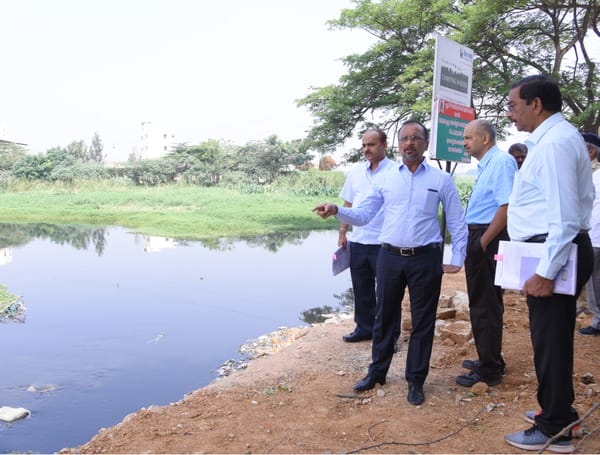
Mahendra Jain and officials visiting Bellandur lake for an inspection. Pic: BDA
The rule is meant for apartments. But is BWSSB also going spend, on transporting the untreated sewage from its own networks, to a sewage dump?
The irony of STP rule
The irony of the current situation is that, many old apartments have not installed the STPs, and are leaving the wastewater to the BWSSB sewage network and BBMP drains. There are also the apartments constructed before the year 2010 which did not have any mandate to construct STPs. Then there are apartments having less units – smaller than KSPCB and BWSSB norms, and discharge their sewage to the BWSSB network.
There are thousands of multi-residence buildings, paying guest facilities, commercial complexes and individual houses across the city in the areas not covered by BWSSB. In Bellandur ward alone, there are 30,000 individual households – that itself works out to around 14 MLD. Imagine the volume from the entire catchment area. Where does the sewage from these units go?
When BWSSB and the state have failed in providing sewerage infrastructure before sanctioning construction plans, what is a credible solution?
In Feb 2017, BWSSB prepared a 1900 crore DPR for the project for setting up the infrastructure for water supply and sewerage lines in 110 villages, and sent it to the Urban Development Department. The work was inaugurated in April and is supposed to take two years to complete.
BWSSB also has plans for new STPs including three at:
-
Koramangala & Challaghatta Valley, near Nagasandra near Challaghatta to treat 60 MLD of sewage
-
Bellandur Amani Kere, on the upstream of Varthur lake, with a capacity to treat 90 MLD of sewage
-
Near Varthur Kodi, in Varthur, to treat 12 MLD sewage.
None of these are ready yet.
Even after treatment through STPs, the water has to be naturally filtered through wetlands for removal of nitrates and phosphates. Karnataka Lake Conservation and Development Authority (KLCDA) says it has identified over 150 acres at Bellandur where wetlands can be preserved and created, according to reports, and that BWSSB is also planning bioremediation at the drains leading into the lake. The process will take time, but it is a good option according to experts.
Meanwhile BDA has been removing the weeds at Bellandur lake. The progress is slow. Two amphibian machines started working, and residents nearby say they have been idling most of the time in the last couple days. Aerators were supposed to be installed, but that has not happened yet.
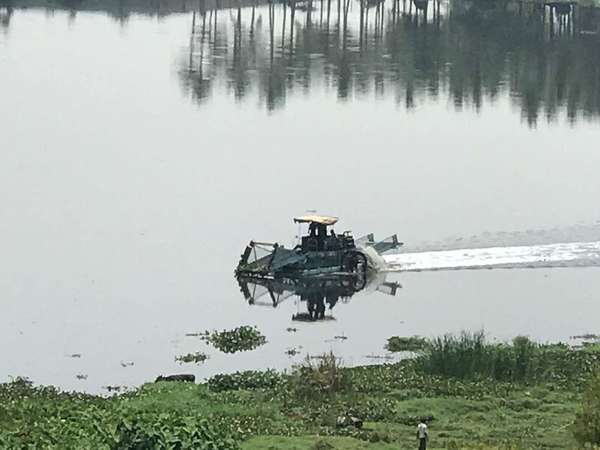
Deweeding machine at work in Bellandur lake premises. Pic: Indu Vittal
The hyacinth removed have been lying on the wayside, and with evening rains, it is resulting in bikers slipping on the mush and falling.
It feels like the government’s left hand does not know what the right hand is doing; There seem to be only ad-hoc reactions to the court orders every now and then. The result: so many things seem happening, yet so little progress!
This note from Nagesh Aras points out the complex set of players responsible for different aspects of a lake’s pollution, from BDA to BWSSB to KSPCB. Without a single department taking the bottom line for water issues, things cannot improve. For lakes, there is the Karnataka Lake Conservation and Development Authority (KLCDA) formed recently, but going by the history, one only hopes that it does not become yet another toothless body!
The elephant in the room is governance. Without fixing that, we can keep talking about transporting sewage from apartments in tankers and deweeding till the cows come home, with no result.