BBMP seeks help in each ward; increases fine on plastic ban violators

BBMP has put its foot down to make the implementation of plastic ban a success. However, ward level citizen volunteers are an essential ingredient in the success of plastic ban and scientific waste management.

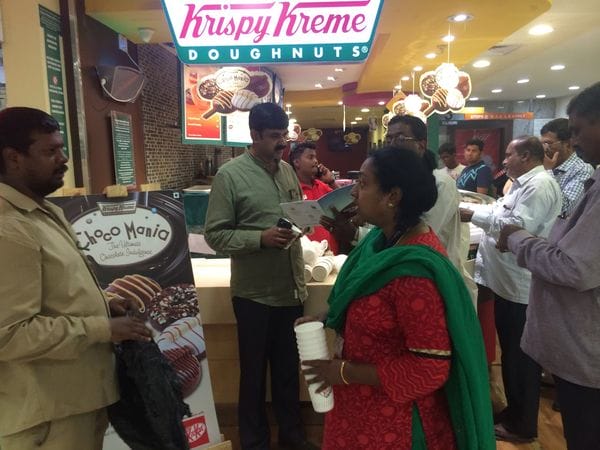
Joint Commissioner- East Yatish Kumar inspecting and penalising shops that violated plastic ban. Pic courtesy: SWM volunteers team

Bruhat Bengaluru Mahanagara Palike has put its foot once again to show that plastic ban is here to stay, unlike many earlier instances of plastic ban notifications that were ineffective. With the National Green Tribunal postponing the hearing of petition against plastic ban to July 15, 2016, BBMP has released a notification that orders heavy fine on violators. The revised fines are listed below:

Fines for manufacturing and sale of banned plastic items
Criteria Fine for first time offense Fine for second time offense
Manufacturing Rs 2,00,000 Rs 5,00,000
Storage Rs 1,00,000 Rs 2,00,000
Selling Rs 50,000 Rs 1,00,000
Commercial users Rs 25,000 Rs 50,000
Domestic users Rs 500 Rs 1000

The notification has also empowered the Joint Commissioners, BBMP Revenue Officers, all BBMP engineers to seize and fine the violators, along with health officers, thus giving more hands for the system to monitor violations. The entire notification can be seen here:

Leave a Reply

Your email address will not be published. Required fields are marked *

Similar Story

Bengaluru’s GBA and Hyderabad’s CURE: What they have in common and where they differ

While the mega-cities have split up into smaller corporations, both have put state leadership in control of city governance.

With the Core Urban Region (Integrated Governance) Bill 2026, better known as the CURE Bill passing in the Telangana Legislative Assembly, India's two fastest-growing mega-cities—both having crossed the 1.3-crore population mark—now operate under brand-new urban governance laws enacted within roughly two years of each other.  Both states confronted the exact same structural challenge: a single, overstretched corporation, fractured inter-agency coordination, and an urgent need for hyper-local administrative units capable of  delivering civic services efficiently. In an earlier article, we broke down how local governance would change with the Greater Bengaluru Governance Act. Read it here. Two mega-cities, one playbook The…

Similar Story

SIR in Bengaluru: Disenfranchisement at a grand scale

With Bengaluru Urban seeing a 42 per cent reduction in the voter rolls, is the SIR an update or a denial of electors' rights?

The CEO Karnataka recently published the final rolls for Karnataka after finishing their hurried and stressful Special Intensive Revision (SIR). People were asked to prove that they live where they do, and map themselves or their parents/ancestors to the 2002 voter roll. The final roll published now has 4.54 Crore electors in Karnataka as against the 5.54 Cr as per the 2025 Special Summary Review; a reduction of almost one crore electors or 18% of the earlier rolls. However, the numbers in the 28 constituencies in Bengaluru Urban paint a more drastic picture. The 1.026 crore electors as per the…