What a day at the “Zero Plastic Run” that was flagged off from Decathlon, Sarjapur Road on June 20th!
This green event organised by Decathlon, Sarjapur, and well-supported by Kasa Muktha Bellandur, various local citizen groups and Runners High, saw a sizable group of enthusiastic runners of all ages show up in the early hours of a cold, cloudy and windy Saturday morning. As the name indicates, this event was organised to showcase that such an event can be conducted and enjoyed thoroughly by going completely green.
Runs usually see a whole lot of trash generated through the course of the event – starting from distribution of goodies to participants (plastic disposables, T-shirts wrapped in plastic sheets and goodies) to refreshments that are served in disposables, and a whole lot of plastic water bottles. A run can be a mass garbage generator. We have seen this in many recent events in Bengaluru. While there is an effort made by environmentally conscious citizens to keep the event green, we have hardly achieved what we would want to. Disposable single-use plastics make their presence felt in a big way at these events.
What’s important to remember is that recycling plastics is not at all efficient, if not impossible. Some plastics just cannot be recycled. Some will take a whole lot of energy to recycle and always end up as a lower quality plastic product after recycling. Plastic bottles for instance can only be down-cycled. They can never come back as another plastic bottle. So we should move to paper cups, shouldn’t we? Paper cups have a wax or plastic coating (otherwise it cannot hold water), that greatly reduces its recyclability and hence its economic worth as a recyclable material. Moreover, we need to ask ourselves, can we do without the single-use, disposable goods completely, especially when we organise marathons, parties or community gatherings? Do we have better choices that do not compromise the environmental cost with ease of use?
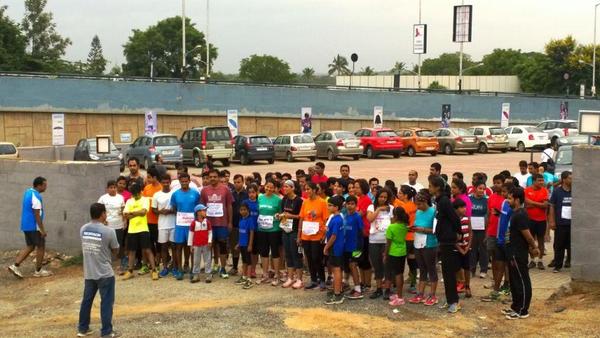
Runners being briefed about the concept of the Zero Plastic Run. Pic: Sudhir
We proved at the Zero Plastic Run that a run can be completely green. So, this is what we did together. We avoided distribution of goodies wrapped in plastics, we avoided bibs. Not that event should not have bibs, they will… but in this instance, the only bibs we used had ‘green’ slogans, and they were promptly collected at the end of the event, to be reused for another event.
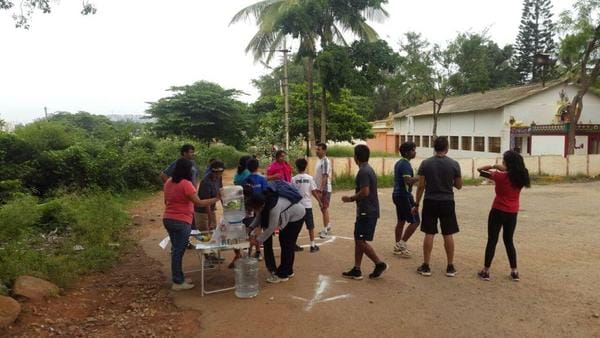
Runners take a break at one of the refill stations. Pic: Sudhir
Before the run started, all participants were briefed about the concept of the run, about not littering on the route, the usage of steel cups and using their own bottles wherever possible. There were no disposable plastic bottles or plastic cups for drinking water. The refill stations, at intervals throughout the trail, were manned by volunteers who handed out water to thirsty runners in steel cups. The cups were rinsed in an organic citrus solution for disinfecting. At the end of the event, refreshments were in the form of whole fruits in a big container. After a good run in lovely weather, nothing tasted better than yummy, fresh fruits. All that we generated at the end of the run was organic waste (fruit peels).
All who came went home with a sense of achievement and purpose. We will strive to support green events like this in the future as well. With the Zero Plastic Run, we have shown that it is possible.
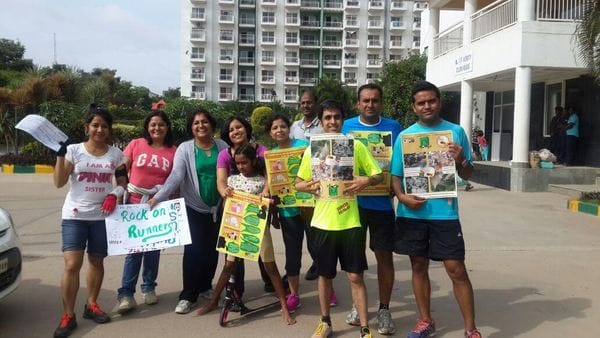
An enthusiastic bunch of participants from SJR Verity. Pic: Sudhir
The volunteers were mainly from SJR Verity apartments in Kasavanahalli. As part of the anti-plastic campaign launched by them a couple of months back, they reached out to nearby shops, apartments and supermarkets on reducing plastic carry bags and disposable plasticware. There was good representation from other communities in and around Sarjapur road, among both runners and volunteers. Rainbow Residency had a big group of 40 runners, including kids, attending the run. Many runners were beginners, and it was a pleasant surprise to see young kids beating the adults. All winners in the respective categories won gift vouchers and goodies sponsored by Decathlon. After the prize distribution, volunteers took down contact details of those runners who were interested in initiating waste segregation and anti-plastic campaigns in their respective communities. Those interested, can find relevant information at www.2bin1bag.in.
Many thanks to all the participants, volunteers and Decathlon for organising this event. We do expect future events organised by Decathlon will be greener. We could hear volunteers already planning for the next event. So don’t be surprised if you see another invite soon!
Related Articles
Children pave the way for a plastic-free Bengaluru
Lessons in waste management from the Bengaluru Marathon 2014
Children urge eatery owners to say no to plastic and disposables