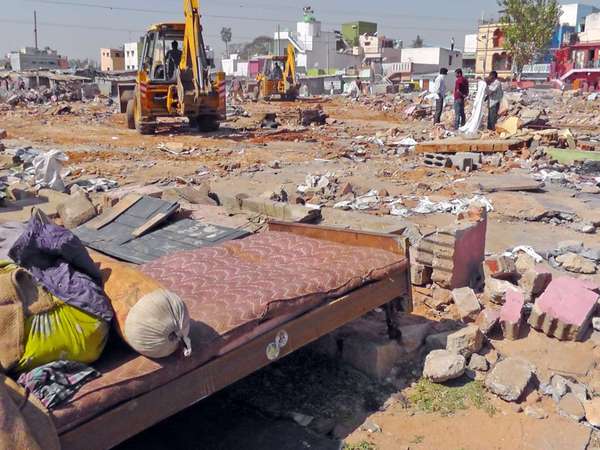
People slept under the very bulldozers that destroyed the community, curled up inside huge circular pipes, while using each other and all of their belongings to generate precious warmth in Bangalore’s bitterly cold nights. Some burnt anything and everything expendable to keep tiny fires going. Smoke billowing up from these fires, personal belongings strewn around here and there – the occasional lovely mirrored wooden dressing table lying amidst a sea of rubble, steel almirahs popping out of nowhere like mini skyscrapers – the Ejipura EWS quarters resembled a badly devastated war-zone.

Some family’s furniture piled together at the demolished EWS quarters. Pic: Karthik Ranganathan
And yet, people laughed. Cried. Some cried more than they laughed while some others, notably children, played like they owned the world. The world’s probably our stage for politics and greed, but still remains the child’s play-ground. Whether it was the kid who was letting his little ball go round and round inside the huge pipes, or the kid who tried becoming the very ball by climbing up and then sliding down the circular pipe on his tummy with unimaginable joy, or the sprightly girl, who even while preparing for her exams later in the day, remarked to a friend that the whole place felt like a picnic to her, with the unbelievably open spaces, non-existent boundaries and unimplemented rules.
Tinsheds at EWS quarters demolished. Pic: Karthik Ranganathan
They were grateful to a fault when we handed them tea, biscuits and buns bought from local tea stalls and bakeries even after they probably realised that people like us would frequent the mall that destroyed their very houses. High-school kids from the remaining families volunteered to help distribute the food as soon as they woke up, doing their best to augment our rather meagre volunteer strength in the mornings. One man had to leave for Chennai, for his sister’s wedding. Yet he took the time to help out with the food distribution till it was very nearly time for him to leave.
They were frustrated too, and rightly so. Some bluntly rebuked our attempts to provide relief, some openly discouraged by these pitiful efforts. An irate drunk man’s words, however, were closest to the truth. Heavily drunk, and disgruntled with the simple rice and sambhar that was being served for lunch, he took it out on me –"Neenga mattum Imperial Hotel-la saapidareenga, aana engalukku verum sorum-sambharum-dhaana? (You folks have lunch at Hotel Imperial, while all we get is just plain rice and saambhar?) Engalukkum 50-roobai saapaadu kudungalen. (why don’t you give us 50-rupee meals?) Kaasu dhaan vechurukeengalla? (You can very well afford it, can’t you?) Neenga veetula methai-la thongareengaa. Naanga inga pipe-la kuLur-la thoongarom (You folks sleep on comfortable mattresses inside your houses while we sleep in these pipes, out in the cold). His words hit me like a sledgehammer. Even while I had a resigned smile on my face, my mind was racing along indignantly, tempted to retort, no doubt spurred on by my empty stomach, starved of that day’s breakfast and lunch. But I kept quiet. As I type these words in the comfort of a sofa at home now, even as he is probably sleeping outside, freezing in Bangalore’s winter, those words come back to haunt me.
Over the last five days, I have been witness to many a scene that I have never encountered before. I have seen my friends brutally dragged into the police van for protesting against the demolitions and also seen other women bravely court arrest even in the face of police intimidation. I have seen unreciprocated kindness and honesty among the affected residents. During a blanket distribution drive yesterday at midnight, one old frail lady told us she had already received one for her family and pointed us to some families that had not received any. Other residents chose to safeguard all the blankets in one place while the distribution went on, not touching even a single one till we realized that they had received none and gave them some. All this happened in the same area where, just the previous day, an old lady had succumbed to the cold and died.
Selfless students from St Joseph’s did their best to help out in the afternoons by conducting surveys, distributing food, water and even administering first aid, as did other concerned citizens who helped in arranging and distributing food daily.
Unfortunately, I also witnessed first-hand the brusqueness and intimidation that our politicians are famed for, as the local Congress MLA N A Haris and his entourage refused to answer any questions regarding the status of the proposed project in Sulikunte, even as they questioned my right to be on the site.
Most of the families have now moved out. Based on our food and material distribution, we now estimate around 500-600 people who have not moved out yet. But they have been forced to the fringes of the site and are fearful of being evicted completely with their belongings. Some even admitted to me yesterday night that they had received messages from policemen telling them they need to vacate the site by today (Jan 24th), even as conflicting messages were being conveyed to the media by the State Government and BBMP regarding possible temporary accommodation at the site till the end of the academic year. But not many have the means to relocate and don’t even know where they can go. The bandages that we, the civil society can apply, will do little to heal the fractures caused by the inhuman way in which their lives and livelihoods have been destroyed.
Two days back, while distributing food, I could not help admire a tiny idol of Jesus sitting rather beautifully between two slabs of stone, even as the rest of the wall and house had completely collapsed around it. Going back a little later to catch it on camera, I could no longer find it. It meant more to somebody than just a pretty photograph.
Life goes on.⊕
Its really an apathy of BBMP rendered on residents of EWS quarters, Ejipura, could it not give alternate accomodation before demolishing their houses ? Could Court not accomplish its powers to order a STAY from demolition? Our STATE GOVERNMENT is also insensitive to all the happenings that took place during demolition and after effects of people suffering in cold, having no shelter on their heads, no food and water, school going or college going students left in the lurch of not attending their classes. Central Government is also abstinating itself from as that is more concerned about its votebank to anounce the reservations and subsidize the gas cylinders from six to nine and from nine to twelve in Delhi.