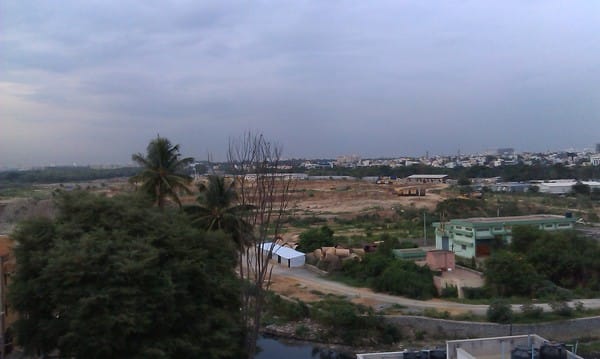
Construction activities continue to encroach the drain coming from Madivala valley that leads to Bellandur lake. Pic: Nikita Malusare
There seems to be no end to controversies surrounding the Bellandur SEZ project opposite Agara Lake near Koramangala, Bengaluru. Karnataka’s Lake Development Authority (LDA), which conducted an inspection recently following media reports, has asked KIADB to stop construction activities on Bellandur lake catchment area by Manipal ETA Infotech Ltd.
The LDA is a governmental body working for the regeneration and conservation of lakes in and around Bangalore city within BMRDA jurisdiction.
Based on the report of the inspection held on June 12th, 2013, Chief Executive Officer of LDA Ravi Ralph wrote to Karnataka Industrial Areas Development Board (KIADB) asking them to stop construction activities and re-classify and maintain the area as Non- SEZ zone or a sensitive zone.
The inspection report by LDA clearly mentioned that such a construction will have an adverse effect on the water which flows to Bellandur lake.
Findings of LDA report
On the orders of the LDA CEO Ravi Ralph, Executive Engineer S R Nagaraj and Assistant Executive Engineer C Nagesh Rao inspected the catchment areas of Bellandur lake where construction of Manipal ETA Infotech is proposed, on June 12th, 2013.
This drain in the Madivala valley channels excess water from Agara area to Jakkasandra area and finally to Bellandur lake.
At the time of inspection, the storm water drain was found to be constructed for about a length of around 150 to 200 metres after which the drain is left open and is not lined.
The width of the drain has been reduced at this juncture and construction debris has been dumped due to huge developmental activities beside the drain. This has restricted the flow of water into Bellandur lake, remarked the inspectors.
The reported concluded stating that “the huge construction activities in this catchment area have resulted in change of land use and directly impacting the catchment of Bellandur lake.”
The Lake Development Authority, in turn, wrote to KIADB requesting to stop the construction activity. “In effect, the said area should be classified and maintained as sensitive area,” said the letter.
KIADB puts the onus back on Manipal ETA
Following the letter, KIADB has asked Manipal ETA Infotech to seek necessary approval from LDA and Karnataka State Pollution Control Board (KSPCB) before continuing any construction activities.
KIADB also directed Manipal ETA Infotech Ltd to seek approval of State High Level Clearance Committee –
-
For change of name of the company from M/s Manipal ETA Infotech Ltd. To M/s Mantri Tech Zone Pvt Ltd,
-
To extend their time period for implementation of the project.
Manipal ETA Infotech seeks approval from LDA
In response to all these letters, Manipal ETA Infotech Ltd. wrote to CEO of LDA on august 31, 2013, justifying the work being done. The proposed project in no way will affect the Storm Water Drain as they have maintained a buffer zone of 30 meters as per zonal regulations, claimed the letter, dthus disputing the inspection report of LDA.
“We are in no way contributing to the reduction of catchment area nor are we playing any role in blocking the storm drain flow and thus impacting Bellandur lake,” says the letter.
Manipal ETA Infotech has already agreed to follow all the conditions laid by the Ecology and Environment Department and accordingly a compliance letter is also sent to Regional Office of the Ministry of Environment and Forests periodically, stated the letter.
The letter claimed to have received approvals from KSPCB and Ministry of Environment and Forests. With this letter, Manipal ETA Infotech has approached the Lake Development Authority (LDA) seeking the necessary approval for the proposed development.
SEZ, or residential-commercial?
Interestingly, the letter said that the land in question was allotted to Manipal ETA Infotech Ltd by KIADB for residential and commercial developments, and that the development doesn’t dome under SEZ classification.
On the contrary, the State-level Expert Appraisal Committee (SEAC), Karnataka, which had scrutinised this project in its 67th meeting held on April 8th, 2011, sees the project as a SEZ project. “The proponent and environmental consultant present explained the ToR. The proponent informed that Special Economic Zone (SEZ) is located within the project site and 27 MW cogeneration power plant is also proposed. The SEZ will be treated as a separate unit as per SEZ norms,” the report said.
Copies of all the above letters are with Citizen Matters.
Citizen Matters first broke the story on the environmental issues with the Bellandur SEZ in late March 2013 and since has published several stories. They are:
Rs 2300 cr realty project near K’mangala on, without BWSSB’s knowledge
Agara SEZ to multiply traffic on Sarjapur Road
Mantri’s 72 acre project encroaching Rajakaluve: IISc report