Ahead of the budget, tell the BBMP where and how to spend your money

Would you like to ask the government to earmark funds to sort out specific civic issues in your neighbourhood? This is your chance to let them know.

Most of our neighbourhoods in Bengaluru are beset with infrastructure issues; issues that need to be fixed to ensure a better quality of life for us. In a city that is as cosmopolitan as ours, the issues are also not the same across the city; they differ from one neighbourhood to the next.

Every year, our local government prepares an annual budget for the city, in which, budgets are allocated to all the neighbourhoods (wards). Also, a decision is taken on which issues would be taken up for work in each neighbourhood. So far, it was difficult, maybe even impossible for citizens like us to participate in this process and express our needs for our neighbourhood in a structured manner.

Which is why Janaagraha Centre for Citizenship and Democracy has launched MyCityMyBudget. This is a campaign aimed at giving citizens a unique opportunity to participate in the city’s budgeting process. It provides them with a channel through which they can tell the local government what they want for their respective neighbourhoods.
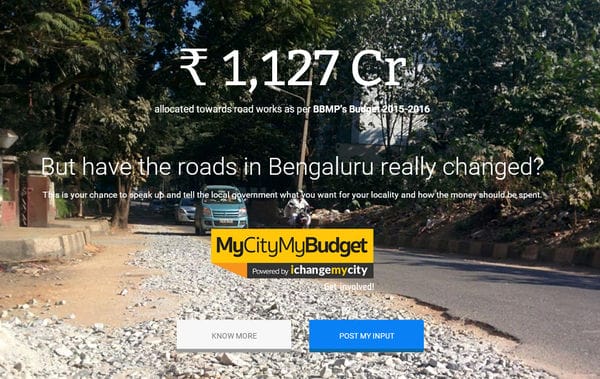
A screengrab from the site.

Do you want that broken pavement in front of your house fixed? Do you want more trees in your street? Is the crime level in your area too high? Do you face erratic power supply? Not enough buses servicing your area? Whatever be the civic issue, this campaign allows you to voice it.

MyCitymyBudget is an endeavour to gather inputs from various citizens and groups across the city and submit them to the local Government. The Government would be requested to consider these inputs while preparing the budget.

To join the campaign, visit MyCitymyBudget and fill up this simple Budget Input Form to let the local government know what issues you want fixed in your neighbourhood. There is no limit to the number of forms you can fill up; which means you can highlight any number of issues in your locality.

Related Articles

KERC directs BESCOM to tie up loose wires
BBMP’s 6728 crore budget: Yet another unrealistic financial plan for the city?

Leave a Reply

Your email address will not be published. Required fields are marked *

Similar Story

Karnataka SIR 2026: Top FAQs and community concerns addressed

As the SIR is underway and voter forms are distributed, much confusion remains about how to fill them. Here are some FAQs to understand the process.

As of July 8, booth level officers (BLOs) have distributed over 4.57 crore enumeration forms for the mandatory Special Intensive Revision (SIR) in Karnataka. Yet despite the 82.45% completion rate, the process has faced widespread criticism and been plagued with problems including BLO burnout, and the Kannada-only forms. If you are still figuring out how to fill the enumeration form, read Part 1 of this series. In this part, you can find answers to some common questions on filling the form, online enumeration, progeny mapping, etc. The SIR process poses specific challenges to transgender and queer communities due to changes…

Similar Story

SIR for Karnataka voters: All you need to know about enumeration 

Voter verification requires linking your 2025 rolls to your 2002 records. Here's how you can fill the forms and register.

Karnataka's Special Intensive Revision (SIR), which began on June 30, requires every voter to complete a fresh verification exercise. The SIR is carried out by the Election Commission of India (ECI) to prepare and revise electoral rolls, and ensure its accuracy. The process especially aims to remove deceased voters and duplicate names in the rolls, including those of  citizens who have migrated and are registered as voters in  multiple places. The election commission announced the process with the aim that ‘no eligible citizen is left out and no ineligible citizen is included in the electoral roll’. In the Special Summary…