Flowers that bloom in Lalbagh in March

Lalbagh is quite colourful in March, thanks to the flowers that bloom in the season. Take a virtual floral tour of Lalbagh through this feature!

Several blooms to delight the senses! A walk in Lalbagh is always something that will bring a lot of joy. I decided to capture some of the blossoms that appealed to my eyes, my nose, my touch, and sometimes, as they rustled in the morning breeze, to my ears, too! Some of them are quite uncommon trees that I have not yet seen outside the park.

The Purple Bauhinia (Bauhinia blakena) and the Cabbage Bark Tree (Andira inermis) can be seen in the garden.
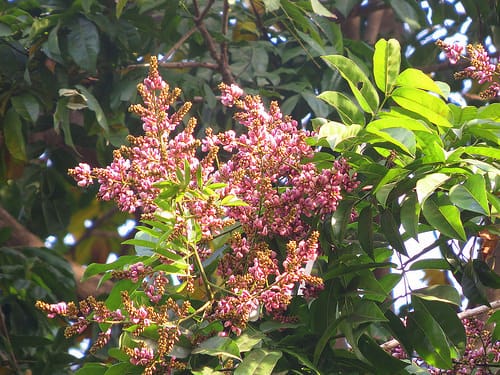
These are the flowers of the Cabbage Bark Tree (Andira inermis). Pic: Deepa Mohan

The beauty below is known as Pride of Bolivia (Tipuana tipu). It tickles me that a tree which is apparently named after the Tiger of Mysore should have the common name, Pride of Bolivia!
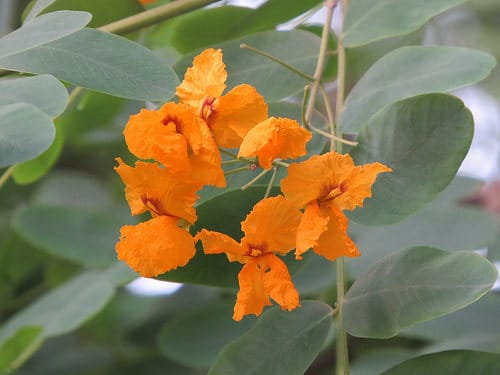
The Pride of Bolivia (Tipuana tipu) Pic: Deepa Mohan

The “octopus” flowers of the Umbrella tree (Schefflera actinophylla), are just beginning to bud. Then there is Rangoon Creeper (Combretum indicum) – children as well as birds love to sip the drop of nectar from this flower! The flowers have a lovely, heady fragrance, too.
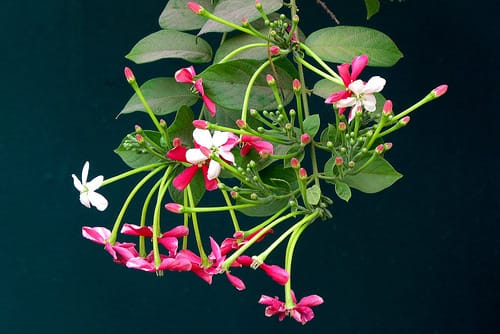
Children, as well as birds, love to sip the drop of nectar that can be found at the base of this flower. Pic: Deepa Mohan

The Kanaka Champa (Pterospermum acerifolium) is another beauty to behold:
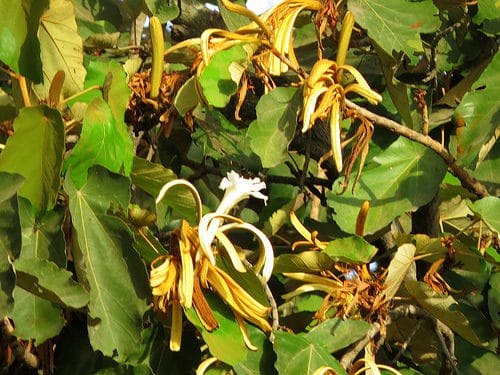
The Kanaka Champa (Pterospermum acerifolium). Pic: Deepa Mohan

Finally, here is one of the most beautiful…. the Philippine Jade Vine (Strongylodon macrobotrys) that blooms annually at this time. The unusually coloured blooms, in close-up:
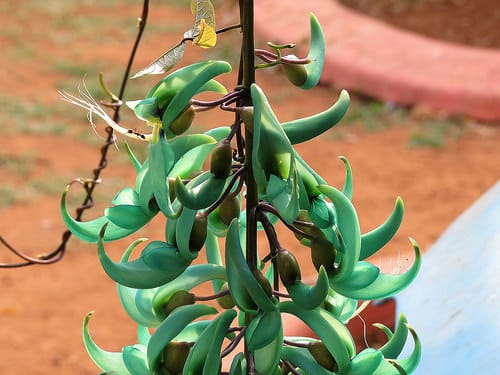
The unusually coloured blooms in close up Pic: Deepa Mohan

The video compilation of all these flowers and more:

All these photos were taken in Lalbagh on 1st March 2017. These are only a few of the many flowers you can see right now… so do go and visit our beautiful public park, and enjoy the flowers in one of our lung spaces.

Related Articles

Rock Eagle Owls of the NICE Road

Leave a Reply

Your email address will not be published. Required fields are marked *

Similar Story

Where are the pollinators in Bengaluru?

Despite the volumes of citizen-generated data on the city's biodiversity, pollinators who sustain the urban ecosystem do not seem to be getting their due attention.

Urban biodiversity is often discussed in terms of tree cover, lakes, or flagship species, but far less attention is paid to pollinators—the insects and birds that quietly sustain urban ecosystems. In Bengaluru, a rapidly urbanising city with a strong culture of citizen science, large volumes of biodiversity data are now being generated by the public. But what does this data tell us about pollinators in the city? This article draws from a data jam hosted by OpenCity in Bengaluru that explored pollinator observations using publicly available, citizen-generated datasets. By analysing long-term observation records and spatial data on land use and…

Similar Story

Beyond the parks and gardens, Bengaluru’s ‘wasteland’ ecosystems call for protection

Open Natural Ecosystems in Bengaluru harbour rich biodiversity. Take a look at what they hold and what we risk losing to unchecked development.

When we discuss urban nature, we often forget about real natural habitats. In Bengaluru, widely called the Garden City, most talks about urban nature focus on landscaped parks, roadside trees, and manicured gardens; in other words, artificial ecosystems designed for looks and human comfort. As lay citizens, we usually notice only such nature as we see around our homes, workplaces or other areas we generally pass by. While these places do have some ecological value, they mostly support a few highly adaptable species. This has strong negative implications for native flora and fauna that depend on open scrublands, grasslands, rocky…