Remember eating cars and planes? Yes, it’s Bombe Mithai!

In the past, children would flock around his cart as he molded candy into whatever shape they wanted. Meet the Bombe Mithaiwala!

Here is a picture of the Bombe Mithaiwala. I met him during the Republic Day flower show at Lalbagh.
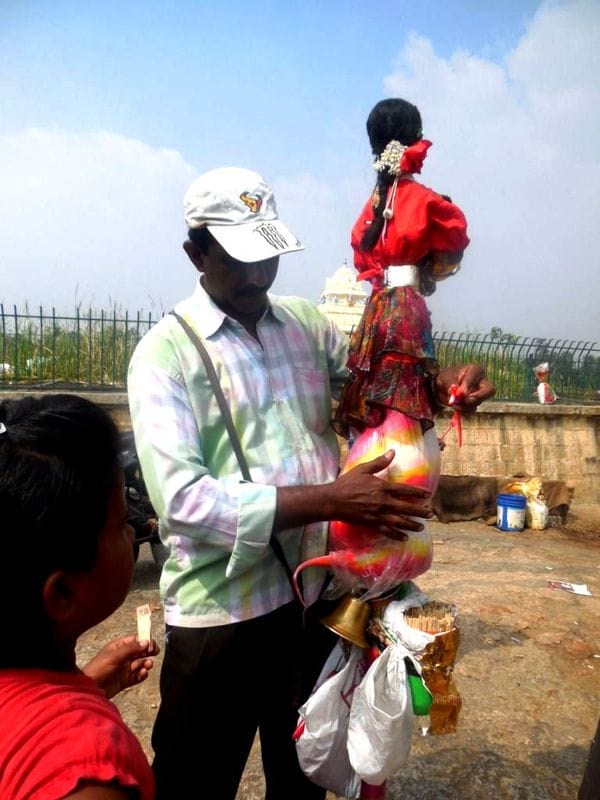
The Bombe Mithaiwala with his bombe (doll). Pic: Smitha Jacob

I saw him standing with a doll propped on a stick and asked him what was special about it. He showed me a rubbery red, white and yellow chewy candy which he kept in a huge packet under the doll, and said “Bombe Mithai.”

Children soon began gathering around him as he started shouting, “Airplane, peacock, car, doll, flower… Enu beku?”

A child shouted, “Car!” He then pulled some candy from the packet (it looked like a rubber tube when pulled on), shaped it into a car and propped it on a little stick. This one was sold for Rs 10.

He could mold the candy into any shape that was asked for and was really good at it. My son asked for an airplane.
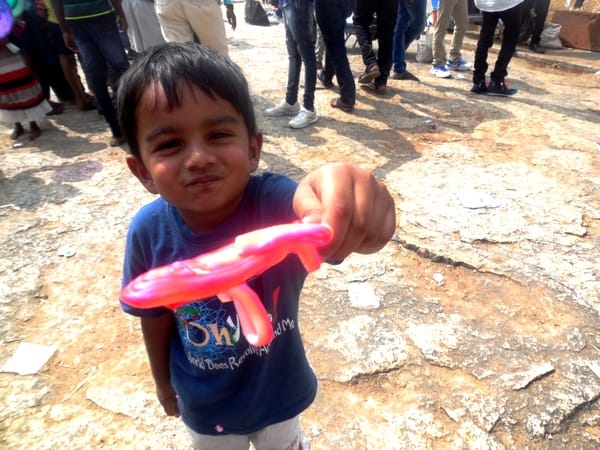
Candy shaped like an airplane. Pic: Smitha Jacob

The candy was good! We loved it, except for the fact that it stuck to the teeth. We were supposed to lick it apparently…

Later, one of my Kannadiga friends told me that the Bombe Mithaiwala (bombe translates to doll in Kannada) used to be a common sight in the past. The mithaiwalas would walk through lanes and streets shouting “Bombe Mithai, Bombe Mithai”.

Related Articles

Collaborate with Citizen Matters to document Bengaluru’s people

Leave a Reply

Your email address will not be published. Required fields are marked *

Similar Story

Safety still out of reach: Everyday struggles of women with disabilities

Women with disabilities face increased risks in public and private spaces because of consent violations, unsafe surroundings and neglect.

Every morning, Samidha Dhumatkar travels from her home in Mumbai’s western suburbs to Churchgate, where she works as a telephone operator at a university campus. Her journey involves taking a rickshaw, boarding a train, and walking to her workplace, similar to thousands of other Mumbaikars who commute daily. However, as a person with a visual disability, Samidha’s commute is fraught with threats to her safety. In their book, Why Loiter? Women and Risk on Mumbai Streets, writers Shilpa Phadke, Sameera Khan, and Shilpa Ranade, argue that spaces are not neutral. Moreover, they are not designed equally. “Across geography and time,…

Similar Story

India’s stray dog debate puts the nation’s conscience on trial

Street dogs spark a national test — will India choose compassion or fear as law, humanity and coexistence come under strain?

At the heart of a nation’s character lies how it treats its most vulnerable. Today, India finds its soul stretched on a rack, its conscience torn between compassion and conflict, its legal pillars wobbling under the weight of a single, heartbreaking issue: the fate of its street dogs. What began as a Supreme Court suo moto hearing on August 11th has morphed into a national referendum on empathy, duty, and coexistence, exposing a deep, painful schism. Two sides Caregivers and animal lovers: They follow Animal Birth Control (ABC) and Catch-Neuter-Vaccinate-Return (CNVR). Their goal is to reduce dog populations and rabies…