CAG’s latest bag of exposes for Karnataka

The nation’s top auditor has an industrious staff at Bengaluru for sure. Last week, CAG's Karnataka office relased their latest audit reports (read:scams), and it took a large carry bag to fit all their volumes. The picture says all.

Every year, the state AG (Accountant General) prepares audit reports on state government and some of its agencies. This year’s reports were presented on February 14th in the Karnataka legislative assembly. The same evening, CAG held a press conference to distribute the reports.

There are five reports this time. As usual, the reports are full of CAG’s exposes, all leading to loss of hundreds of crores of rupees. The reports come in a study bag, overall weighing somewhere around 7-8 kgs. A bagfull of exposes, you might call it.
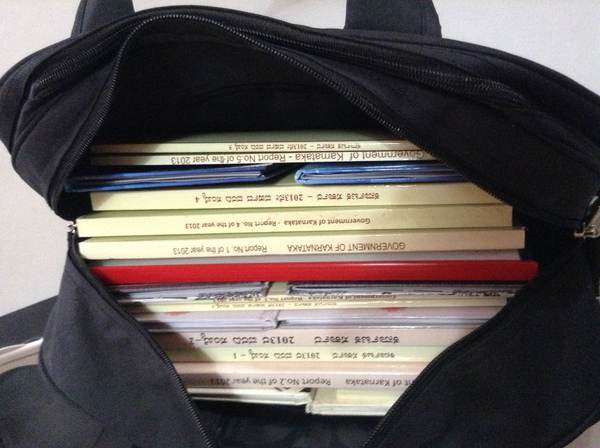
The CAG’s bag, full of exposes. Pic: Subramaniam Vincent.

Except two smaller reports, others come in books with about 200 pages each. The CAG bag had the English and Kannada copies of all these books. Accompanying each book is a booklet with summary of all chapters. These booklets also come in both languages, and also have a soft copy of the entire report attached to them.

There is also a summary of all the reports, in a press brief, which the two AGs – who had prepared the reports – read out in the conference.

The conference started with one of the AGs, Anita Pattanayak, saying that the press had done a good job of covering CAG’s last two reports which had some major exposes. Unlike most government press conferences, this one was well-organised and data distributed properly. Many CAG officers were present, giving details and clarifications to reporters in between. The contact details of all those attended, was collected.

Comments:

  1. C N Kumar says:

    Will be useful if you can upload the soft copies that readers can download.

    The CAG report that accompanied the story

    Indira Nagar park site given to a private club

    Was very informative and useful

  2. U. VISHWANATH RAO says:

    Yes, it would be very helpful if the contents of the CAG report would be very much useful to us. Thanks

Leave a Reply

Your email address will not be published. Required fields are marked *

Similar Story

Heatwaves are now a natural disaster in India. What changes for funding?  

While heatwaves now come under the Disaster Management Act, making relief and mitigation funds accessible, States must fix planning gaps.

In August 2026, the Ministry of Home Affairs recognised heatwaves as a natural disaster eligible for relief under the National Disaster Management (NDM) Act 2005. It’s a decision climate and policy experts have advocated for over the years. So, what are the implications of that change on heat financing in India?  But first, why heat is an urgent policy issue  Earlier this year, 95 out of the world’s 100 hottest cities were located in India. With 75% of the country’s population residing in districts prone to high or extreme heat, it is no coincidence that India has the largest share…

Similar Story

Bengaluru’s GBA and Hyderabad’s CURE: What they have in common and where they differ

While the mega-cities have split up into smaller corporations, both have put state leadership in control of city governance.

With the Core Urban Region (Integrated Governance) Bill 2026, better known as the CURE Bill passing in the Telangana Legislative Assembly, India's two fastest-growing mega-cities—both having crossed the 1.3-crore population mark—now operate under brand-new urban governance laws enacted within roughly two years of each other.  Both states confronted the exact same structural challenge: a single, overstretched corporation, fractured inter-agency coordination, and an urgent need for hyper-local administrative units capable of  delivering civic services efficiently. In an earlier article, we broke down how local governance would change with the Greater Bengaluru Governance Act. Read it here. Two mega-cities, one playbook The…