CAG’s latest bag of exposes for Karnataka

The nation’s top auditor has an industrious staff at Bengaluru for sure. Last week, CAG's Karnataka office relased their latest audit reports (read:scams), and it took a large carry bag to fit all their volumes. The picture says all.

Every year, the state AG (Accountant General) prepares audit reports on state government and some of its agencies. This year’s reports were presented on February 14th in the Karnataka legislative assembly. The same evening, CAG held a press conference to distribute the reports.

There are five reports this time. As usual, the reports are full of CAG’s exposes, all leading to loss of hundreds of crores of rupees. The reports come in a study bag, overall weighing somewhere around 7-8 kgs. A bagfull of exposes, you might call it.
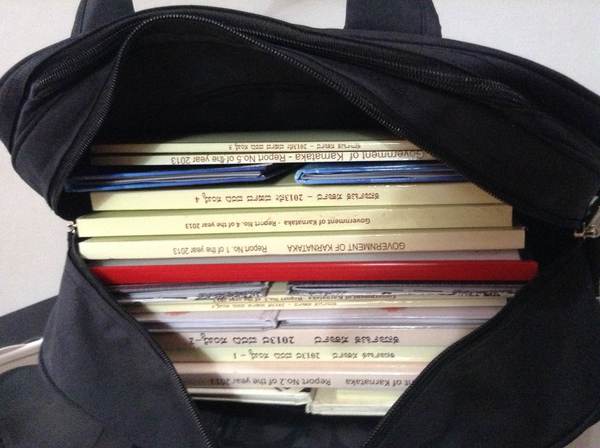
The CAG’s bag, full of exposes. Pic: Subramaniam Vincent.

Except two smaller reports, others come in books with about 200 pages each. The CAG bag had the English and Kannada copies of all these books. Accompanying each book is a booklet with summary of all chapters. These booklets also come in both languages, and also have a soft copy of the entire report attached to them.

There is also a summary of all the reports, in a press brief, which the two AGs – who had prepared the reports – read out in the conference.

The conference started with one of the AGs, Anita Pattanayak, saying that the press had done a good job of covering CAG’s last two reports which had some major exposes. Unlike most government press conferences, this one was well-organised and data distributed properly. Many CAG officers were present, giving details and clarifications to reporters in between. The contact details of all those attended, was collected.

Comments:

  1. C N Kumar says:

    Will be useful if you can upload the soft copies that readers can download.

    The CAG report that accompanied the story

    Indira Nagar park site given to a private club

    Was very informative and useful

  2. U. VISHWANATH RAO says:

    Yes, it would be very helpful if the contents of the CAG report would be very much useful to us. Thanks

Leave a Reply

Your email address will not be published. Required fields are marked *

Similar Story

The real estate shift: How Karnataka’s proposed apartment law shortchanges homeowners

Karnataka apartment owners may not get a fair share of their land as the KAOMA 2026 replaces value-based UDI with an area-only formula.

The Karnataka Apartment (Ownership and Management) Bill, 2026 (KAOMA) changes how a homeowner's share of the land is calculated — and the new formula gives the individual less than what the old law, that is the Karnataka Apartment Ownership Act, 1972 (KAOA), promised. The KAOMA Bill was passed by the Karnataka legislature in August, but is yet to receive assent from the Governor, who has sought clarifications on certain provisions. What is UDI and why does it matter? When you buy an apartment, you buy two things: The flat — a depreciating asset (buildings lose value over time). Your Undivided…

Similar Story

Big promises, unheard residents: Bengaluru’s new parking rules need a rethink

The draft rules meant to manage road space demand end up expanding supply, outsourcing enforcement, and pricing residents out of their streets.

On August 11, the Urban Development Department quietly published the draft Greater Bengaluru Authority (Parking) Rules, 2026 — the legal framework  meant to give teeth to Bengaluru's much-discussed Parking Policy 2.0. Citizens have thirty days to send in objections. Yet, few will read all eighteen pages of the notification. Fewer still will notice that a law framed as a way to curb traffic demand is, on close reading, a plan to expand parking supply and hand over enforcement to private players, while leaving the ordinary resident worse off.  That gap between the promise and what’s on paper matters, because parking…