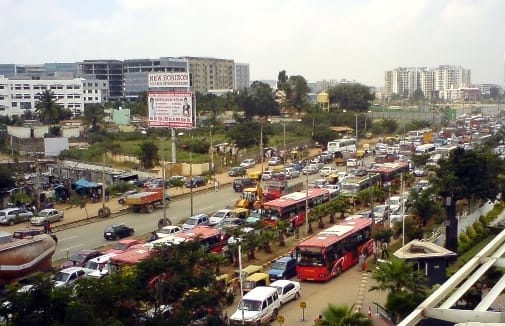
Vehicular traffic causes maximum air pollution in Bangalore city.
Benagluru’s air may not be the most polluted in the country, but it is among the top 15 polluted cities in the country with its particulate matter increasing over the years and nitrogen dioxide levels way above permissible limits. It is a known fact that the transport sector is a major contributor to air pollution in the city with the vehicular population inching towards 50 lakh vehicles on the roads.
Ozone, carbon, ions, molecular markers of particulate matter, sulphates are significantly high at many locations were studies have been conducted. In 2007, quantified, the city had a pollution load of 54.4 tonnes per day of PM10 (particulate matter around 10 micrometres), 217.4 tonnes per day of oxides of Nitrogen and 14.6 tonnes per day of SO2. Transport, road dust and construction contributed a major part of PM10.
Standards for Air Quality*
|
Pollutant |
Time Weighted Average |
Concentration in ambient air |
||
|
Industrial Area |
Residential Area |
Sensitive Area |
||
|
Sulphur dioxide (SO2) |
Annual average # |
80 mg/m3 |
60 mg/m3 |
15 mg/m3 |
|
24 hrs ## |
120 mg/m3 |
80 mg/m3 |
30 mg/m3 |
|
|
Oxides of Nitrogen (NO2) |
Annual Average |
80 mg/m3 |
60 mg/m3 |
15 mg/m3 |
|
24 hrs |
120 mg/m3 |
80 mg/m3 |
30 mg/m3 |
|
|
Suspended Particulate matter (SPM) |
Annual Average |
360 mg/m3 |
140 mg/m3 |
70 mg/m3 |
|
24 hrs |
500 mg/m3 |
200 mg/m3 |
100 mg/m3 |
|
|
Respirable Particulate Matter (RPM) > 10mm |
Annual Average |
120 mg/m3 |
60 mg/m3 |
50 mg/m3 |
|
24 hrs |
150 mg/m3 |
100 mg/m3 |
75 mg/m3 |
|
|
Lead (Pb) |
Annual Average |
1.0 mg/m3 |
0.75 mg/m3 |
0.50 mg/m3 |
|
24 hrs |
1.5 mg/m3 |
1.00 mg/m3 |
0.75 mg/m3 |
|
|
Carbon Monoxide (CO) |
8 hrs |
5.0 mg/ m3 |
2.0 mg/ m3 |
1.0 mg/ m3 |
|
1 hr |
10.0 mg/ m3 |
4.0 mg/ m3 |
2.0 mg/ m3 |
* National Ambient Air Quality Standards.
# Annual arithmetic mean of minimum 104 measurements per year taken twice a week, 24 hourly at an uniform interval
## 24 hourly / 8 hourly values should be met 98% of the time in a year. It may exceed 2% of the time but not on 2 consecutive days[1]
Many times, the gravity of numbers and words like ‘significantly high’ or ‘above permissible limits’ is lost unless one can relate to it or have a sense of it from an experience. While effects like global warming, melting polar ice caps and El Nino may not strike close to home, the health impact of air pollution certainly does. Being exposed to a polluted environment all the time increases one’s susceptibility to infections.
Air pollutants come in contact with the human body in two ways – Inhalation and Adsorption (coming in contact with a surface). So the most affected parts are the eyes, respiratory system and the skin. Effects on the respiratory system vary from chronic cold, cough, sneezing to asthma and bronchitis. Effects on the eyes range from itching, watering to perpetual conjunctiva infection.
A combination of one or more pollutants has a far more serious affect than one pollutant alone eg. Poly Aromatic Hydrocarbon + NOx.
|
Pollutant |
Source |
Reason |
Health Effect |
|
Carbon Monoxide (CO) |
Gasoline vehicles. |
Incomplete combustion of the fuel. More from old vehicles and poorly maintained vehicles |
* CO has an affinity for haemoglobin and forms carboxy haemoglobin – can cause death in extreme cases. * Headaches common Increases risk for people with heart diseases |
|
Oxides of Nitrogen (NOx) |
More in Diesel, less in Petrol |
Combustion of a fossil fuel |
* They are mainly acidic oxides and affect the mucous membrane. Irritant to the eyes and respiratory system. * Aggravates asthma |
|
Particulate matter |
Mainly from Diesel vehicles. Poorly maintained vehicles |
Incomplete burning of fuel, over exerted engine (many reasons) |
*Wreaks the respiratory system. |
|
Hydrocarbons (HC) – unburnt and partially burnt |
Poorly maintained petrol and diesel vehicles |
Incomplete combustion. Converts to Poly Aromatic Hydrocarbons (PAH) |
* Irritant to the eyes, skin and respiratory system. * Carcinogenic |
|
Sulphur dioxide |
Gasoline vehicles |
Combustion of fossil fuel |
* An acidic oxide, is highly corrosive. Affects the eyes and respiratory system |
|
Benzene |
C6H6 |
Directly from the fuel. Burns to form PAH |
* Carcinogenic. *Reproductive problems and birth defects likely |
Enemy of lungs
Studies have also indicated that Indians have lesser lung capacity than those in the west and this could be due to many innate factors. This fact coupled with increasing pollution, industrialisation, urbanisation and life style choices will only cause lung functions and existing respiratory disorders to worsen.
ENT specialist, Dr. Vasanthi Anand explains the effects on the respiratory system, what begins as an allergic reaction can lead to prolonged infection in many. The emitted particulate matter, gases and toxins get inhaled through your nose and mouth and irritates the respiratory mucosa of nose, larynx and lungs.
She adds that the irritation of the mucosa causes excessive nasal secretions, sneezing, coughing, mucus production and becomes hypersensitive to dust and pollens during this period, it gets worse in people with nasal allergy and asthmatic persons. Their susceptibility to viral infections and gradual secondary bacterial infection also increases. So pollution does increase the incidence of nasal infection, sinus infection, bronchitis, bronchial asthma and aggravate chronic heart diseases hence leading to increased morbidity and mortality.
“Some of the toxins emitted are known to be carcinogenic and can cause lung cancer. Patients that I see come with chronic complaints of nasal obstruction, nasal watery discharge, sneezing and repeated headache. Many of these patients are from professions using two wheelers as mode of transport. It then becomes a choice of long term medication or a change of profession,” she explains.
Save your skin
Dermatologists explain the affects on the skin, in a paper, Global Warming and its impact on skin disorders by Sanjiv Grover and Rajeshwari. The authors point out that a 2 degree rise in temperature could increase the carcinogenic effectiveness of solar UV rays by 10%. While some dermatological effects like tanning, skin aging and carcinogenesis is more frequently heard, increase in global temperatures also change the insect – vector – pathogen – disease patterns and increase in human dermatophytes and mould infections.
Harmful for eyes
Dr Ashwin Mallipatana, Paediatric Ophthalmologist, points out that while high concentrations of pollutants themselves can cause reactive conjunctivitis in the eyes. But, the very presence of pollutants in the atmosphere makes the reaction to allergens like dust, pollen and organic matter much worse, this interaction between the allergens and pollutants has led to the concept of ‘urban eye allergy syndrome’. Although kids are not necessarily more susceptible, Dr. Ashwin sees this pattern in the kids he treats. Preventing these eye allergies is quite a challenge, measures like helmets with visors and plain glasses are suggested to patients. He is aware of parents who have moved away from the city to get rid of their child’s allergy.
Air pollution is an enormous issue that needs to be addressed by both the government agencies (in terms of policy, implementation, monitoring and enforcement) and the citizenry in a pro-active way. Pretending that it is not an issue with an impact will only lead to it snowballing into a major environmental and health issue real time and not in the future.
Related Articles