A moth, not a hummingbird

If you happen to see Hummingbird Hawk Moth this winter, be assured that you have a lot of good luck on your plate!

A moth that looks like a tiny bird! India does not have Hummingbirds, those tiny creatures of the light and air that so delight those living or visiting abroad, especially the western coast of America. Our smallest birds are our Sunbirds and Flowerpeckers.

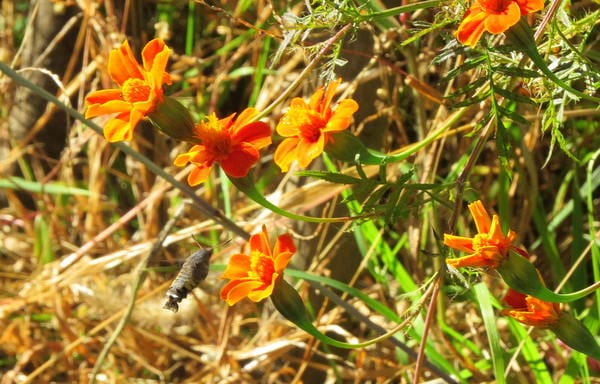
However, even in urban gardens, one may find oneself looking at something that seems remarkably like a Hummingbird, and yet seems different. In India, this probably means that one is looking at a Hummingbird Hawk Moth! The scientific name for this small creature is Macroglossum stellatarum. They belong to the family called “Sphingidae”.
Pic: Deepa Mohan

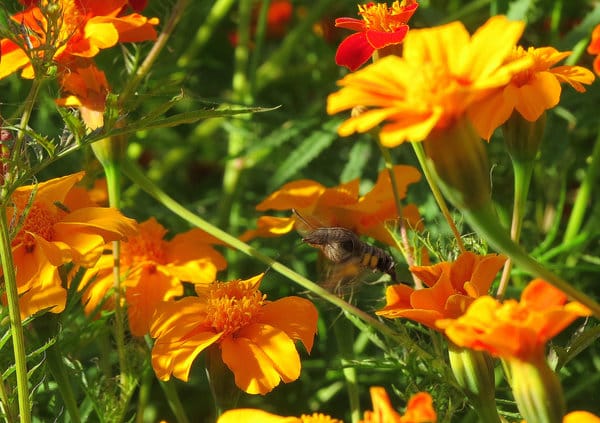
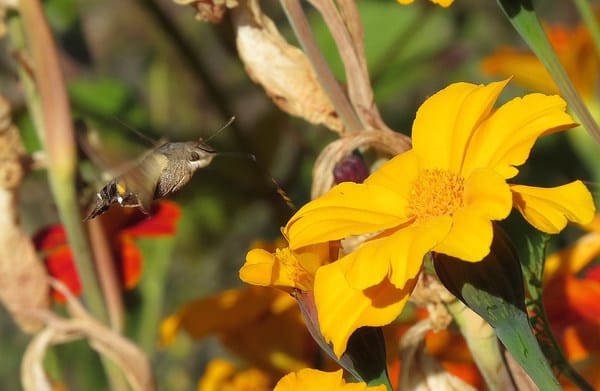
In our country, these moths can be found in the northern parts of the country during summer, and in the south, too, in winter. The moth’s long proboscis and its hovering behaviour, accompanied by an audible humming noise, make it look remarkably like a hummingbird while feeding on flowers.
Pic: Deepa Mohan

It flies during the day, especially in bright sunshine, but also at sunset and sunrise…, and even in the rain!

Pic: Deepa Mohan

Hummingbird hawk-moths have been seen as a lucky omen! The British forces saw them flying on D-Day during the Second World War, and took it to be a sign of victory, which eventually proved true.
Pic: Deepa Mohan

These moths are particularly fond of nectar-rich flowers and they can be seen feeding on flowers such as marigolds (which was where I took these photographs). Here is a short video I took, of this unusual moth that looks like a tiny bird: 

So…the next time, during these winter months, you hear a humming sound near the garden flowers…look closely and see if there is a Hummingbird Hawk Moth around to delight you!

Related Articles

Damsels dancing in nature!
Bangalore’s first eBirder meet
Finding the hidden birds in urban green spaces

Leave a Reply

Your email address will not be published. Required fields are marked *

Similar Story

Pallikaranai’s 1-km buffer zone sparks debate on housing rights, encroachment and ecology

On World Wetland Day, Chennai's Pallikaranai marsh shows how decades of state‑sanctioned encroachment leave residents and ecology at risk.

Across Pallikaranai marshland, migratory birds can be spotted, searching for forage and water. Yet the wetland they depend on has steadily depleted. As Chennai has grown in an amoeba-like manner, ebbing with the promise of ‘development,’ the marsh has borne the brunt. In the 1990s, the marsh covered 2,450 hectares, nearly 70% of its original size. Today, barely 500 hectares remain. In recent years, the marshland has often entered public discourse. In September 2025, Chennai Metropolitan Development Authority (CMDA), acting on an order from the southern bench of the National Green Tribunal, halted planning permission for development within the Pallikaranai…

Similar Story

Commuters, vendors bear the brunt of rising air pollution in Chennai’s Ambattur

IIT-M’s Project Kaatru finds high PM2.5 levels at Ambattur Estate, Padi flyover and Dairy Road, exposing residents to dust and pollution daily.

Commuters passing through Ambattur Industrial Estate inevitably find a layer of dust coating their vehicles, faces, and hands. For Lalitha*, a domestic worker employed at a high-rise apartment near Padi flyover’s Saravana Stores, the last two weeks of December have been especially unbearable. "Dust, dust, dust everywhere," she says, coughing through a persistent cold. At 6 pm, when the rush hour begins, it takes her nearly 30 minutes by bus to cover the 5 km journey home. The ride to the Dunlop area is punctuated by pollution, blaring horns, and endless traffic snarls. “It should take 15 minutes usually, but…