When we first met Sarthak* in November 2025, he was eight years old and in Grade 2. We remember seeing him sitting on his teacher’s chair with both legs up, his shirt untucked, tear stains on his face, and demanding her phone.
We came to know Sarthak through our work as Social Work Fellows with Brain Bristle, a Mumbai-based non-profit working to advance autism inclusion and equitable education for children in low-income schools. The Fellowship places selected Master’s students of psychology with specialised training in under-resourced schools across Mumbai. The Fellows work to address systemic gaps and help children learn and thrive in mainstream classrooms. The fellows provide direct support to 300+ students daily across more than 100 classrooms in 16 schools.
One of the schools where the Fellows are placed is a Brihanmumbai Municipal Corporation (BMC) school in Chembur, where we work alongside teachers, shadow teachers and parents to make classrooms more accessible.
In India, 1 in 68 children under the age of 10 is reportedly diagnosed as autistic. While 50–60% of them have high support needs, less than 1% are effectively supported, included, and educated. In the classrooms where we work, we see every day how difficult it can be for children with developmental disabilities to learn and participate when the systems around them are not equipped to support their needs.
Every child’s challenge is unique
With Sarthak, sometimes the difficulty is not that he does not know something, but that he cannot access the way it has been presented. He may struggle with “What number will you get if you add 4 to 61?” but successfully solve “61 + 4.” Similarly, reducing an MCQ from five options to two can allow him to demonstrate the actual skill.
We also work with Siddharth*, a Junior KG student with speech delays and some behavioural difficulties. Play creates opportunities for communication, interaction and classroom-readiness skills such as holding a pencil.
Noor*, a Grade 1 student with visual difficulties and developmental delays, works on foundational skills such as pencil control, copying lines, early academic concepts and functional communication.
Read more: For parents of children with autism, this project promises early intervention
Gaps in meeting the needs of all children
One of the biggest gaps we have observed over our eleven months of working in this school is between what a child needs in order to learn and what a school can realistically provide. Meanwhile, we as Social Work Fellows are now in the school, catering to the academic and behavioural needs of 4–5 students with severe behavioural and learning difficulties.
The classroom teachers often manage large classes of approximately 1:50, with multiple classes being merged due to the limited number of teachers available in the school on a given day. Within these classrooms, students may also be functioning at significantly different developmental and academic levels.
Teachers are therefore required to accommodate a wide range of learning needs while simultaneously delivering the prescribed curriculum, maintaining classroom discipline, and completing administrative responsibilities. In this context, expecting teachers to provide highly individualised and sustained support to a child with significant additional needs, alongside these existing responsibilities, may not be realistic.
Our education system lacks the tools and trained professionals such as counsellors and special educators, needed for inclusive learning. Most schools have little understanding of autism or developmental disabilities, and regular classroom teachers rarely receive formal training in inclusive education. While Western countries provide a wide range of specialized support for autism and intellectual disabilities, India is still struggling to provide basic care.
Limited resources and space constraints in a BMC school
Space is another challenge. There is no dedicated safe or regulated, sensory calming space where a child like Sarthak can go when overwhelmed. This makes regulation difficult for the child while also affecting the rest of the classroom.
Another gap is the use of existing resources. The school has many visual learning materials, books, toys and teaching aids in the FLN room, but many have remained unused and poorly organised due to lack of time, resources or knowledge on how to best use them. Having resources is not the same as having access to usable resources. Without training, time or systems to use them, their potential remains unrealised.
Seeing these gaps has made us ask a larger question: How can we make inclusion possible in schools that were not built from the get-go to be inclusive?
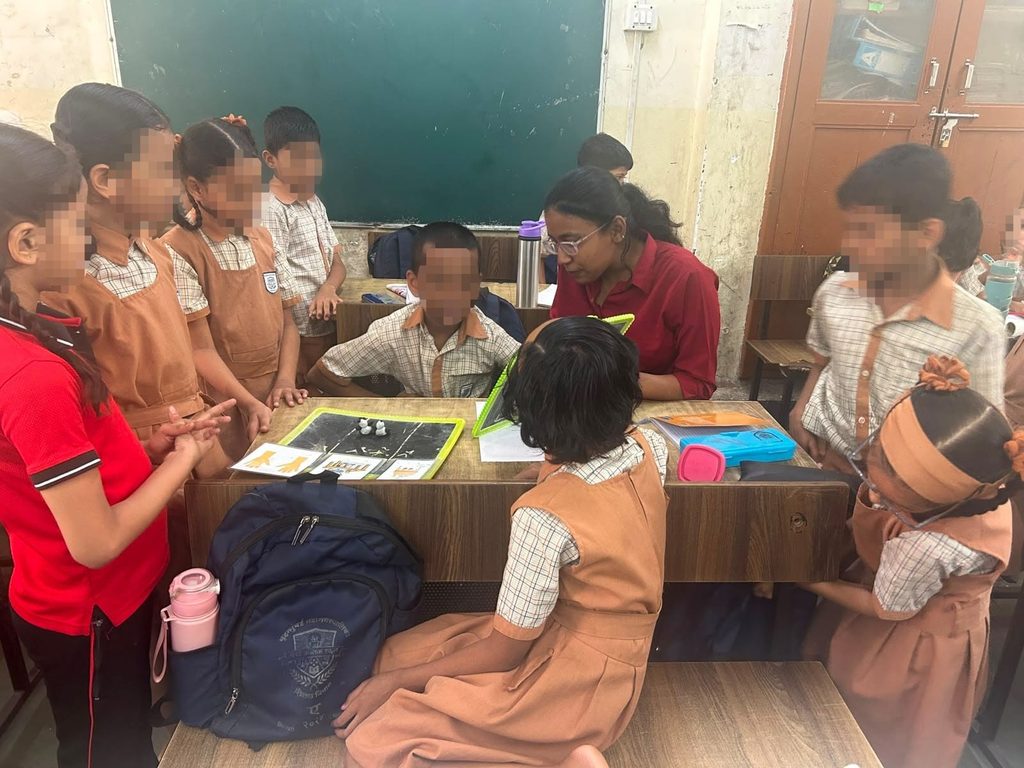
How inclusion works in the classroom
Being Social Work Fellows has allowed us to move beyond learning about inclusion and experience what it actually looks like. Interventions can be created when time, resources and specialist support are limited.
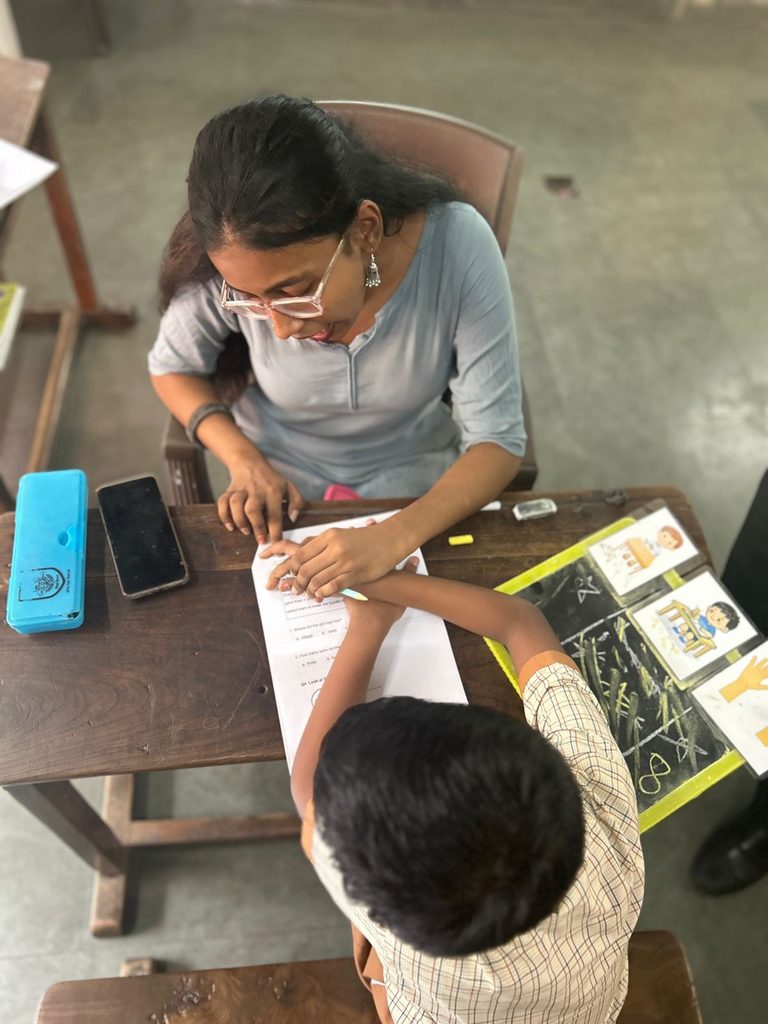
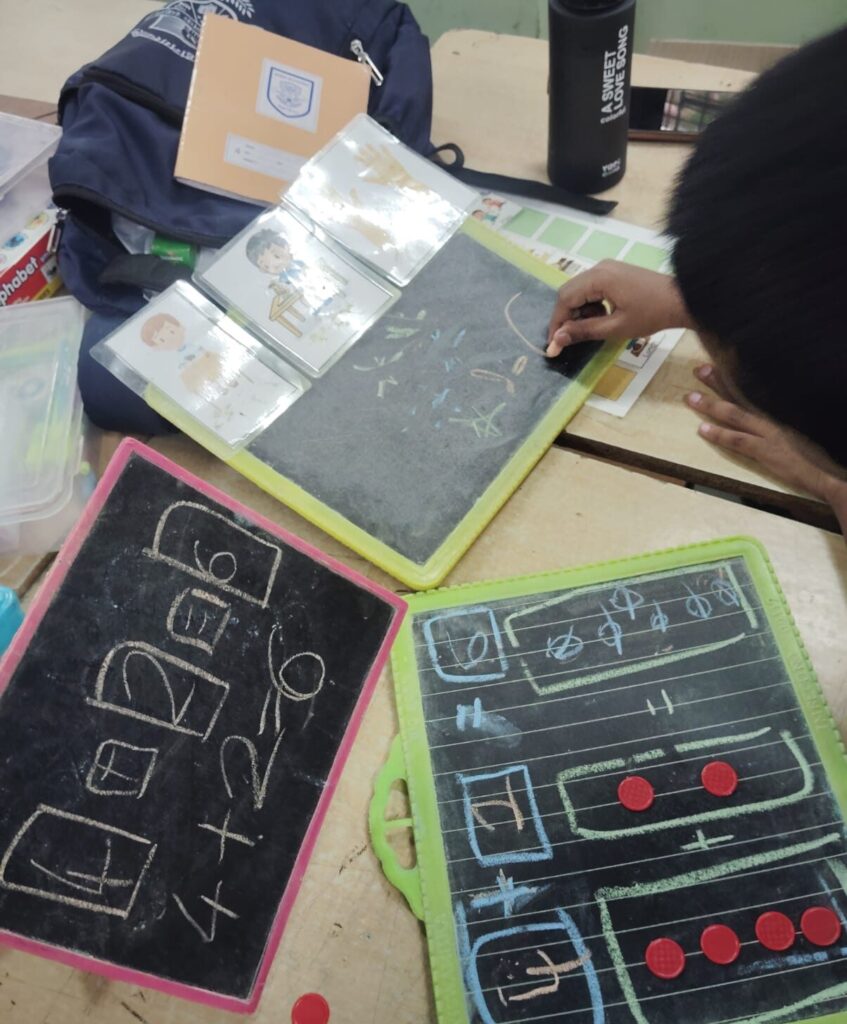
We take grade-level concepts and turn them into interactive games, custom worksheets, and use engaging video clips to make the topic easier to understand. We work on core academic skills and emotional regulation using tactile materials like sensory toys or flash cards to keep the energy positive.
For example, if we are working on CVC words ending in the “-an” sound, we might first make a clay model of a pan. The child therefore has a concrete object connected to the sound pattern before we begin working with written words.
If a child is overwhelmed, restless, or losing interest, we don’t force them to do what we’d planned for the day. Instead, we try to show acceptance of their needs and then try to modify the behaviour by having a quick sensory reset, switching to a tactile break, or breaking the activity down into tiny tasks to make it more efficient for the child to perform.
Creating pockets of change in the system
A huge part of our work is shaping the environment around the child. We have learned that you can’t support a child in isolation. We work continuously with our teachers and parents to be a team and we work with the child to help them learn, understand what we need to do better and fill the gaps with positivity, acceptance, persistence, friendship and empathy. It’s really important to make a comfortable space in the classroom for our students, so they can fully grow into themselves.
When a child who is considered “weak” suddenly completes a task with modified instructions, or a child considered “unmanageable” sits and works with clear expectations and reinforcement, it can change how others see what the child is capable of.
When peers start understanding how to support their friends and teachers start intentionally including, the entire atmosphere shifts. It stops being about “fixing” a difficulty and becomes a shared culture of warmth, patience, group learning and belonging.
That change can be seen in the way Sarthak now moves through his school day. With visual schedules and other support, Sarthak has gradually become more independent and can now complete parts of his routine himself, including moving completed activities to the “all done” section, checking what comes next and preparing his materials.
Read more: Autism and the city: Intervention and support services widely available in Bengaluru
Rethinking inclusion in Mumbai’s classrooms
Working in these classrooms has changed how we think about inclusion. What we do know is that inclusion is making sure that the child in question is not the only person in the room who has to change.
If Sarthak is expected to sit like everyone else, if Siddharth is expected to talk like everyone else, and if Noor is expected to learn at the same level as everyone, we’re expecting a homogenous society and that’s not how the world works.
To us, inclusion isn’t just about getting a special place in society because you were different and now you’re included, it’s about having a real voice that’s heard and the creation of a sense of belonging. Inclusion means a neurodivergent child is provided the right adapted tools, sensory breaks, and communication support so they can actively learn, play alongside their peers, form real friendships and feel completely understood for who they are.
For inclusion to become part of the school itself, teachers need the time and training to adapt classroom teaching and schools need the systems and specialist support to guide children with different needs. Without training, time or systems, the potential of the children remains unrealised.
Systemic changes for inclusive schooling
Here’s what schools can do to build systems that support inclusion:
- Autism-informed personnel in every school: Every school, regardless of the income group it serves, should have access to personnel trained in autism and developmental disabilities, including special educators or other appropriately qualified professionals who can support teachers and students.
- Sensory-safe spaces: Schools should have a designated, accessible space where students can regulate when they are overwhelmed. A sensory-safe space is not a place to isolate a child; it is a support that allows them to regulate and return to learning.
- A baseline of inclusive teaching for every teacher: All teachers should receive basic training in inclusive education and Universal Design for Learning (UDL), so that adapting instructions, materials, communication and classroom routines becomes part of everyday teaching rather than an exceptional intervention.
- Trained paraprofessional support: Students with higher support needs may require trained paraprofessionals who can work alongside classroom teachers, support communication and regulation, and respond appropriately to behaviours without making the child feel excluded from the classroom.
- An institutional culture of inclusion: Inclusion cannot depend on whether an individual teacher happens to be willing or able to make accommodations. School leadership needs to treat reasonable adaptations, flexible teaching and different ways of learning as part of how the school operates.
- Ongoing professional development and usable resources: Schools need access not only to teaching materials, but also to the training, time and professional support required to use them effectively. Teachers and support staff should have ongoing opportunities to develop their understanding of autism, developmental disabilities, behaviour support, communication and inclusive pedagogy.
*names changed to protect identity