Clothing waste is not generated every day, yet it remains a part of Chennai’s waste stream. As the city lacks disposal information and dedicated collection systems, clothing waste enters the mixed waste channels. Community-led initiatives such as that by the Residents of Kasturba Nagar Association (ROKA) highlight the gaps in the system and the potential of decentralised collection, reuse, repurposing, upcycling and recycling.
Lack of a sustainable system to manage cloth waste
Currently, there is no system for unusable cloth collection and no information for the public on how to dispose of clothes. Most unusable clothes, especially inner garments, are disposed of in street bins. People think they do not have value, even though they are recyclable. Door-to-door collection of waste is intermittent, as operators focus on wet, dry and hazardous waste.
That’s why, people mostly discard clothes into the blue bin (the coloured bin meant for recyclable waste). These clothes are sometimes collected from doorsteps and taken to a Materials Recovery Facility (MRF). While clothes may be segregated in an MRF, many have been closed in the last year (88 out of 137 total MRF centres were closed), making the chance of collection and aggregation of clothes to near zero.
Clothes need to be collected separately. The GCC sends separate vehicles for mattresses and cushions, but there is no such separation exclusively for clothes. The Thooimai Mission CTCL (waste to resource conversion mission for sustainable waste management by the Government of Tamil Nadu) tried monthly collection of several types of waste, such as e-waste and soft plastics, but it is unclear how much of an impact it had on people across Chennai.
Read more: What happens to your dry waste in Chennai?
Unsustainability of the current system
There is currently no government-facilitated system for the collection and processing of clothing waste. From my experience of visiting MRFs over seven to eight years, I have observed sanitary workers taking old clothes in good condition during aggregation. Although this process has not been codified or institutionalised as policy, it is welcome because recycling should be the last option, while repurposing and reusing should come first.
I have also seen unusable, stained, and torn clothes being dumped in MRFs. The few facilities running smoothly need a structured collection system operating via vendors and aggregators for waste items like thermocol and clothes.
In 2018–19, many vendors were assigned specific waste categories by the GCC for monthly collection. However, disruptions due to COVID-19 prevented this from becoming a permanent system. Now, piles of clothes lie around, get spoiled by rain, and are transferred from MRFs into street bins and dump yards. This is clearly unsustainable.
Options to responsibly dispose of old clothes
In the last four to five years, many people have started upcycling, recycling, and reusing old clothes. A prominent starting point among these for responsible citizens is collection drives.
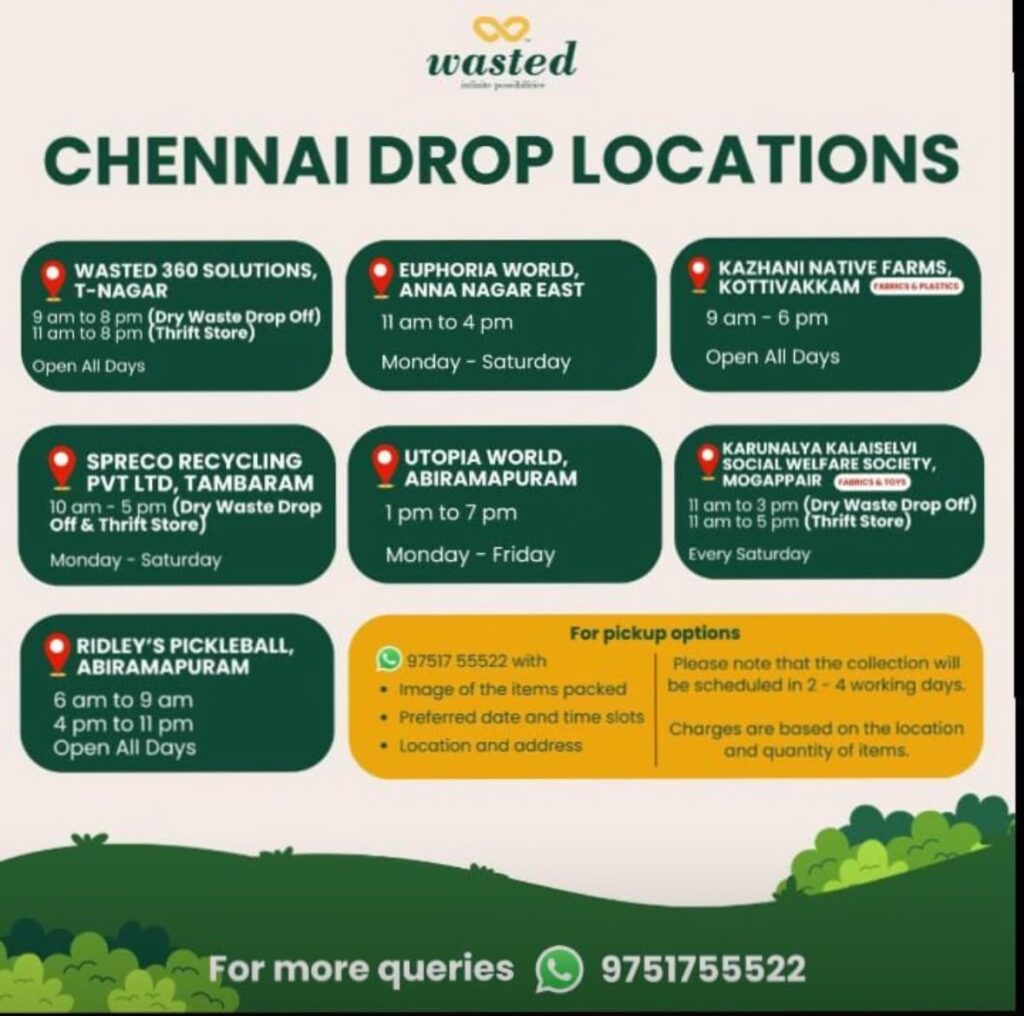
Multiple collection drives take place, but they are concentrated in South Chennai. However, within these areas, there are several permanent collection centres. People can deposit their clothes here rather than waiting for one- or two-day drives.
These centres are operated by Wasted 360 and Spreco Recycling in West Tambaram. Here, clothes are segregated into those that can be donated, those that cannot, and fashionable branded items that can be sold in thrift stores.
Read more: The journey of waste: Ever wondered where all the trash in Chennai ends up?
Reduce, repurpose, thrift or recycle
There are not many thrift/repurpose-oriented facilities of cloth waste management, although it’s a good mechanism to have in place. The practice is slowly picking up, with only a few organisations collecting clothes for the sake of repurposing.
When considering such repurposing options, everything eventually comes back to reducing consumption in the first place. Sustainability means looking back at consumption, re-evaluating how we consume, and finding solutions that minimise dumped waste.
Development of citizen-led collection drives
ROKA started a waste collection drive in 2018. At Greater Chennai Corporation’s (GCC) request, ROKA initially collected residents’ clothes and e-waste and gave them to the corporation. To assess general waste management practices in the community, ROKA conducts battery-operated vehicle walks. This is a localised community effort by us, where residents and volunteers walk alongside local BOV drivers to create an interactive door-to-door community monitoring setup for waste segregation. The need for cloth waste collection drives also became clear during these walks.
Waste items like clothes, e-waste, X-rays, tablet strips, mattresses, pillows, and cushions are not generated daily. People want to dispose of them responsibly, but no GCC system exists for their collection or aggregation. During door-to-door awareness visits conducted by ROKA, we saw batteries, wires, inner garments, and clothes being discarded into bins allocated for recyclable waste (blue bins) or sanitary waste (red bins). We realised that people might dispose of them sustainably if a proper platform were provided.
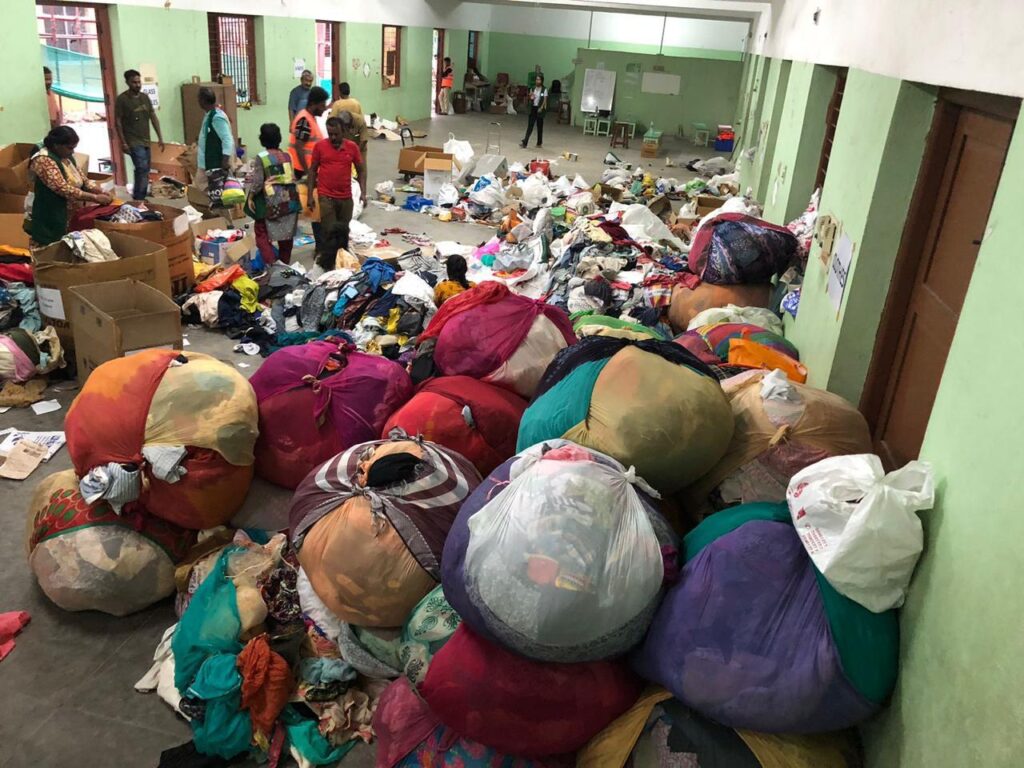
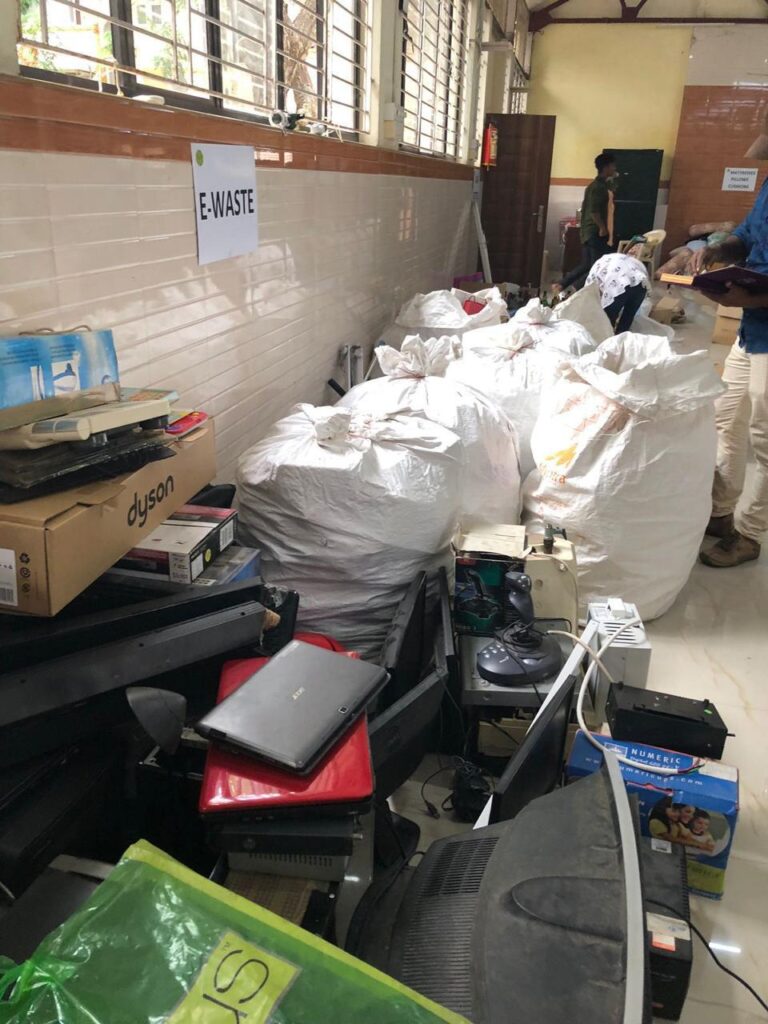
With this in mind, ROKA started a large-scale collection drive running one centre at a time. As word spread and the demand for recycling increased, we tied up with gated communities working on solid waste management. The materials were collected and then taken to an aggregator or recycler.
COVID-19 interrupted this process, prompting a hiatus for one and a half years. We resumed it in 2021 and encouraged gated communities to organise their own collection drives. By 2022, we were actively guiding communities and connecting them to recyclers/collectors. At ROKA, one drive receives 10–12 tonnes of clothes, of which around 60–70% may be usable. These go to charitable organisations, orphanages or underprivileged areas. The remaining 30-40% of clothes go for recycling or upcycling.
Clothes remain among the materials most lingering in landfill waste. More communities must organise weekly or monthly drives. Decentralised collection can prevent old clothes from reaching dump yards while boosting donation, reuse, repurposing, upcycling, and recycling across Chennai. With greater GCC support, these drives can expand, reducing pressure on the corporation and collectors while making waste management more efficient and sustainable.
Some practical tips on responsible disposal of cloth waste for residents:
- Do not assume only wearable clothes can be handed over. Stained, worn or unusable textiles, including kitchen cloths, should also be diverted from mixed waste.
- Make sure clothes are clean and dry before disposal; stains are acceptable.
- Call and arrange a pick-up from some of the aggregators, who offer scheduled doorstep collection on assigned days.
- Note that usable textiles recovered by aggregators may be donated to NGOs or other organisations, while only the unusable portion is sent for recycling.
- Be aware that community collection drives follow a donation model and do not charge for drop-offs. Doorstep pickup, however, may involve a fee to support recycling operations.
Now, different collection drives happen every weekend, although they remain concentrated in South Chennai despite efforts to reach North Chennai. Here is a list of aggregators in Chennai residents can contact:
Cloth waste aggregators
- Wasted 360: +91 98411 14347
- Spreco: +91 96558 80250
- Recycle Mart (also offers door to door pick up): +91 6379 543 889
- Goonj: +91-44-49533991
- Little drops (only clothes in good condition): +91 98840 80869
- Thuli (only clothes in good condition): +91 8779771167
Communities conducting collection drives
- Residents of Kasturba Nagar Association (ROKA)
- Zero Waste Initiatives, Velachery
- Federation of OMR Residents Association (FOMRRA)
- EKO Connectors, R A Puram
- ZELAFI,Velachery
- AWCEM Fundation
- S T Royal Springs, Thiruvanmiyur
- SIMPLE, Thalambur, OMR
[Writing assistance provided by Lakshmi Yazhini, Program Associate at Oorvani Foundation.]